5 Reasons to Avoid Natural Travertine for Your Dining Table Top
Scroll through any interior design account on Instagram and you will spot it — that warm, honey-toned stone with its distinctive veining and characteristic surface pits, draped across a beautifully styled dining table. Natural travertine has a timeless, old-world appeal that is genuinely hard to resist.
But here is the thing nobody mentions in those aesthetically perfect photos: a dining table is not a hotel lobby floor. It is a working surface that takes three meals a day, seven days a week. And travertine — as gorgeous as it is — is simply not built for that job.
Before you commit to a travertine slab for your dining table top, read this first.
What Is Natural Travertine?
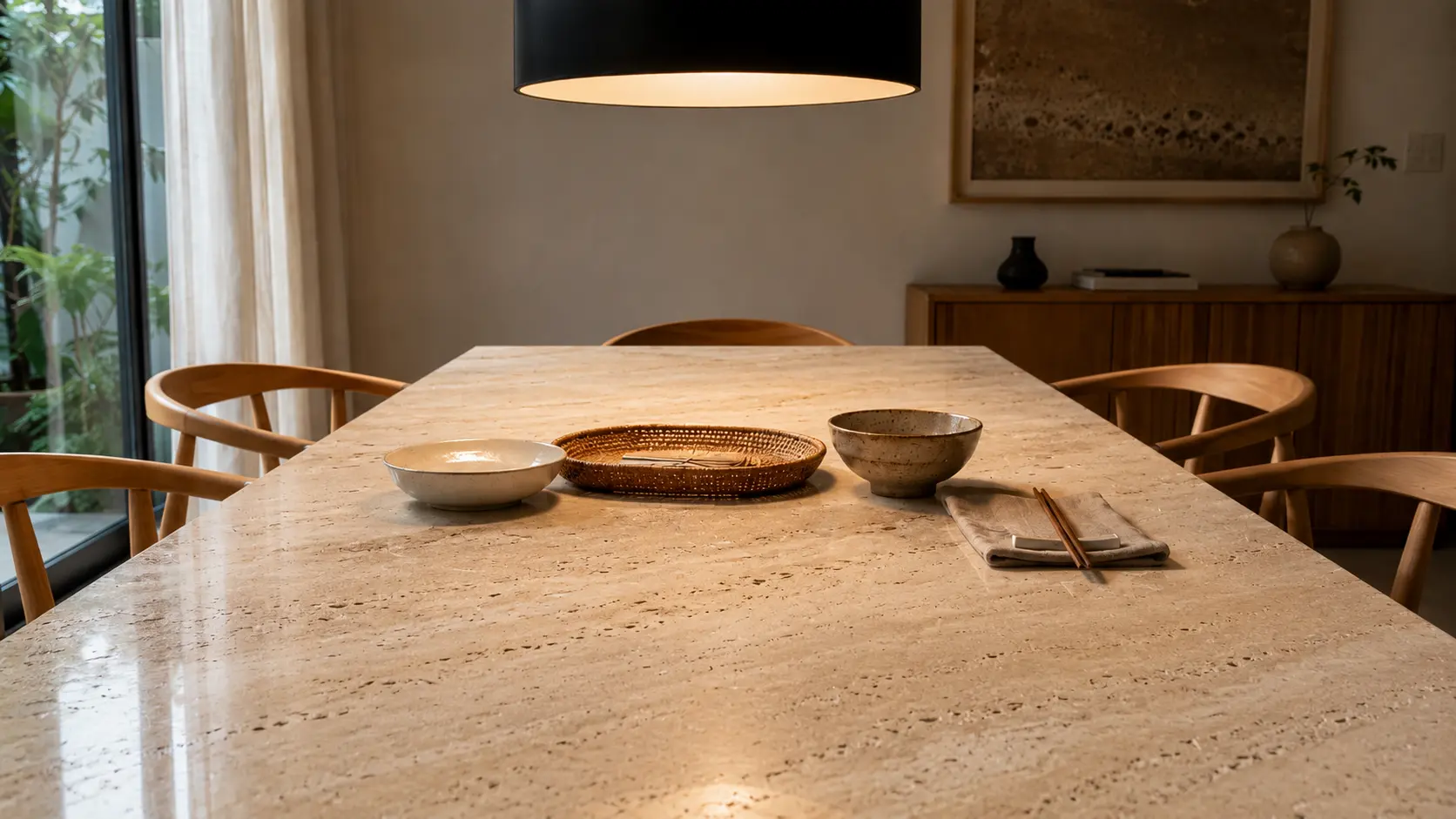
Travertine is a form of natural limestone formed from mineral-rich spring water over thousands of years. It is quarried primarily in Italy, Turkey, and Iran, and prized for its warm beige, ivory, and walnut tones. The defining feature of travertine — the one that makes it so visually recognisable — is its natural voids and pits: hollow cavities formed when gas bubbles escape during the stone's formation.
Those voids are not a defect. They are part of the material's character. But on a dining table top, they become a very serious problem.
Reason 1: The Holes in the Stone Trap Food, Grease, and Bacteria
Every slab of natural travertine comes with voids — some tiny and barely visible, some large enough to catch a fingernail. In flooring applications, these are typically filled with grout or resin before installation. On a table top, filled or unfilled, those pockets become traps for everything that lands on your dining surface: food crumbs, cooking oils, sambal splatter, curry gravy, and bacteria.
You can mop a floor. You eat off a table.
Even with careful resin filling and regular resealing, the filler in voids degrades over time — particularly under the heat of serving dishes and the mechanical stress of plates and cutlery sliding across the surface. Once that filling breaks down, you are essentially eating above a network of tiny, bacteria-harbouring pits that no standard cleaning routine can fully sanitise.
For a family that regularly hosts Hari Raya or Chinese New Year gatherings — where the table sees hours of heavy use and dozens of dishes — this becomes a genuine hygiene concern, not just an aesthetic one.
Reason 2: It Stains Before You Can Reach for a Cloth
Travertine is a highly porous stone. Without aggressive and continuous sealing, liquids do not sit on the surface — they sink into it. On a dining table, that means a splash of kopi-O, teh tarik, dark soy sauce, red wine, curry gravy, turmeric-laced rendang, or even a smear of cincalok will begin penetrating the stone within seconds of contact.
Sealing slows the absorption, but it does not stop it. And here is the practical reality of dining: spills happen fast, they spread across the whole table, and no one is positioned with a microfibre cloth ready to blot every drop before it absorbs.
The result? Permanent dark rings and discolouration that no cleaning product removes. Even professionally sourced, high-quality stone sealers require reapplication every six to twelve months — a maintenance cycle that most homeowners simply do not keep up with consistently. Miss one cycle, and the stone's absorption rate accelerates significantly.
There is also the matter of the void fills. The grout and resin used to patch travertine's natural holes is even more absorbent than the stone itself. Once fills absorb food residue, they turn visibly darker — a yellowish or grey-brown discolouration that wipes clean at the surface but has already soaked in deeper. On a light-coloured travertine slab, these stained fills stand out against the surrounding stone.
For comparison, non-porous surfaces like quartz stone require zero sealing — spills wipe away cleanly regardless of how long they sit.
Reason 3: Malaysian Food Will Chemically Etch the Surface
This is the reason that catches most homeowners completely off guard — and it is the most damaging of all five.
Travertine is calcium carbonate. When acid contacts calcium carbonate, a chemical reaction occurs: the acid dissolves the polished surface of the stone. The result is an etch mark — a dull, rough, discoloured patch on what was previously a smooth, polished dining table top.
What counts as acidic? Practically everything on a Malaysian dining table:
- Tomyam and asam pedas
- Calamansi lime and lime juice
- Ketchup, chilli sauce, and most bottled condiments
- Soy sauce and oyster sauce
- Vinegar-based dressings
- Most carbonated drinks
- Fruit juices
If you regularly serve Malaysian food at home, travertine etching is not a question of if — it is a question of when.
An etch is not a stain. Stains sit on the surface and can sometimes be drawn out with the right cleaner. An etch is physical damage — the stone surface has been permanently altered at a chemical level. There is no cleaning product that fixes an etch. The only remedy is professional grinding and repolishing, which costs money and takes your table top out of use.
As explored in our guide on the Mohs hardness scale and what it means for countertop selection, the chemical composition of a stone matters just as much as its surface hardness. Calcium carbonate-based stones — travertine, marble, limestone — lose that battle to everyday food acids every time.
Reason 4: Your Cutlery Will Win Every Time
Travertine sits at approximately Mohs 3 on the hardness scale — softer than glass (Mohs 5.5), and well below the Mohs 6 to 7 range of most engineered stone products. In practical terms, this means the surface scratches readily under regular dining use.
Ceramic plates dragged across the surface, a steak knife making contact at an angle, a fork dropped from hand height — all of these leave visible marks on travertine. Unlike harder surfaces where minor abrasions are microscopic and essentially invisible, travertine shows scratches clearly.
The edges are even more vulnerable than the flat surface. Travertine chips at corners and along profiles when struck, and dining table edges take constant low-level impact: chairs being pushed in and pulled out, bags placed against the edge, children who treat every table corner as a personal obstacle course.
On a kitchen countertop, a small chip in a corner near the wall is manageable and largely invisible. On a dining table top that sits at eye level and serves as the visual centrepiece of your dining room, chips and scratches become unavoidable eyesores within months of installation.
This is precisely why natural stones like terrazzo face similar limitations when applied to high-contact working surfaces — beautiful in the right application, but exposed on a dining table, their mechanical vulnerabilities become impossible to overlook.
Reason 5: The Maintenance Is a Full-Time Commitment
Let us be direct about what owning a travertine dining table top actually requires:
- Sealing every 6 to 12 months — mandatory and without exception, or staining and etching risks multiply significantly
- pH-neutral cleaners only — standard household sprays, Dettol multipurpose cleaner, vinegar-based products, and most commercial kitchen sprays will either etch the stone or strip the sealer
- Immediate response to every spill — not after dinner, not in five minutes; the moment it lands
- Periodic void maintenance — as resin filling in natural pits degrades, voids need cleaning out and refilling
- Professional restoration every few years to address accumulated etch marks, scratches, and general dulling of the surface
All of this for a surface you sit at every single day, three times a day. A travertine dining table top is not a low-maintenance statement piece — it is an ongoing maintenance responsibility that will cost you time and money for as long as you own it.
Engineered surfaces like quartz and sintered stone, by contrast, require nothing beyond a damp cloth and a mild detergent. No sealing schedule. No specialist cleaners. No professional restoration.

So What Should You Use for a Dining Table Top?
If you love the natural stone aesthetic, there are far more practical options that deliver the look without the liability.
Sintered stone — Manufactured under extreme heat and pressure, sintered stone is non-porous, acid-resistant, scratch-resistant (Mohs 6+), and requires zero sealing. It handles Malaysian cooking and dining conditions without complaint. Available in slab sizes large enough for most dining table formats, and in designs that convincingly replicate the warm, earthy tones of natural travertine and marble.
Quartz stone — Engineered quartz is non-porous, stain-resistant, and comes in hundreds of finishes including realistic stone-look designs. It will not etch from food acids, will not absorb spills, and holds up to normal cutlery contact without scratching.
For a side-by-side breakdown of how these and other materials compare across every property that matters, our complete guide to countertop materials in Malaysia covers fourteen options in detail. If you have narrowed it down to sintered stone or quartz but are not sure which suits your home better, our quartz vs sintered stone guide walks through the key differences to help you decide.
What If You Still Insist on Travertine?
Fair enough. Not every decision is purely rational, and sometimes a material speaks to you in a way that no amount of practical advice can override. If travertine is the one — here is the only mitigation strategy that genuinely works.
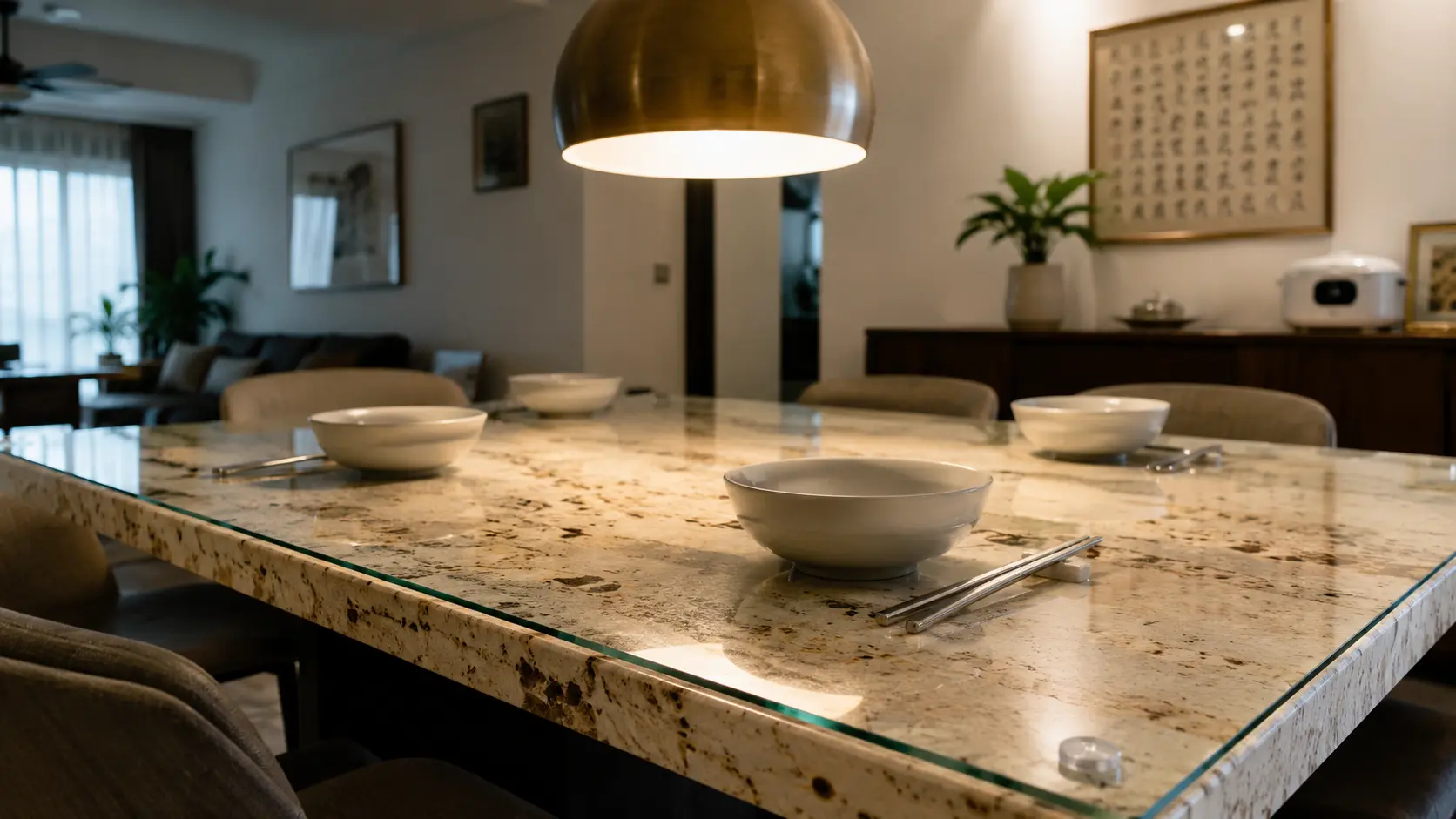
Lay a sheet of transparent tempered glass directly over the travertine surface.
The glass becomes the actual dining surface. All food, spills, cutlery, and plates land on the glass — not the travertine. The stone beneath is completely protected from staining, etching, scratching, and bacteria. And because the glass is clear, you still see the full travertine aesthetic beneath: the warm tones, the natural veining, every characteristic pit. You get the look without paying the daily maintenance price.
What to Specify When Ordering
When you visit a glass supplier in Malaysia to have a custom piece cut:
- Thickness: 10mm is the most practical choice for a dining table. 8mm works for smaller tables; go up to 12mm for tables wider than 120cm or if the travertine base has any flex.
- Edge finish: Polished edge only — smooth, rounded, and safe to touch. Never accept a raw-cut edge.
- Shape: Made-to-measure to the exact dimensions of your travertine slab. Most glass shops in Klang Valley, Penang, and Johor Bahru can cut and temper to custom sizes without difficulty.
- Glass type: Clear float glass — not tinted, not frosted — so the travertine below remains fully visible.
- Rubber bumpers: Place small clear silicone bumper pads between the glass and the stone at regular intervals around the perimeter. These prevent the glass from sliding, absorb minor impacts, and allow air circulation beneath to prevent moisture build-up.
The Trade-offs to Know
Tempered glass is the right solution, but it does change the experience of the table:
- In certain lighting conditions — particularly with overhead pendant lights — the glass surface picks up reflections. On a bright day, you see the travertine; in the evening under direct light, you see the room reflected back at you.
- Glass shows fingerprints and water marks readily. You trade one cleaning routine (sealing, pH-neutral cleaners) for another (regular wiping with a glass cleaner).
- The table gains a slightly formal quality — some find this elegant; others miss the rawness of exposed stone.
None of these are dealbreakers. They are simply the realities of the solution. Tempered glass is safe — if it ever does break under extreme impact, it shatters into small, rounded fragments rather than sharp shards — and it is far easier to replace a glass sheet than to restore a damaged travertine surface.
If you are committed to travertine, this is the only practical way to live with it. The glass handles the daily punishment; the travertine handles the aesthetics. Each does what it is actually good at.
The Bottom Line
Natural travertine is not a bad stone. Used in the right context — a feature wall, a hotel lobby floor, a bathroom accent — it is genuinely beautiful and entirely appropriate. The problem is asking it to perform as a daily dining surface in a Malaysian home where acidic food is served every day and spills happen at every meal.
The honest reality is this: travertine will look spectacular on day one. By the end of year two, between the etch marks, the stains, the scratches, and the worn-out fills, it will look like a surface that has seen better days — and you will have spent a significant amount of time and money trying to keep it presentable.
Invest that effort and budget into a material that is suited for the job. Your dining table will look better for longer, and so will your weekends.