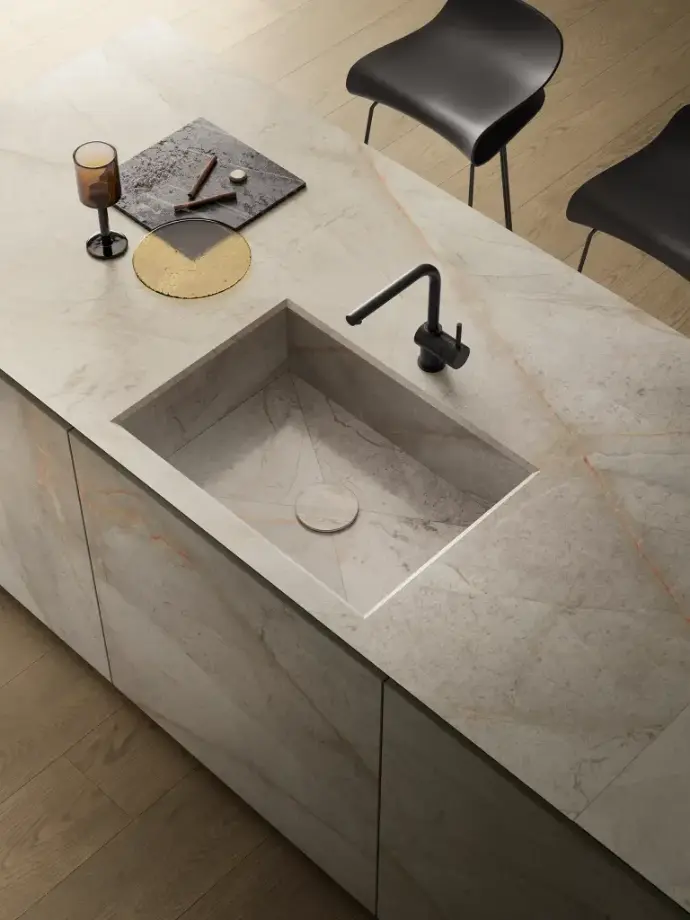
One quotation from your carpenter, or a direct trip to the stone showroom — which one actually serves you better?
Neither choice is automatically wrong. Bundling the stone into your carpenter's quotation can work well when the carpenter names the exact brand, collection, and thickness up front — but sourcing your own stone supplier gives you more control over material, price, and who is accountable if something goes wrong.
Key Takeaways
- A carpenter's stone bundle is fine when the quotation names the brand, collection, and thickness — not just "quartz top"
- Vague line items are the real risk: quartz supply-and-install pricing in Malaysia ranges from around RM110 to RM689 per square foot depending on brand and collection, so "quartz" alone tells you almost nothing about what you're paying for
- Going direct to a stone supplier gives you a named brand, a viewable slab, and one point of contact for accountability and warranty
- Going direct doesn't require your carpenter and stone supplier to coordinate with each other — you just confirm your edge profile with the carpenter so cabinet doors are built to the right height, then show your design to the fabricator when they template
- A carpenter can sometimes offer a genuinely lower price — even free running feet of stone — by subsidising it from their cabinet margin; a stone fabricator can't match that, since stone is their only source of revenue
- An unusually low or free stone offer is also the biggest red flag for material substitution — compressed marble sold and installed as "quartz" is a common complaint, and unlike real quartz, it stains
- Brand warranty often requires the stone factory to have received full payment — if your carpenter owes the factory money, the warranty may not apply even though you've already paid the carpenter in full
- Ask three questions before signing any carpenter's quotation: brand, collection/thickness, and price per square foot

What Does It Actually Mean to "Bundle" the Stone with Your Carpenter?
Bundling means your carpenter sources the countertop stone on your behalf and folds it into the same quotation as your cabinets, so you deal with one contractor instead of two. Most carpenters in Malaysia have a standing arrangement with one or two stone suppliers, and when your cabinets are ready, the stone is fabricated and installed as part of the same project.
It's convenient. You sign one quotation, follow one timeline, and never have to sit through a stone brand comparison if that's not something you want to spend a weekend on. For a lot of homeowners, that convenience is worth something real.
The catch is what sits behind that convenience: you often don't know what you're actually buying.
Why Is a Vague Stone Line Item a Problem?
A vague line item is a problem because "quartz top" or "stone worktop" on a quotation could mean almost anything, and the price range across brands is wide enough that you have no way to judge if you're getting a fair deal.
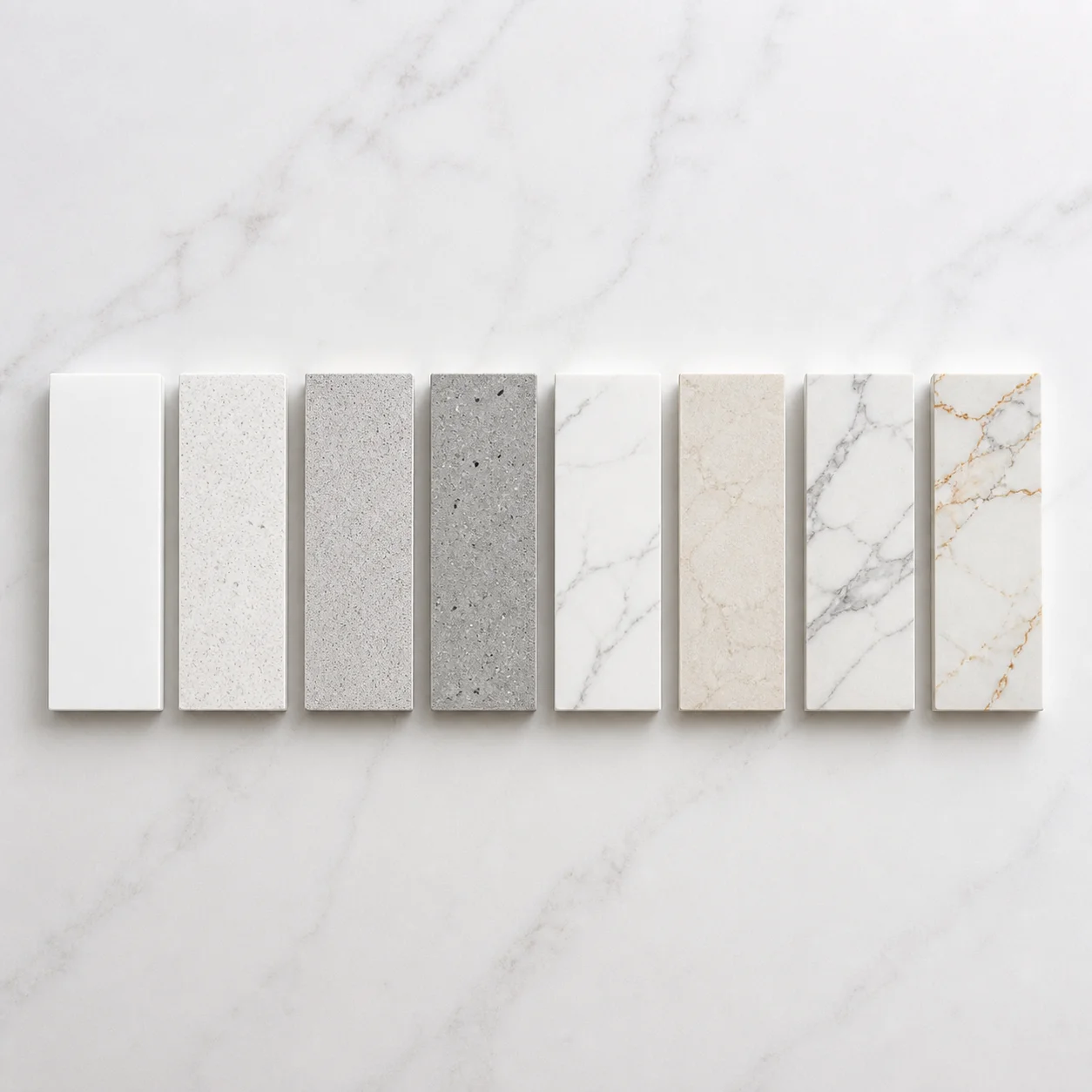
To put a number on it: local Malaysian quartz brands like Zenstone start from around RM110 per square foot (supply and install) and run up to roughly RM160 for premium collections like Calacatta-pattern designs. International brands sit much higher — Caesarstone quartz ranges from around RM332 to RM689 per square foot depending on the collection. That's more than a six-fold difference between the cheapest local white quartz and a premium imported design, and your carpenter's quotation may not tell you which end of that range you're actually paying for.
If your carpenter simply writes "quartz countertop — RM4,500" without naming the brand and collection, you have no way to check whether that price is fair for what you're getting. You're trusting the number, not verifying it.
What Are the Real Risks of Letting Your Carpenter Handle the Stone?
The real risks are limited selection, unclear accountability if something goes wrong, and the possibility that brand warranty doesn't apply to you at all.
Selection is narrow. Carpenters typically work with whichever one or two suppliers they already have a relationship with. If you specifically want Caesarstone from the USA or Silestone from Spain, your carpenter may not be able to source it — or may quietly substitute something else without telling you.
Accountability gets blurry. If a seam looks uneven or an edge chips after installation, who fixes it? Your contract is with the carpenter, not the stone fabricator who actually cut and installed the slab. The carpenter may point to their stone subcontractor, and that subcontractor has no direct relationship with you to resolve it quickly.
Brand warranty may not apply. Premium brands like Caesarstone and Silestone back their products with a manufacturer warranty — but that coverage is usually conditional on installation by an authorised fabricator. Stone that reaches you through an informal carpenter arrangement may fall outside that coverage entirely, even if it's genuine product.
Why Might Warranty Not Apply Even If You've Already Paid Your Carpenter in Full?
Because most brand warranties require the stone factory itself to have received full payment for the job — and that depends on whether your carpenter settled their bill with the factory, not on whether you paid your carpenter.
One of the standard terms in a quartz or sintered stone warranty is that the fabricator must have been paid in full. If your carpenter owes the stone factory money — even after you've fully paid the carpenter — the factory is under no obligation to honour the warranty on your countertop. Your invoice from the carpenter says "paid in full," but that has no bearing on what the carpenter still owes upstream.
This happens more often than most homeowners realise. A carpenter juggling several projects can end up owing balances to more than one stone factory at a time, moving on to a new supplier once trust runs thin with the last one — while the homeowner on the other end has no visibility into any of it. It sounds unlikely, but it's a real and recurring problem in the trade, and it's not something you can detect from your side of the transaction until you actually need the warranty.
This is one of the clearest reasons warranty coverage tends to be more reliable when you pay a stone fabricator directly: the payment that determines your warranty is the one between you and the party actually backing it, not one you have no visibility into.
Why Can Some Carpenters Offer a Much Cheaper — or Even Free — Stone Price?
Because a carpenter already earns their margin on the cabinets, so they can afford to sacrifice part of the stone revenue to win the whole job — something a stone fabricator, who earns from stone alone, can't match.
It's genuinely not unusual in Malaysia for a carpenter to throw in 10, 15, or even 20 running feet of "free" countertop as part of a cabinet package. That's not automatically a trick — cabinets typically carry a wider margin than stone, so a carpenter can use part of that margin to sweeten the stone price and close the whole deal. Stone fabricators don't have that flexibility. Stone is the entire business, not one line item subsidising another, so a fabricator's price reflects the actual cost of the material and fabrication.
This is also why carpenters routinely shop between stone factories asking, "What's your lowest price? How cheap can you go?" — then use one factory's number to squeeze a lower quote out of the next. It's a normal part of how carpenters negotiate, and on its own, it isn't dishonest. What it does mean is that a low or free stone offer is not proof of a good deal on its own — it's a signal to ask exactly what material you're getting, because at some point in that price-squeezing chain, something usually gives.
Why Do Some "Quartz" Countertops From a Carpenter Turn Out to Be Something Else?
When the price gets pushed low enough, the material sometimes gets substituted — most often with compressed marble sold and installed as if it were quartz.
This is a recurring pattern: a homeowner posts a photo of a stained or dulled "quartz" countertop online, someone points out that the staining looks like compressed marble rather than quartz, and the homeowner replies, "But my carpenter said it's quartz." The carpenter isn't necessarily lying outright — they're often relaying what their own supplier told them, without the material knowledge to verify it themselves.
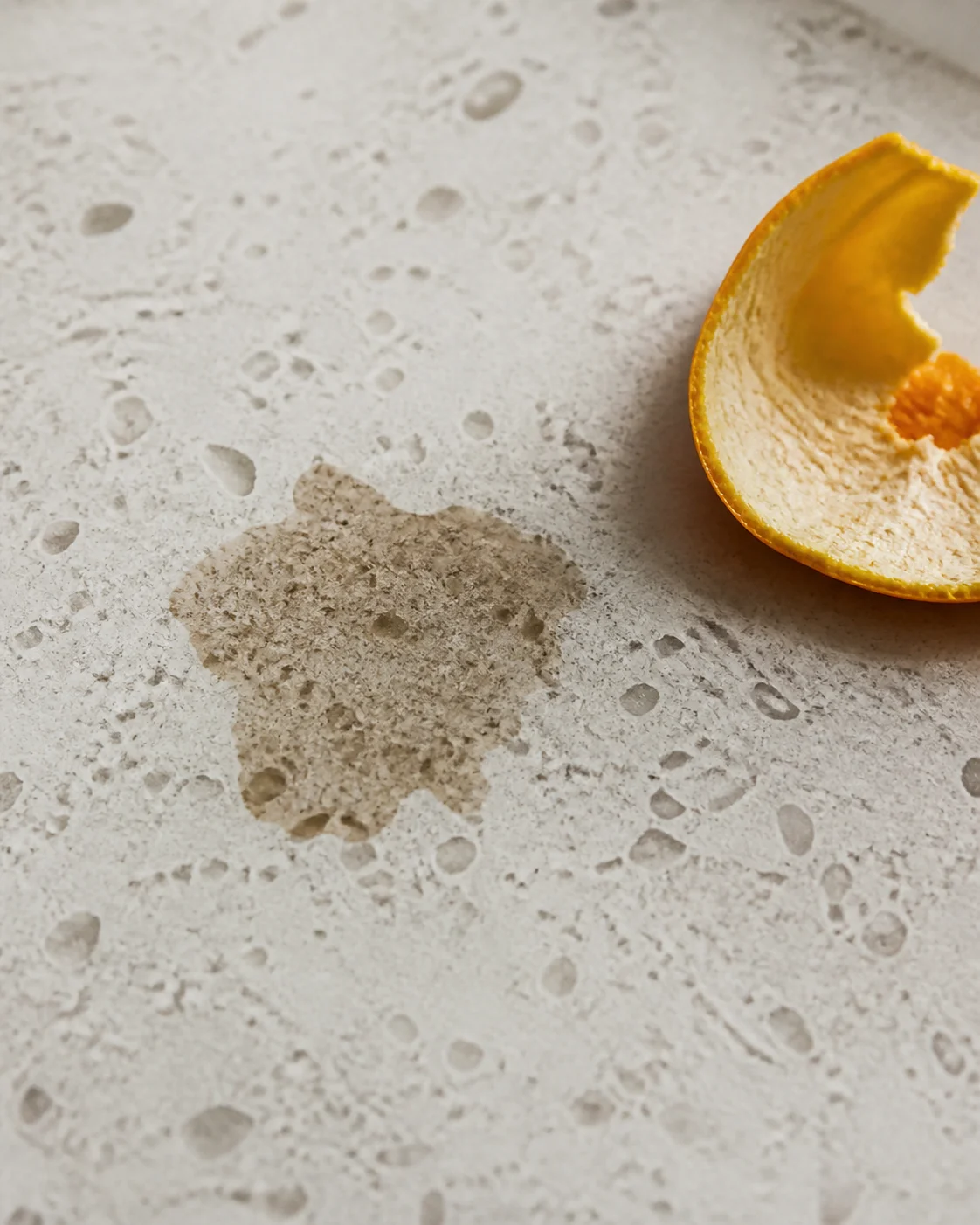
The giveaway is usually the stain. Genuine quartz is engineered to resist staining and etching; compressed marble is not, and it absorbs spills, turmeric, or acidic liquids the way natural marble does. If a "quartz" countertop stains within the first year, that's a strong sign the material isn't what it was sold as. For a closer look at how to tell the two apart before you commit, see Compressed Marble Sold as Quartz: How to Spot the Scam in Malaysia.
When Does Bundling with Your Carpenter Still Make Sense?
Bundling still makes sense when your carpenter can name the exact brand, collection, and thickness of the stone, and the price they're quoting lines up with market rates for that specific product.
If your carpenter can answer those questions without hesitation, you're making an informed decision — you're just choosing to let them handle procurement on your behalf. The problem was never bundling itself; it's bundling without transparency. Ask for the brand name, ask to see an actual sample, and check the price per square foot against published rates before you sign.

What Do You Gain by Sourcing Your Own Stone Supplier?
Sourcing your own supplier gives you a named brand you can see in person, one point of contact who is fully accountable for the material and the installation, and a stronger claim to valid manufacturer warranty.
When you go directly to a stone fabricator, you walk into a showroom, see the actual slab, and know precisely what's going into your kitchen. There's no ambiguity to untangle after the fact. Because the fabricator is often an authorised installer for the brands they carry, your warranty coverage is more likely to hold. And if a problem develops after installation, there's exactly one company responsible for the outcome — not a carpenter pointing at a subcontractor.
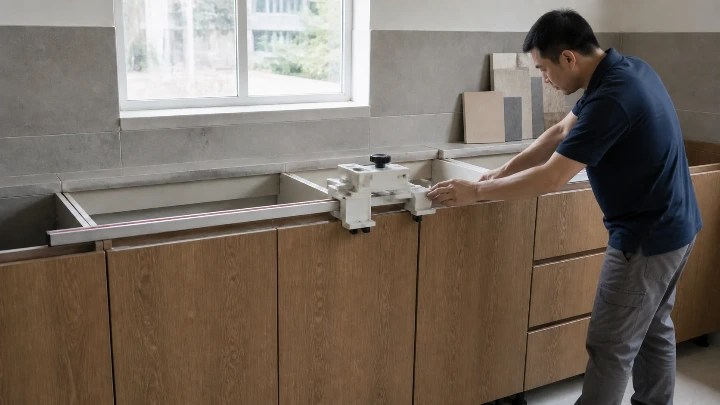
Your stone fabricator will also template your kitchen on-site, after your cabinets are installed, measuring the actual space rather than working from rough estimates. That's the same standard of accuracy you'd want regardless of who supplies the stone — see our guide on do you need to install cabinets before ordering a stone countertop for how that sequencing works.
Does Going Direct Mean More Coordination Between Carpenter and Supplier?
No — your carpenter and stone supplier don't need to talk to each other directly. The one thing that matters is confirming your edge profile with your carpenter early, since that choice determines how much space needs to be left under the cabinet doors.
Different edge profiles need different cabinet door heights. A mitre edge — where the stone is built up to look thicker at the front — needs the cabinet door set lower, typically by 35mm, 40mm, or 50mm depending on the exact profile, so confirm the figure with your carpenter before the doors are made. A single (pencil) profile, or a handleless cabinet design, usually needs the opposite: the door sits higher, and the carpenter leaves the space accordingly. Once that's settled, your carpenter simply builds to it — they don't need any further involvement with your stone supplier.
Your stone fabricator can usually recognise the intended edge profile and cabinet design once they're on-site, and it helps to show them your cabinet drawing when they template. You're the one relaying the decision between the two trades, not coordinating a shared schedule between them.
Carpenter Bundle vs Direct Supplier: A Side-by-Side Comparison
| Carpenter Bundle | Your Own Stone Supplier | |
|---|---|---|
| Material transparency | Often vague — brand and collection may not be named | Full visibility — you see and choose the actual slab |
| Selection | Limited to the carpenter's existing arrangement | Full brand and collection range at the fabricator |
| Accountability if something goes wrong | Split between carpenter and their stone subcontractor | Single point of contact |
| Brand warranty | May not apply, depending on installer | More likely valid through an authorised fabricator |
| Pricing transparency | Bundled into one line item, hard to verify | Itemised and checkable against published rates |
| Coordination required | Minimal — one contractor handles everything | Minimal — confirm edge profile with your carpenter, fabricator templates from your design |
FAQ
Is it cheaper to let my carpenter bundle the stone? Not necessarily — bundled pricing can look cheaper on paper, but without knowing the exact brand and collection, you can't confirm whether it's actually a good rate or a marked-up substitute for a cheaper material.
Can I still use my own carpenter if I source stone separately? Yes. Your carpenter handles the cabinets, and your stone supplier handles the countertop — the two only need to coordinate on timing so templating happens once your cabinets are in place.
Will my carpenter be upset if I source the stone myself? Most carpenters in Malaysia are used to this arrangement and will simply build the cabinets to accommodate whichever stone supplier you choose, as long as you communicate your plan early.
How do I know if my carpenter's stone quotation is fair? Ask for the brand, collection name, and thickness, then compare the quoted price per square foot against that brand's published supply-and-install rate — if your carpenter can't answer, treat that as a signal to look elsewhere.
I already paid my carpenter in full — is my stone warranty safe? Not necessarily. Most brand warranties require the stone factory to have received full payment from whoever contracted them, which is usually your carpenter, not you directly — if your carpenter hasn't settled their bill with the factory, the warranty may not be honoured regardless of what you've already paid.
My carpenter told me it's quartz, but it's staining — what happened? Staining is the biggest giveaway that the material isn't genuine quartz. Compressed marble is sometimes substituted at the lower end of carpenter-bundled pricing, and unlike quartz, it absorbs spills and stains the way natural marble does — ask your carpenter for the original material invoice or brand documentation if this happens to you.
Does sourcing stone myself delay my renovation? It shouldn't — your stone supplier templates on-site once your cabinets are installed, the same as they would either way. The only thing to sort out ahead of time is your edge profile, so your carpenter builds the cabinet doors to the right height.
Conclusion
There's no universal right answer between bundling with your carpenter and sourcing your own stone supplier — but there is a universal right question: do you know exactly what stone you're paying for? If your carpenter can name the brand, collection, and thickness with a price that checks out, bundling is a perfectly reasonable choice. If they can't, going directly to a stone supplier costs you almost nothing extra in coordination — just confirm your edge profile with your carpenter early — in exchange for a lot more certainty about what ends up in your kitchen. Whichever route you take, ask the questions before you sign — not after the slab is already cut.