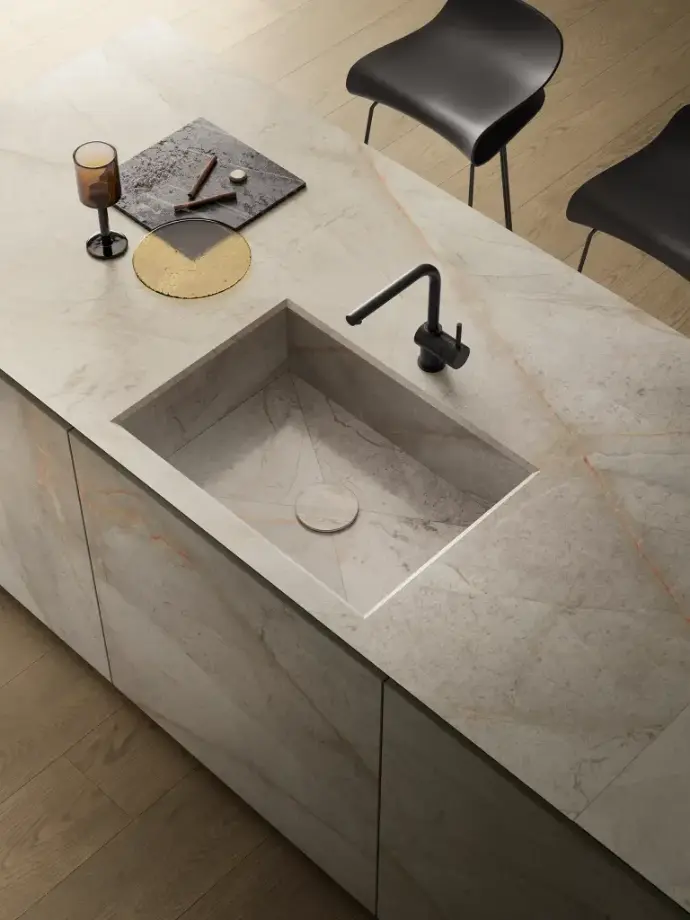
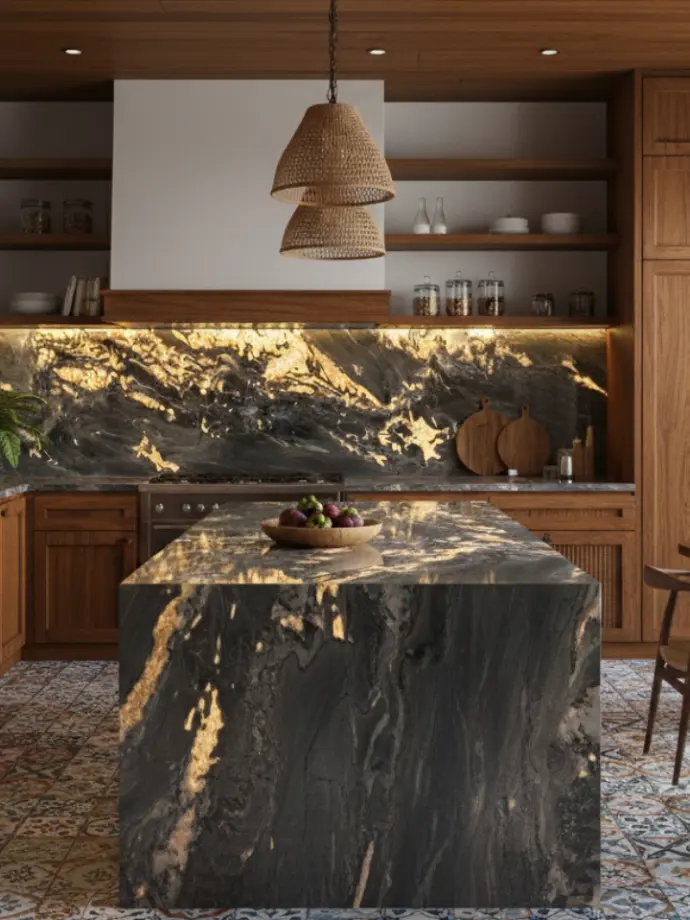
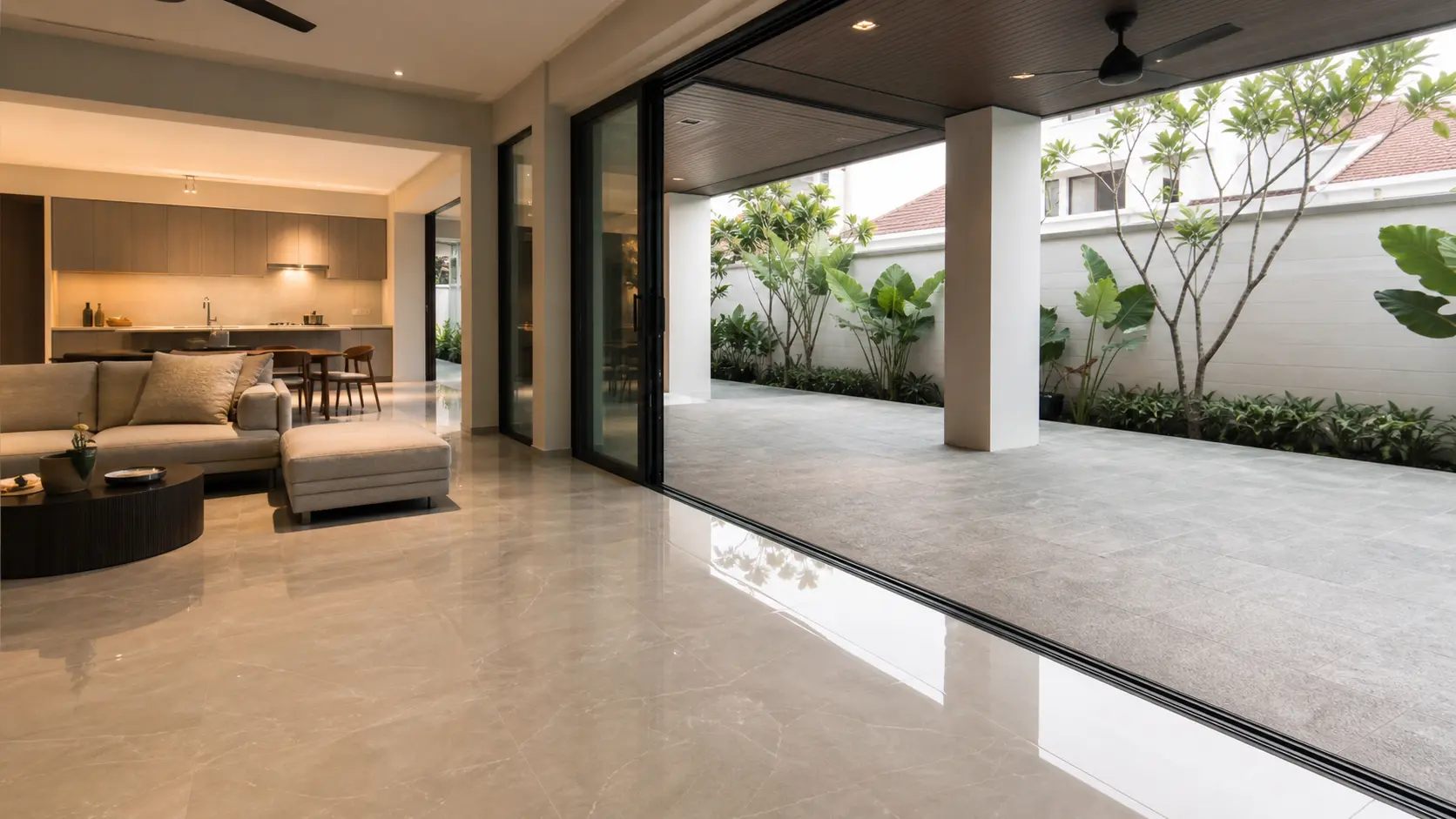
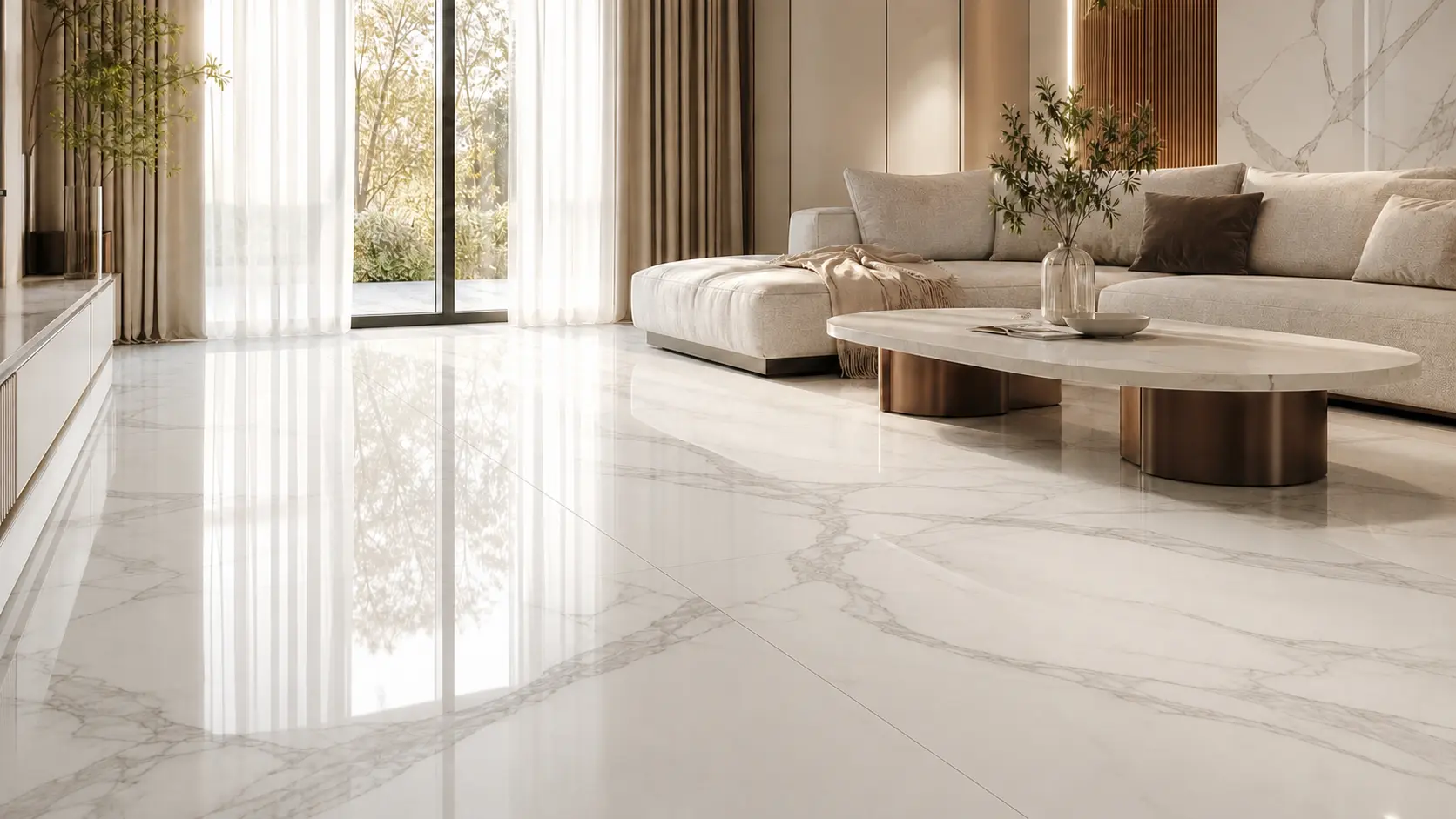
A homeowner in Subang Jaya once asked us to run the same polished porcelain slab from her dining room straight through the sliding doors onto her covered patio, so the floor would read as one continuous surface from inside to outside. We had to flag two problems before any order was placed. First, the polished, glass-like finish that looked stunning indoors would become genuinely dangerous the moment monsoon rain hit it. Second, the specific slab she had chosen was never manufactured for exterior exposure in the first place.
This is the part of stone flooring that catalogues and showroom displays rarely explain. A slab that performs beautifully under your living room ceiling fan can behave completely differently the moment it sits under open sky. If you are planning a floor that continues from your interior into a patio, garden, or covered outdoor area, the material decision is not one choice — it is two, and getting it wrong is an expensive and sometimes dangerous mistake.
Why Indoor and Outdoor Floors Are Solving Different Problems
It's tempting to treat flooring as a single decision — pick a material, pick a finish, lay it everywhere. In reality, an indoor floor and an outdoor floor are being asked to do two very different jobs.
An indoor floor lives under a roof, in a space shielded from rain and shaded from direct sun. It's walked on barefoot, it needs to feel comfortable underfoot, and its biggest daily challenges are spills, dragged furniture, and everyday foot traffic. Slip resistance matters, but mostly in the context of a wet mop, not a downpour.
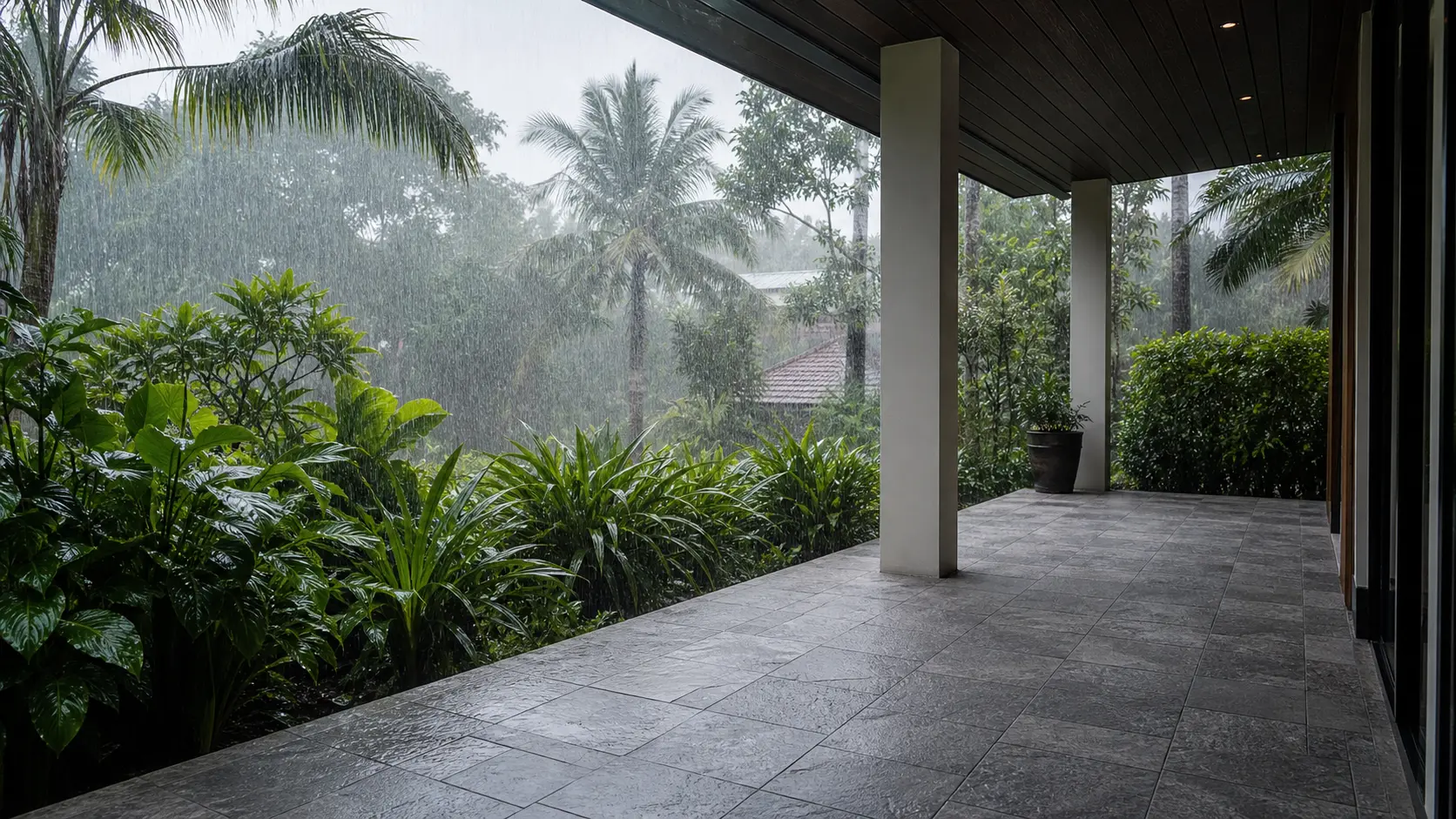
An outdoor floor faces Malaysia's climate directly. That means intense equatorial UV for most of the year, sudden and heavy monsoon rain that leaves standing water on the surface, constant humidity even between rain events, and real temperature swings between scorching midday heat and a sudden downpour. A floor that becomes even slightly slippery when wet is a genuine safety hazard outdoors in a way it rarely is indoors, because outdoor floors get wet often and unpredictably.
Treating these as the same decision is exactly how homeowners end up with a beautiful continuous floor that turns into a slip hazard the first time it rains, or an outdoor slab that stains and discolours within a year.
What Indoor Stone Flooring Actually Needs to Handle
Indoors, the priorities are mostly aesthetic and practical, and almost none of them involve weathering.
Living and dining areas need to look good under a mix of natural and artificial light, resist scuffs from furniture and daily household activity, and stay visually consistent for years — since there's no UV exposure to fade or yellow the surface, a wider range of materials and finishes perform well here, including high-gloss polished finishes that would be unsafe outdoors.
Kitchens face oil splatter, steam, and the turmeric- and chilli-heavy staining that comes with Malaysian cooking, but again, never rain or direct sun. A non-porous, easy-to-wipe surface is what matters, not weather resistance.
Bathrooms and laundry areas deal with constant moisture near the shower, tub, or washing machine, so a slip-resistant finish and low porosity matter — but this is a hygiene and safety concern tied to indoor humidity, not to standing rainwater.
In every one of these indoor scenarios, UV stability is irrelevant, and that opens the door to materials — and finishes — that would fail outright the moment they're exposed to Malaysia's weather.
What Outdoor Stone Flooring Actually Needs to Handle
Outdoors, the same square footage of floor has to survive conditions that never let up.
Standing water from monsoon rain. Malaysian downpours are sudden, heavy, and frequent. A porous or semi-porous material absorbs water repeatedly over the years, leading to staining, efflorescence — that chalky white residue that appears on exterior masonry — and eventual weakening of the bond between the slab and the substrate below.
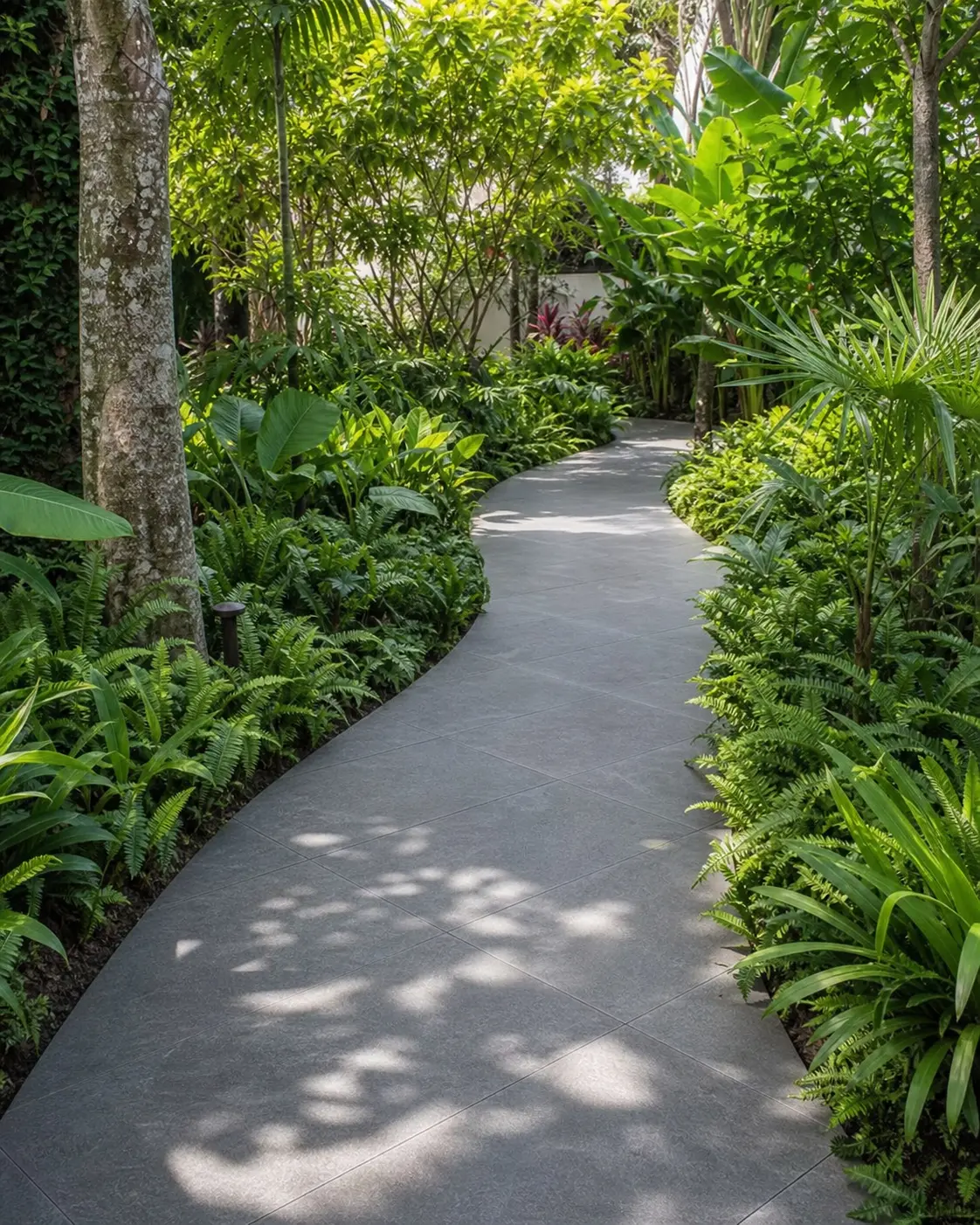
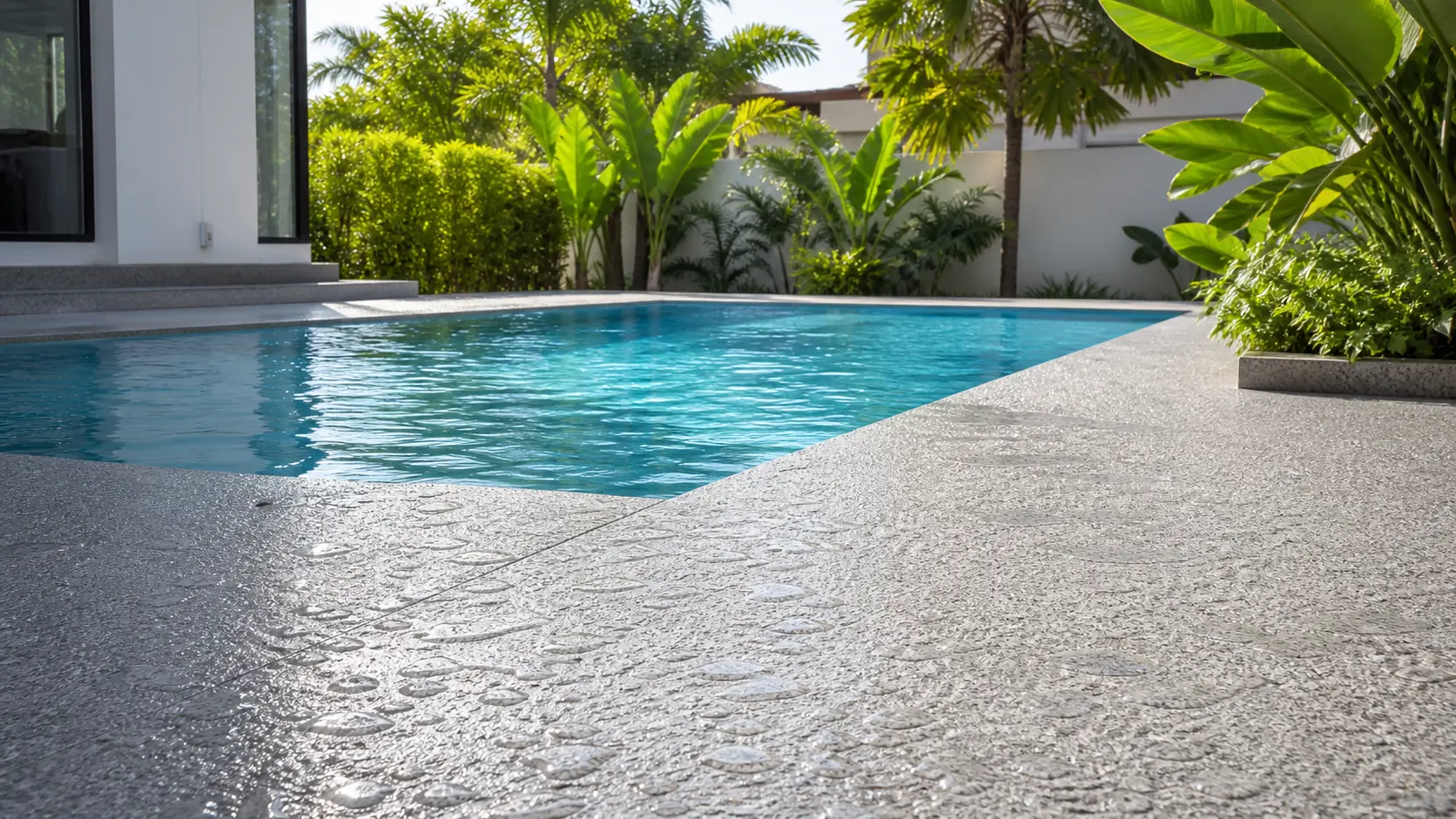
Slip resistance when wet. This is the single most overlooked factor in outdoor flooring decisions. A material can be exceptionally hard and scratch-resistant and still be entirely unsuitable outdoors if its finish turns slick underfoot in the rain. Polished and high-gloss finishes, which are perfectly safe indoors on a dry floor, are genuinely dangerous on an outdoor patio, garden pathway, or poolside deck.
Direct UV exposure. Malaysia's near-equatorial sun is intense and consistent year-round. Any material with a resin binder is at risk of breaking down chemically under sustained UV exposure — the colour fades or yellows, and the change cannot be reversed.
Humidity between rain events. Outdoor surfaces in Malaysia rarely get the chance to fully dry out. This creates ideal conditions for mould and algae to take hold in any texture or porosity the surface offers, particularly in shaded garden areas.
Temperature cycling and thermal expansion. Outdoor slabs heat up considerably under direct sun and cool rapidly during rain. Over a large uninterrupted outdoor floor area, this repeated expansion and contraction puts real stress on both the slab and the adhesive bed beneath it if expansion joints aren't correctly specified.
Vehicular or point-load areas. If you're considering stone slab flooring anywhere near a car porch apron or driveway edge, this is a conversation to have directly with your fabricator before ordering — vehicle loading requires a different specification and installation approach from a pedestrian patio or garden path, and not every product is rated for it.
Material by Material: What Works Where
Sintered Stone — Works Indoors and Outdoors
Sintered stone is the material we recommend most often for exterior flooring, and it performs just as well indoors. It's made by compressing natural mineral powders under extreme heat and pressure, producing a dense, essentially non-porous slab with no resin binder at all. Because there's no resin to break down, sintered stone doesn't yellow or fade under sustained UV exposure, and its zero porosity means monsoon rain doesn't penetrate the surface — no staining, no efflorescence.
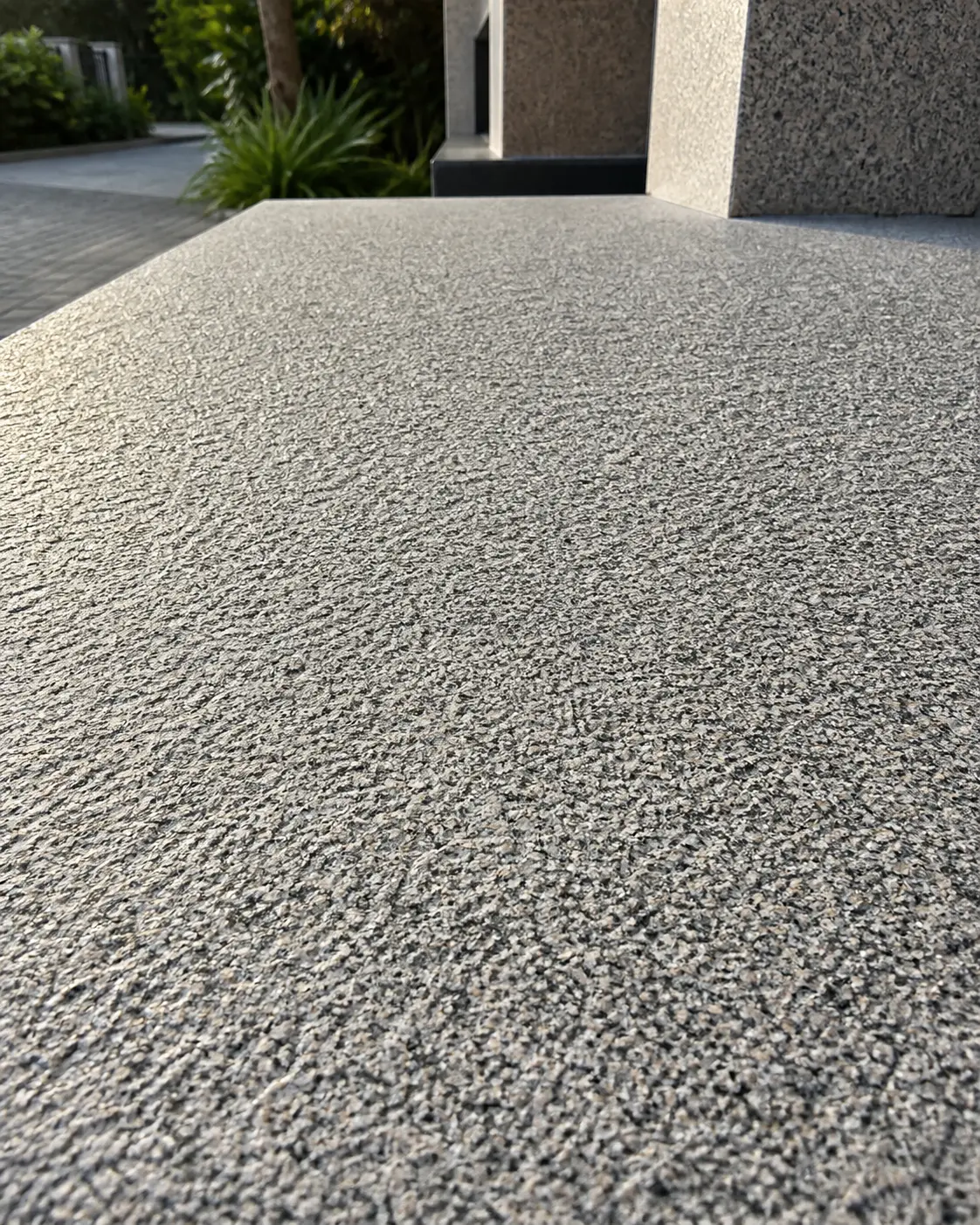
Crucially for outdoor use, sintered stone is available in textured, slip-resistant finishes specifically formulated for wet areas, unlike a polished finish that turns hazardous when wet. Brands like Moca Compact and Dekton are the two most commonly specified for exterior flooring projects in Malaysia. For the full picture on how this material performs underfoot — including pricing, installation, and what to expect during the process — our full guide to sintered stone flooring in Malaysia covers it in depth.
Porcelain Slab — Works Indoors, Only Some Products Work Outdoors
This is where the indoor-versus-outdoor distinction gets genuinely confusing for homeowners, because not every porcelain slab is manufactured to the same specification. The core material — dense, fired porcelain clay — is inherently weather-resistant, but thickness, firing quality, and the specific product range all determine whether a given slab is actually rated for exterior use.
The same caution that applies to porcelain slab thickness for kitchen countertops applies here — a slab manufactured for an indoor living room floor is not automatically suitable for a patio exposed to rain and thermal cycling. Just as important is the finish: a high-gloss porcelain slab that looks spectacular in a dry dining room becomes a slip hazard the moment it's wet, which is why exterior-rated porcelain products are almost always specified in a textured or structured finish rather than gloss. If you're drawn to the large-format, minimal-grout-line look of porcelain slab, our guide to linear match porcelain slab flooring is worth reading before you decide where to use it. Always confirm with your fabricator that the specific slab and finish you've chosen is rated for exterior use before it goes anywhere near an uncovered outdoor floor.
Granite — Works Indoors and Outdoors, with Finish and Weight Caveats
Granite is a natural stone with a long track record as an exterior flooring material in Malaysia — five-foot ways, garden paths, and porch floors have used it for decades. It's inherently weather-resistant with no resin binder to break down under UV. For a broader look at how granite performs as a material generally, our guide on whether granite is still the best countertop choice for Malaysian kitchens is a useful reference, even though that piece focuses on countertops rather than floors.
The caveats are twofold. First, finish matters just as much as it does with porcelain — a polished granite floor is beautiful indoors but becomes treacherous outdoors when wet, so exterior granite flooring should always be specified in a flamed, leathered, or otherwise textured finish. Second, granite slabs are considerably heavier than sintered stone or porcelain slab of a similar size, which is a real consideration for elevated balconies or condominium outdoor spaces where the structural capacity of the slab below may be limited.
Quartz Stone — Indoor Only, and Rarely Used for Flooring at All
Quartz stone is roughly 90–93% natural quartz crystal bound together with polymer resin and pigment. It's an excellent countertop material, but it's rarely specified as a flooring material even indoors, largely due to cost relative to porcelain or ceramic alternatives at that scale. Where it does appear as an indoor floor accent, the same rule applies as everywhere else in the home: keep it strictly indoors. The resin binder is not UV-resistant, and under Malaysia's intense year-round sunlight, it breaks down chemically over time — the surface yellows or takes on a dull, washed-out appearance, permanently. Our guide to the disadvantages of quartz stone countertops covers this UV discolouration issue in more detail, and the same chemistry applies whether the quartz is on a countertop or underfoot.
Quick Reference Table
| Material | Indoor | Outdoor |
|---|---|---|
| Sintered Stone | Excellent | Excellent (textured finish) |
| Porcelain Slab | Excellent | Only exterior-rated, textured products |
| Granite | Excellent | Excellent (textured finish; weight limits on balconies) |
| Quartz Stone | Good, but rarely used for flooring | Not suitable — UV yellowing |
Slip Resistance: The Detail Most Homeowners Miss
Hardness and slip resistance are two different properties, and it's entirely possible for a floor to score well on one and fail badly on the other. A material can be scratch-proof and stain-proof and still send someone sliding across a wet patio if the finish is wrong for the location.
Flooring finishes are typically rated on a slip-resistance scale, with rougher, more textured finishes offering significantly more grip when wet than smooth polished or gloss finishes. This is exactly why the material recommendations above keep repeating the same point in different words: the same base material — sintered stone, porcelain slab, or granite — can be entirely appropriate for an outdoor area in one finish and genuinely hazardous in another. When you're finalising a flooring order for a patio, garden path, or poolside deck, ask your fabricator specifically about the slip rating of the finish, not just the durability of the material. A beautifully polished slab belongs indoors, full stop.
Installation Also Changes Between Indoors and Outdoors
Material and finish are only part of the story — how the slab is laid matters just as much, and this is another point where indoor and outdoor flooring diverge.
For sintered stone specifically, full-bed adhesive application using a 2-in-1 cement adhesive — applied to both the substrate and the underside of the slab — is essential for a secure, long-lasting bond, whether the floor is indoors or outdoors. Standard tile cement does not have sufficient bonding strength for large-format slabs.
Outdoor installations carry an additional requirement that indoor floors don't: correctly specified expansion joints to accommodate the thermal movement caused by direct sun exposure and sudden temperature drops during rain. Skipping or under-specifying these joints on a large outdoor floor area is one of the more common causes of long-term cracking. A perfectly level, properly prepared substrate matters in both settings, but outdoor substrates also need adequate drainage falls so that rainwater doesn't pool on the surface.
A Note on Pricing
Flooring is priced differently from a countertop's single supply-and-install rate. Stone for flooring is sold by the slab, then cut to size for your specific floor area — with a separate cutting charge on top of the slab price, billed per square foot. As a reference, this cutting charge is RM 7 per square foot for quartz stone and RM 10 per square foot for sintered stone. If you're unfamiliar with the premium end of the sintered stone category, our brand guide on what Dekton is explains what sets it apart.
Important pricing note: The cutting charges above are separate from the slab price itself and from installation, both of which vary depending on the specific colour, product, and floor area involved. For an accurate flooring budget, always obtain an itemised quote from your fabricator covering slab cost, cutting, and installation for your specific indoor and outdoor areas.
Should Your Indoor and Outdoor Floor Actually Match?
The seamless indoor-outdoor look is a genuinely popular request among Malaysian homeowners, particularly for terrace houses with a covered patio or garden area visible from the living room, and it's achievable — but it means matching the visual language of the floor, not necessarily using the identical product throughout.
A textured, exterior-rated porcelain slab in the same colourway as your indoor gloss porcelain floor, or a sintered stone finish that continues from the living room into a covered outdoor dining area in a matching tone but different surface texture, achieves visual continuity without compromising on safety or durability where it matters. Speak to your fabricator early about which exterior-rated products are available in colours that complement your indoor flooring choice — this is far easier to plan for at the start of a renovation than to retrofit later.
Conclusion
The question isn't which stone flooring material is the "best" one overall — it's which one is right for where it's actually going. Indoors, almost every material on this list can deliver a beautiful, comfortable floor, since the roof over your head does most of the work of protecting the surface. Outdoors, Malaysia's rain, sun, and humidity narrow the field considerably, and the finish matters just as much as the material itself: sintered stone and textured granite hold up reliably, exterior-rated porcelain slab can work with the right product and finish selection, and quartz stone should stay indoors entirely.
Before you commit to a flooring material for any area of your home — but especially one that steps outside — confirm with your fabricator exactly what you're buying, whether it's rated for exterior exposure, and what slip rating the finish carries. A floor that looks identical in the showroom can behave in completely different, and sometimes dangerous, ways once it's facing Malaysia's climate for real.