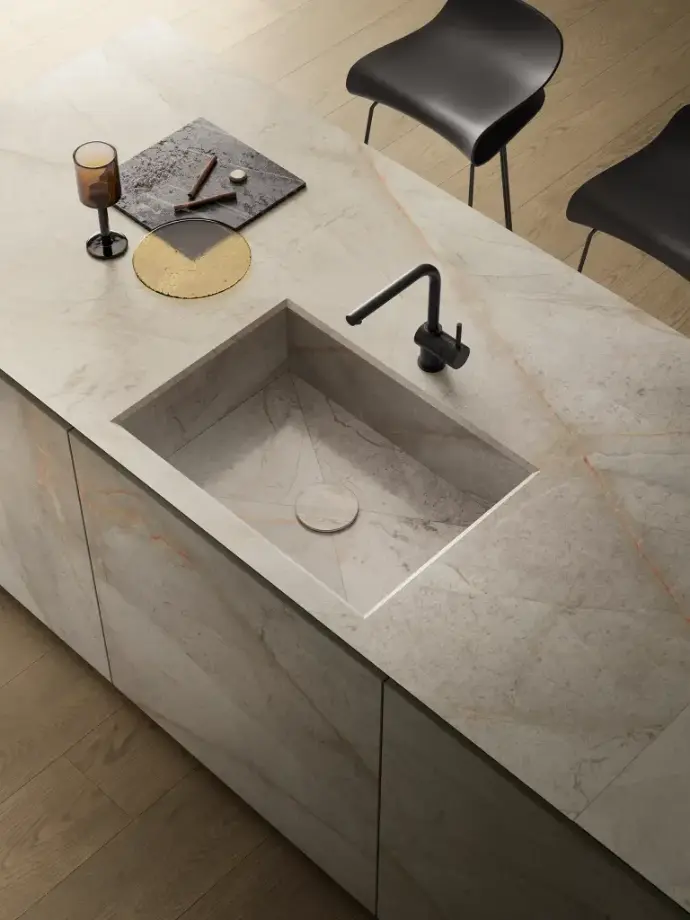
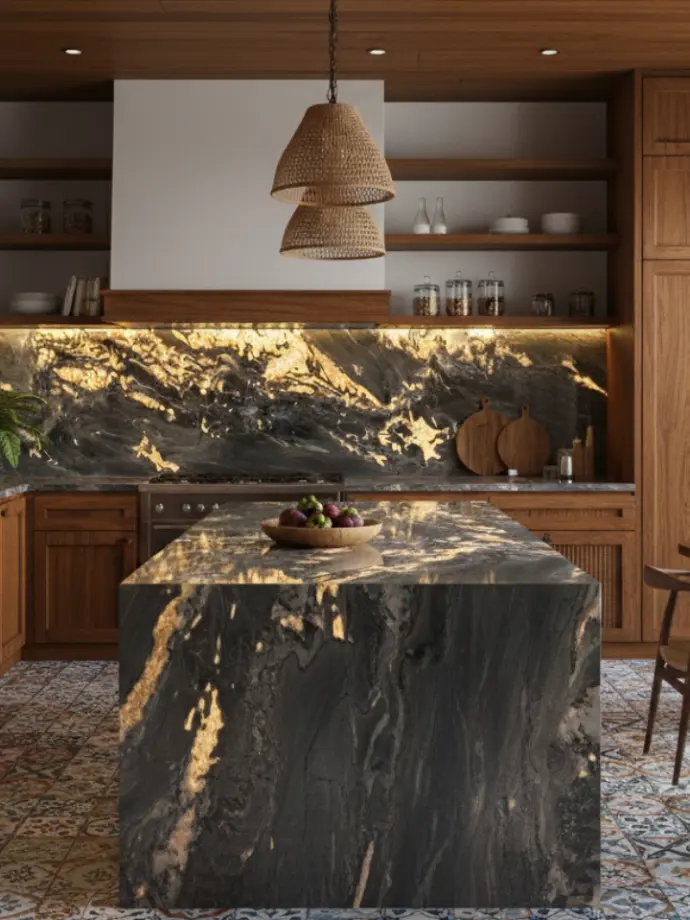
Most homeowners planning a wall cladding project end up visiting two completely different types of suppliers — without realising they exist in separate worlds.
If you've shopped for tiles, you've probably been to a jubin shop. Rows of samples on the wall, standard sizes, familiar finishes — and a tiler who can start work next week. If you've looked at porcelain slabs, you've likely spoken to a stone fabricator instead. Large-format panels, measured templating, and a specialist installation crew.
Same material. Completely different supply chain. And a finish that looks nothing alike once it's on your wall.
They're made from the same core material, so the confusion is understandable. But choosing the wrong format for a wall application is a costly mistake that's very difficult to reverse. The difference in outcome — both visually and practically — is far more significant than most homeowners realise until it's too late.
This guide explains exactly what separates them — and why it matters before you decide.
What Does "Wall Cladding" Actually Mean?
Wall cladding refers to applying a layer of material over a wall surface — whether for protection, aesthetics, or both. In Malaysian homes, this typically shows up as:
- Kitchen backsplashes behind the hob and sink
- Bathroom feature walls behind the vanity or shower
- Living room accent walls as a design centrepiece
- Full-height wall panels in open-plan spaces
Tiles have traditionally dominated all of these applications. Porcelain slabs are the newer option, growing in popularity as large-format stone looks become a mainstream design preference in Malaysia.
What Are Porcelain Tiles?
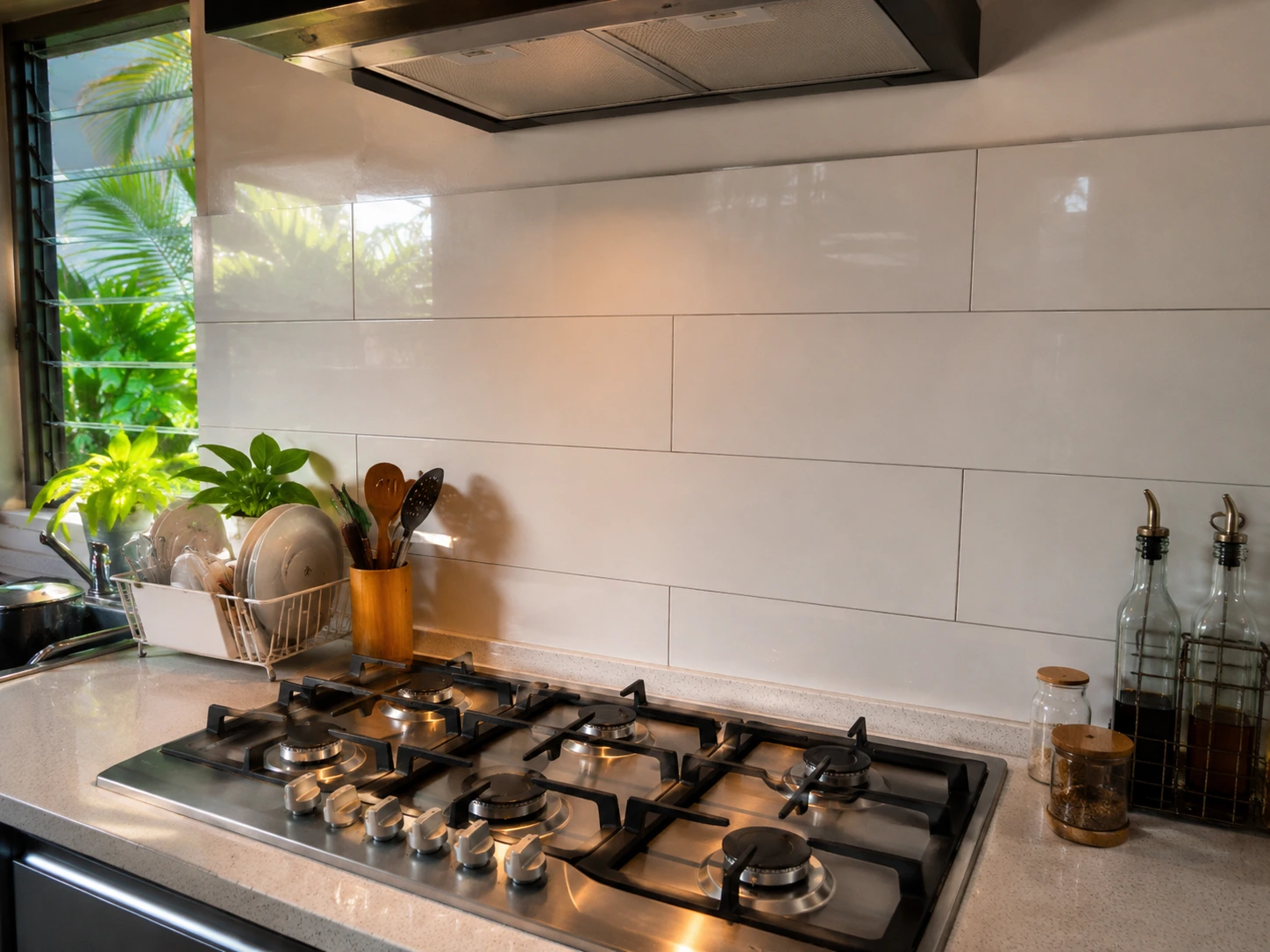
Porcelain tiles are kiln-fired ceramic tiles with a dense, low-porosity body. They come in standard sizes — typically 30×60 cm, 60×60 cm, or 30×30 cm — though larger tiles up to 60×120 cm exist.
What you're working with when you choose tiles is a modular system. Each piece is installed individually, with grout filling the gaps between them. In Malaysia, tiles are sold at jubin shops — dedicated tile retailers found in most towns, from shop lots in Chow Kit and Jalan Ipoh to larger tile galleries in Petaling Jaya and Johor Bahru. Your tiler will typically source or help you select tiles directly from these suppliers.
They're the go-to choice for most standard renovations because:
- Most tilers in Malaysia are trained and equipped to handle them
- Jubin shops stock an enormous range of colours, textures, and finishes at accessible price points
- Replacing a damaged piece is relatively simple
What Are Porcelain Slabs?
Porcelain slabs — sometimes called large-format porcelain panels — are produced in significantly larger formats: typically 1,200×2,400 mm, 1,600×3,200 mm, or even larger. They're made from fine porcelain clay fired at high temperatures — the same fundamental process as tiles — but at a scale that changes everything about how they're handled, cut, and installed.
At these dimensions, a single slab can cover the majority of a standard wall without a single joint.
In Malaysia, porcelain slabs are not sold at jubin shops. They're supplied by stone fabricators — the same workshops that cut and install quartz stone and sintered stone countertops. This is because slabs require:
- Specialist cutting equipment — wet-blade saws, CNC routers, and angle grinders
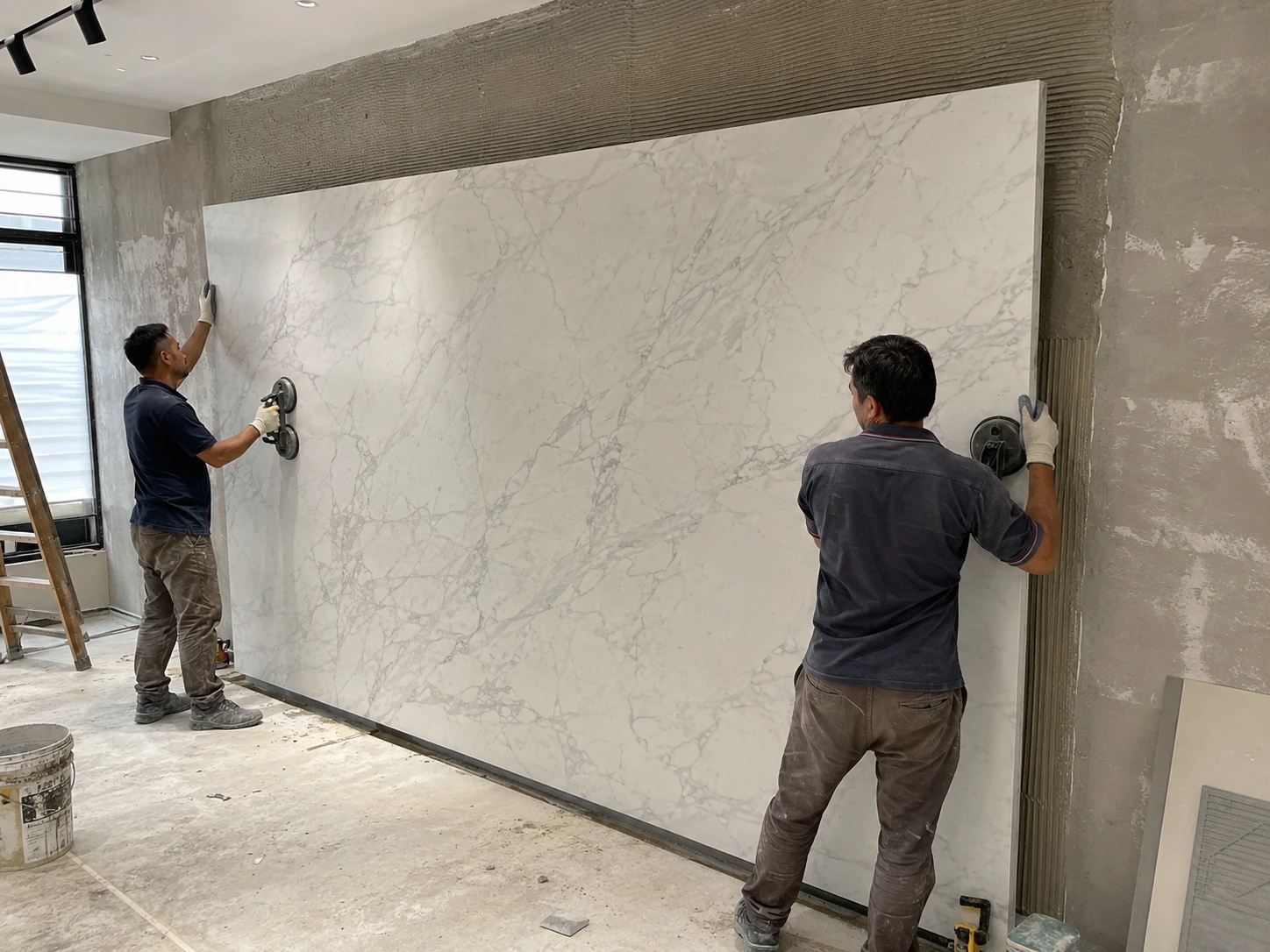
- Suction cup lifters to safely handle panels weighing 30–120 kg or more
- Experienced installers who understand adhesive loading, wall preparation, and large-format alignment
A standard tiler from your jubin shop is not set up for this. Porcelain slab work goes to fabricators precisely because the tools and skills overlap with countertop fabrication, not standard tile-laying.
For a broader breakdown of how these two products differ in general, our guide on porcelain slabs vs porcelain tiles is a useful starting point. This article focuses specifically on what those differences mean when you're cladding a wall.
Why Wall Cladding Is a Different Conversation
Most porcelain comparisons centre on countertops or floors. Walls introduce a different set of priorities that change how you should evaluate each format.
Gravity works against you. Unlike a countertop, a wall panel must be securely adhered to a vertical surface. The larger and heavier the panel, the more engineering is required to keep it there — and the more critical your choice of adhesive, substrate, and installer.
You see it from across the room. A wall surface is often viewed at eye level from a distance. Pattern continuity and grout line visibility matter considerably more here than on a floor you're standing directly on.
Grout lines are far more visible on walls. On a tiled floor, your eyes glide across the surface and move past the grout. On a wall, grout lines are at eye level — front and centre in your line of sight, every single day.
Malaysian homes have specific challenges. High humidity, occasional vibration from nearby construction or MRT lines, and a renovation industry that has historically been tile-centric all factor into how different materials perform in local conditions. These are not hypothetical concerns — they are part of the day-to-day reality of owning a home in Malaysia.
Understanding these factors completely changes how you evaluate porcelain slab versus tiles for wall use.
The Key Differences: A Direct Comparison
1. Size and Format
This is the most fundamental difference — and it shapes everything else.
| Porcelain Tiles | Porcelain Slabs | |
|---|---|---|
| Typical size | 30×60 cm to 60×120 cm | 1,200×2,400 mm to 1,600×3,200 mm |
| Number of pieces per wall | Many | One to a few |
| Pattern continuity | Repeated per tile | Continuous across the surface |
| Supplied by | Jubin shops | Stone fabricators |
| Installed by | General tilers | Specialist installation crew |
Tiles repeat their pattern across the wall. Slabs carry a continuous design — if you're using a marble-vein look, the vein flows uninterrupted across the entire surface.
2. Visual Impact — Seamless vs. Grid
This is where the difference between slabs and tiles is most dramatic — and most immediately obvious.
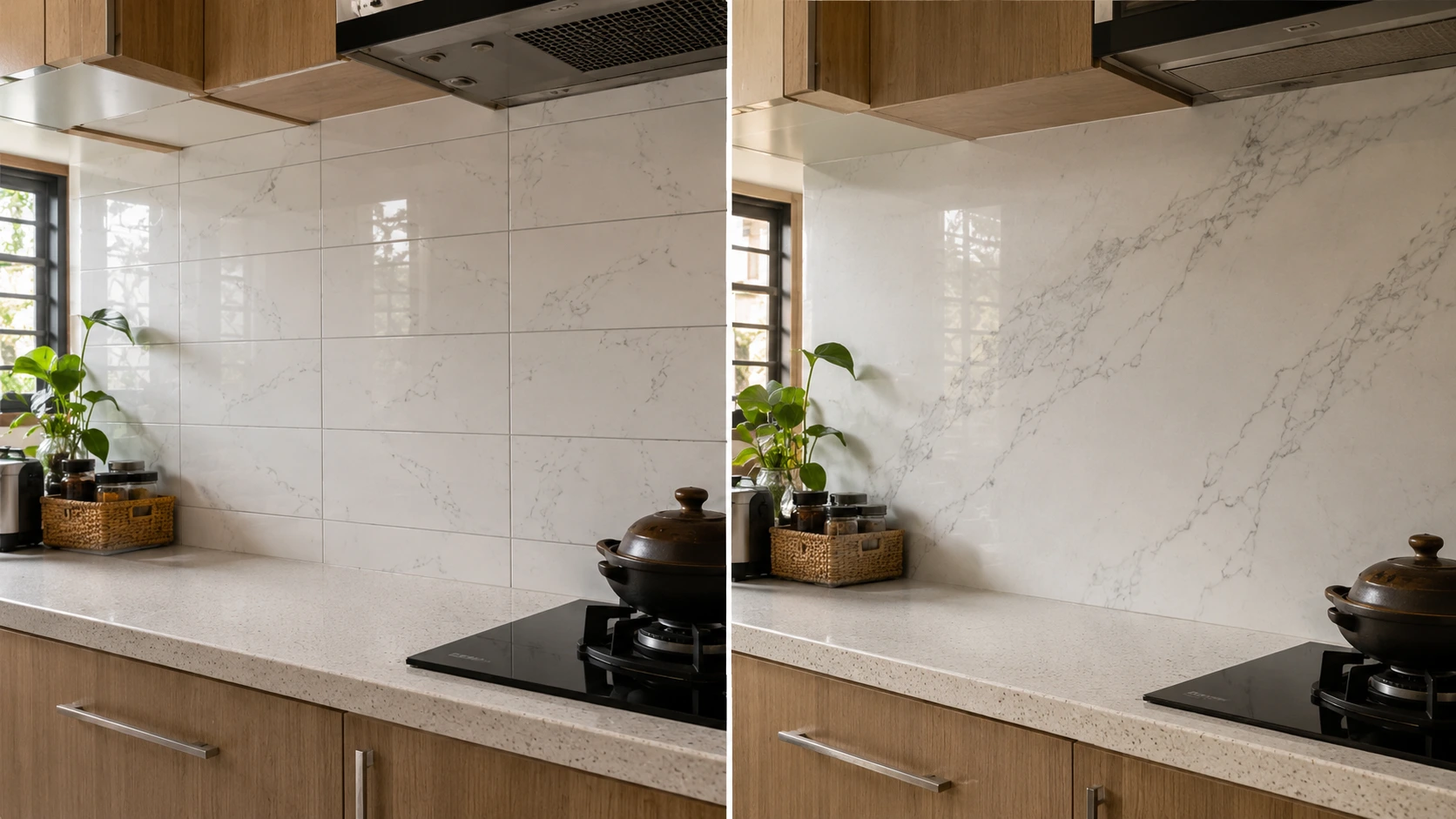
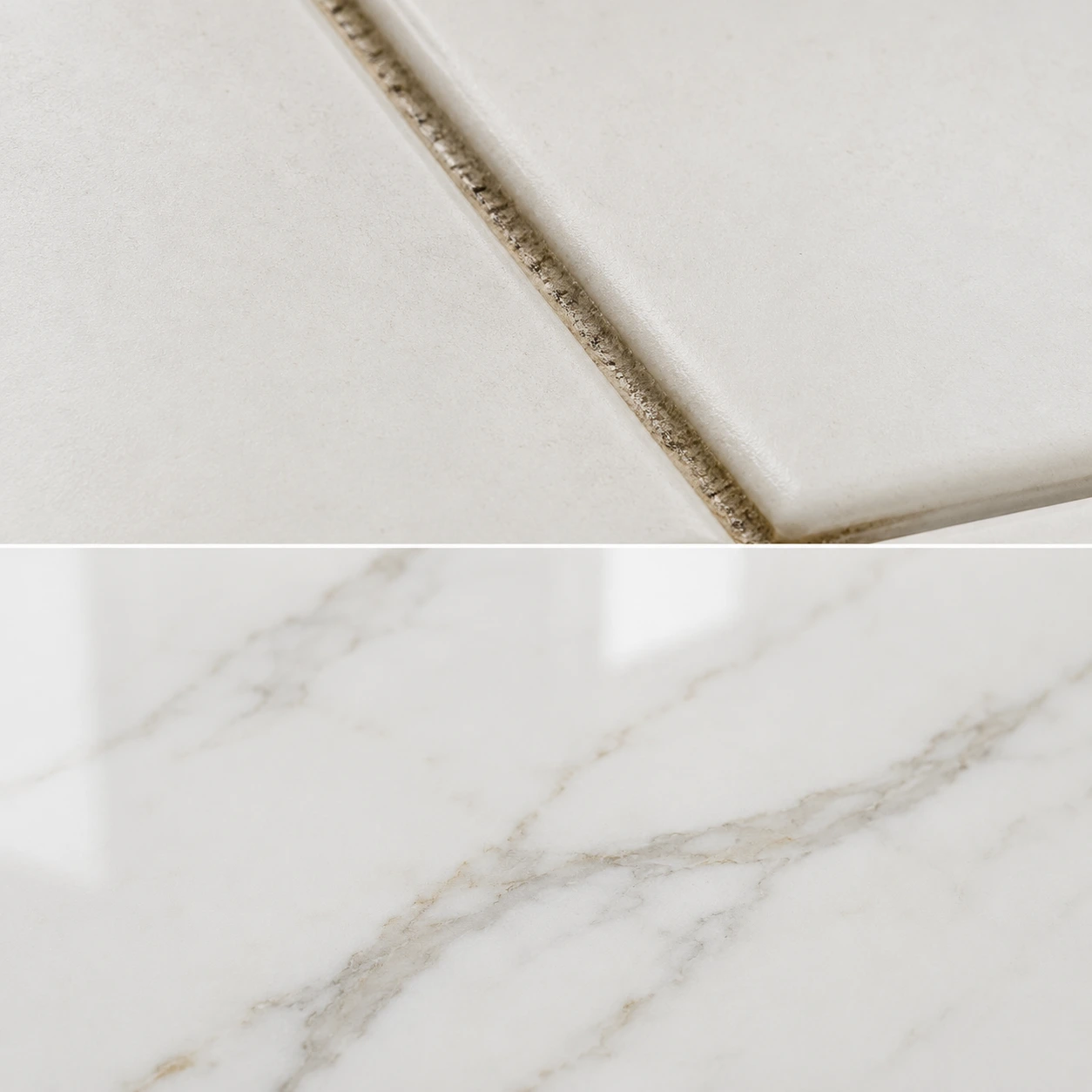
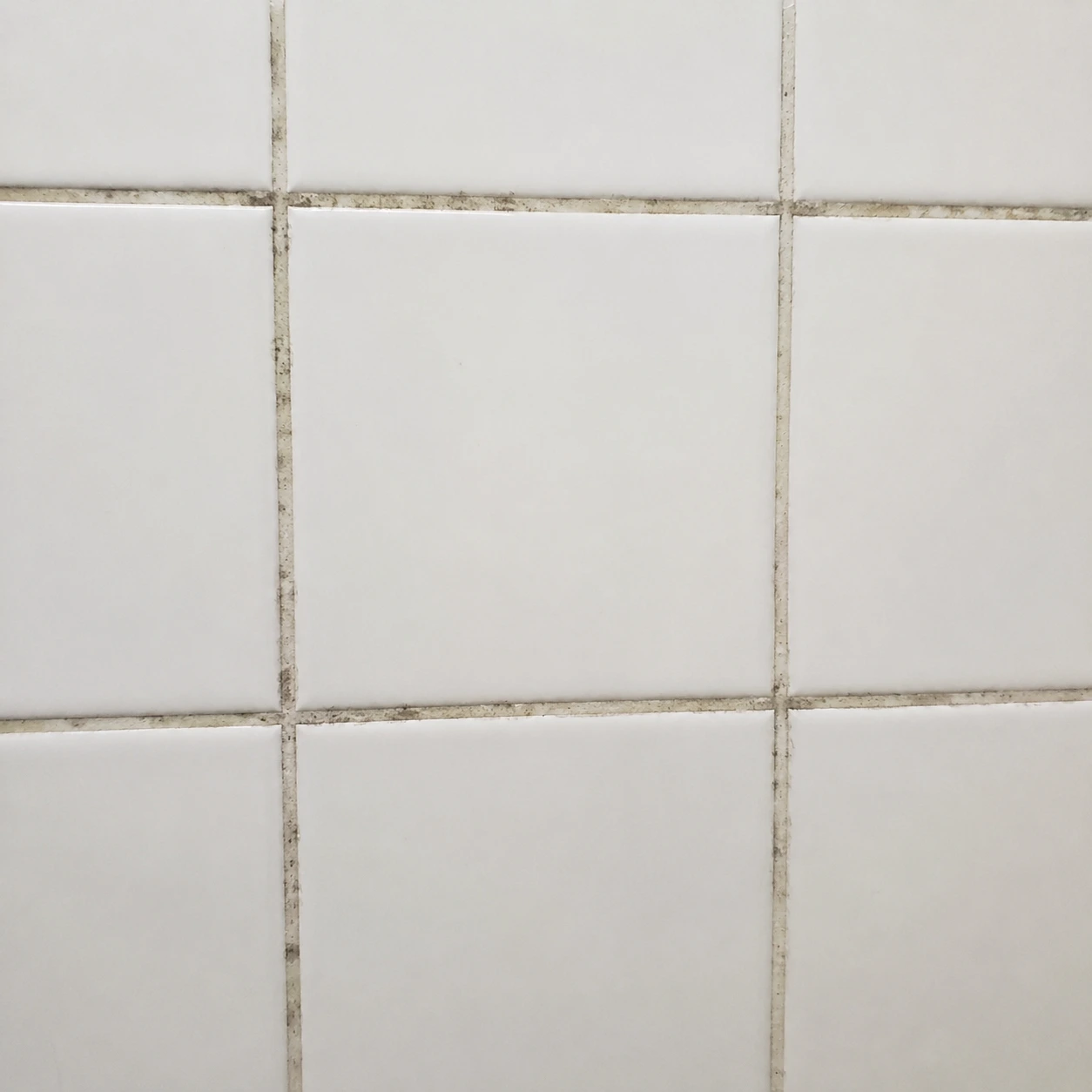
With porcelain tiles, every panel is separated by a grout joint. On a feature wall, this creates a grid. Depending on tile size, spacing, and grout colour, that grid can look intentional and design-forward — or it can fragment what could have been a sweeping, uninterrupted expanse of pattern.
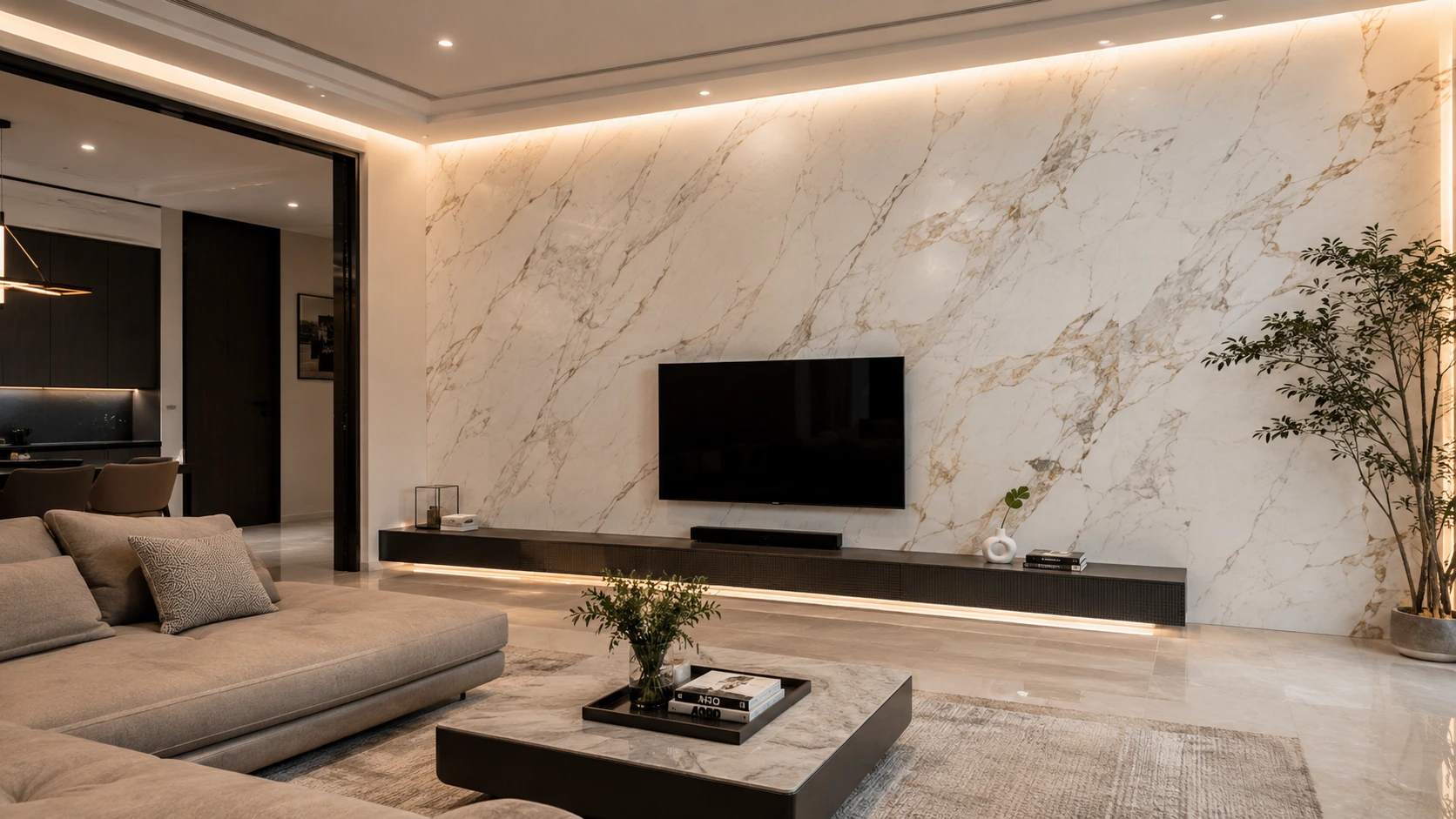
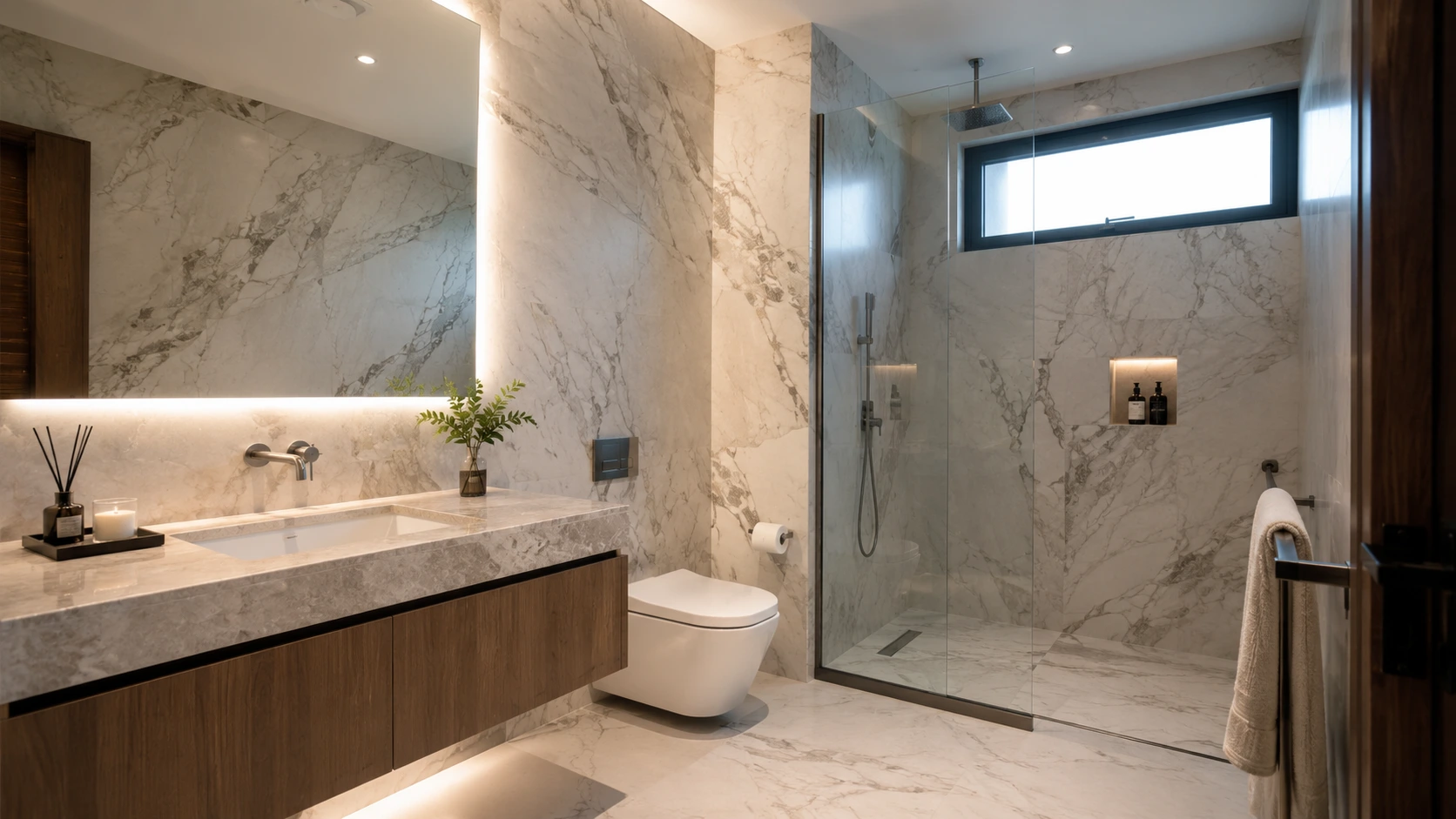
With porcelain slabs, a full wall can be covered by two or three large panels — sometimes just one — with joints so fine they nearly disappear when properly installed. The result is the kind of seamless, monolithic surface you see in high-end hotel lobbies and interior design publications.
For veined materials — Calacatta-inspired marble looks, grey concrete, or dramatic dark stones — the slab format allows the veining to travel across the entire wall without interruption. On a tile, that veining resets with every grout line, and the visual continuity is completely lost. This is why Malaysian homeowners who want a genuine, premium stone wall look almost always end up choosing slabs once they see the two side by side.
Tiles, on the other hand, offer more flexibility in terms of layout patterns. Herringbone, stacked, offset, mosaic — these are tile options, not slab ones. If you want a complex geometric arrangement or a mix of colours, tiles give you more to work with.
3. Pattern Continuity — Book Match and Linear Match
One of the strongest arguments for porcelain slabs on walls is the ability to use book matching or linear matching — techniques that are simply not achievable with standard tiles.
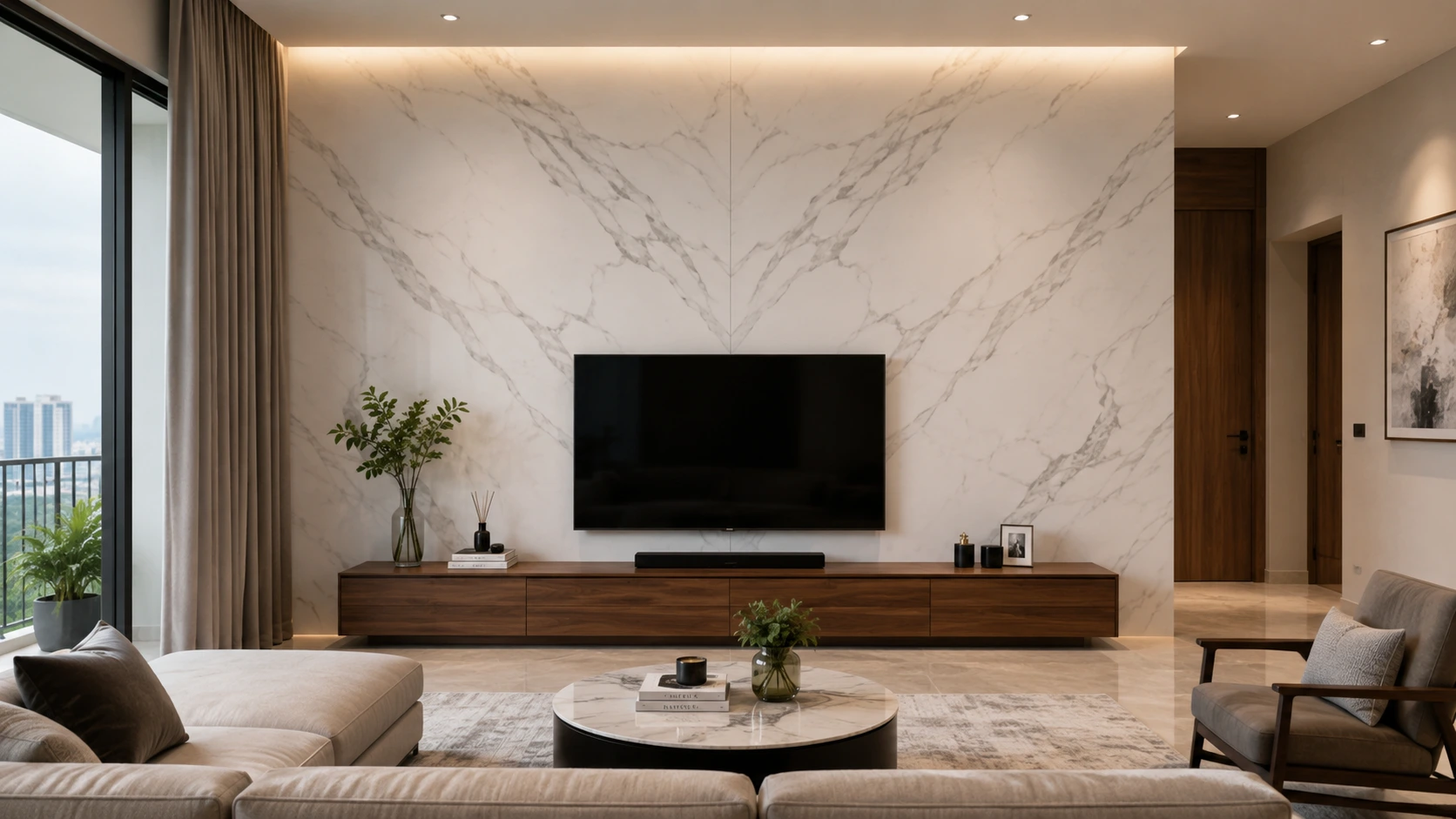
Book matching takes two adjacent slab panels and mirrors them along a shared edge, so the veining on both sides forms a symmetrical pattern — like opening a book and seeing the same image on both pages. When applied to a feature wall in a living room or master bathroom, the effect is remarkable. It looks as though the entire wall was carved from a single piece of stone.
Linear matching runs the pattern across multiple panels in one continuous direction, so the veining flows from left to right — or top to bottom — without interruption, even across panel joints.
Neither technique is achievable with standard porcelain tiles, where each piece contains its own isolated, self-contained pattern. If visual drama and continuity are priorities — and for most Malaysian homeowners investing in a feature wall, they genuinely are — slabs are the clear winner.
To understand more about how pattern matching works across large stone surfaces, our guide on choosing linear match porcelain slab for home flooring covers the technique in detail. The same principles apply equally to walls.
4. Grout Lines — The Maintenance and Hygiene Factor
This is where opinions get strongest — and in Malaysia's climate, the difference is particularly significant.
Porcelain tiles require grout between every piece. On a typical kitchen backsplash, that means dozens of grout joints criss-crossing the wall. On a bathroom wall, even more. Porcelain slabs, installed with minimal or near-invisible joints, give you a seamless surface.
In Malaysia's humid climate, grout lines are a real maintenance concern — particularly in the two most common wall cladding locations: the kitchen backsplash and the bathroom.
Kitchen backsplash: Malaysian cooking is intense by any measure. Wok hei, high-heat stir-frying, curries, and sambal all produce oil and steam that settle on every nearby surface — including the wall behind your hob. On a tiled backsplash, that oil and residue collects in the grout lines. Over time, grout discolours, becomes difficult to clean, and can harbour bacteria. Even with diligent daily cleaning, grout lines in a Malaysian wet kitchen darken noticeably within a few years of use.
A porcelain slab backsplash eliminates this problem almost entirely. With virtually no joints, the surface wipes clean in seconds. There is no grout to discolour, no crevices for oil to accumulate, and no long-term maintenance headache.
If you are planning a renovation and thinking through your backsplash options, our guide on whether you actually need a kitchen backsplash provides useful context on the practicalities of this decision for Malaysian homes.
Bathroom walls: Grout in wet shower areas is a persistent problem in Malaysia's humid tropical climate. Mould and mildew build up in grout lines — particularly in bathrooms without adequate ventilation, which describes the majority of apartments and condominiums across Kuala Lumpur, Petaling Jaya, and Penang. Getting grout genuinely clean requires specific products and effort, and even then the results are temporary.
Porcelain slab wall panels, properly installed with minimal joints and appropriate silicone sealant at junctions, are far more resistant to this issue. The near-zero porosity of the slab surface means moisture has nowhere to penetrate — and mould has nothing to grow on.
5. Who Supplies and Installs Them
This is where the two materials diverge most sharply in Malaysia — not just in price, but in the entire renovation experience.
Porcelain tiles go through the jubin shop channel. You visit the shop, select your tiles, agree on a price, and your tiler handles the rest. It's a familiar, straightforward process that most renovation contractors in Malaysia manage routinely. Their smaller size means they can be cut on-site with standard tools and adjusted easily to fit irregular spaces.
Porcelain slabs go through stone fabricators. You visit the fabricator's yard or showroom, view the actual slab material, the fabricator takes measurements (templating), cuts the panels to size in their workshop, and sends a specialist installation team. It's the same process as ordering a kitchen countertop — because the fabricator is using the same machines and the same crew.
A full-size panel measuring 1,600mm × 3,200mm and 9mm to 12mm thick can weigh between 80 and 120 kilograms. Handling this safely on a vertical surface requires suction cup lifts, specialised adhesive systems, and an experienced installation team. The substrate must also be prepared correctly — a weak, uneven, or insufficiently bonded wall surface will not hold a large slab securely over time.
This distinction matters for your renovation timeline. Tiles can be installed as soon as your tiler is available. Slabs follow a fabrication lead time — typically one to three weeks from templating to installation, depending on the fabricator's schedule and material availability.
This is especially relevant in high-rise properties. Condominium management committees often have specific requirements around fixings and adhesive systems used on internal wall surfaces. In some older buildings, the structural capacity of internal walls may need to be assessed before heavy slab panels are installed at height.
6. Cost — What to Expect
Tiles are generally more affordable — both in material and installation labour. Jubin shops sell at competitive retail pricing, and tiler rates for standard tile work are well-established across Malaysia.
Slabs carry a price premium on both sides. The material costs more per square metre, and fabricator installation — which includes templating, workshop cutting, and specialist fitting — commands higher rates than standard tile-laying.
That said, the gap isn't always as large as it first appears. When you factor in the cost of professional grout sealing, periodic regrouting over the years, and the ongoing labour of cleaning grout lines in a Malaysian kitchen or bathroom, the long-term cost difference narrows considerably. Unlike tiled walls, which may require re-grouting or individual tile replacement over time, a well-installed slab wall is extremely low maintenance.
A practical approach for homeowners working within a defined budget: allocate slab material for the areas that matter most visually — the living room feature wall or master bathroom — and use quality tiles in secondary spaces where the visual impact and maintenance burden are lower.
7. Repairability
Tiles are modular. If one cracks, a skilled tiler can remove and replace it — though colour and texture matching can still be tricky if your original batch is discontinued.
Slabs are harder to repair. A crack or chip in a large-format panel usually means replacing the entire panel. A cracked slab panel also needs to go back to the fabricator for cutting and reinstallation — a more involved process with a longer lead time. Because slabs are often cut to fit a specific space, sourcing the same material in the same format later isn't always straightforward.
This doesn't make slabs the wrong choice — it just means the initial installation quality matters far more.
8. Long-Term Durability on Walls
Both porcelain tiles and porcelain slabs are inherently durable materials. The core properties of porcelain — hardness, non-porosity, and stain resistance — apply to both formats.
The durability difference on walls comes down to joint integrity over time. On a tiled wall, grout joints are the weak point. They can crack, shrink, discolour, or harbour mould — particularly in spaces subject to vibration or humidity swings. Repairing cracked or discoloured grout in an installed tiled wall is possible, but it is fiddly, time-consuming, and rarely looks as good as the original.
On a slab wall, fewer joints mean fewer failure points. The silicone sealant used at panel edges is flexible — it accommodates minor building movement and thermal expansion without cracking, in a way that rigid grout often cannot.
In Malaysia's climate, where humidity levels fluctuate constantly and vibration from nearby construction is a reality in most urban neighbourhoods, fewer joints is a meaningful practical advantage.
Which One Should You Choose?
Go to a Jubin Shop for Tiles If:
- Your budget is tighter — tiles deliver a clean, attractive finish at a lower upfront cost
- You want design variety — geometric patterns, mixed colours, mosaic layouts, and decorative trims are tile territory
- You're doing a straightforward renovation — any competent general tiler in Malaysia can handle the installation
- You're covering a smaller or secondary area — inside a shower niche, a modest backsplash, a guest toilet, or a utility room where the wall is not a focal point
Go to a Stone Fabricator for Slabs If:
- You want a seamless, unbroken look — particularly for living room feature walls and bathroom statement panels
- You're investing in a high-use kitchen — fewer grout lines means a surface that's genuinely easier to clean over years of Malaysian wok cooking
- You want continuous stone patterning — book-match or linear-match vein designs only work at slab scale
- You're already working with a fabricator on your countertop — combining countertop and wall cladding in one order is common, and the same material can often run from surface to wall for a unified look
- Full-height bathroom walls — especially in master bathrooms where a spa-like atmosphere is the goal
Not sure whether your planned kitchen backsplash even needs cladding, or whether you could skip it entirely? This guide to kitchen backsplashes covers when it's worth it and when it's not.
In Malaysia, porcelain slabs are commonly used for stone wall cladding on feature walls, bathroom panels, and kitchen backsplashes in higher-end renovations. For a full overview of the decision framework for stone wall applications, that guide covers the full picture.
A Note on "Porcelain Slab" vs "Sintered Stone" for Wall Cladding
One point of confusion that comes up often: some products marketed for wall cladding are sintered stone, not porcelain slab — even though they look similar and come in similar large formats.
Porcelain slab and sintered stone are made differently, have different performance characteristics, and carry different pricing. If a supplier quotes you a wall panel and you're not sure what it actually is, ask specifically. The distinction matters, particularly for outdoor or high-heat applications.
For a breakdown of how they compare, see The Difference Between Sintered Stone and Porcelain Slab.
One More Thing: Thickness Matters for Wall Slabs
Not all porcelain slabs are suitable for wall cladding. Some are specifically made for flooring — they're thicker and heavier than necessary for a wall, and the adhesive load becomes a concern.
For wall applications, 6mm panels are common in lighter-weight cladding systems. For countertop applications, 12mm or thicker is typically required. The wrong thickness on a wall can mean excessive weight on the adhesive, or panels that feel hollow and fragile.
If you're using porcelain slabs for a countertop alongside your wall cladding, note that the same material in the right thickness works for both — but they're not always interchangeable off the shelf. This post on porcelain slab countertops explains the thickness requirements in more detail.
What to Check Before You Decide
If you are currently weighing up porcelain slab versus tiles for a wall cladding project, these are the questions worth working through with your renovation contractor before any material is ordered:
What is the condition of the wall substrate? Slab installation requires a flat, sound, well-prepared surface. Skipping proper substrate preparation causes serious problems later.
What adhesive system will be used for large panels? Large-format slab panels require a high-grip, flexible adhesive system rated for the panel weight and the application surface. This is not the same adhesive used for standard tiles.
Does the contractor have documented experience installing large-format slab panels on walls? Ask to see photos of previous wall cladding projects, not just countertop or floor work.
What thickness of slab is being recommended? For wall cladding, 6mm to 9mm slabs are most common. Thinner panels are lighter and easier to handle; thicker panels carry more weight but are more forgiving of minor irregularities in installation.
How will the panel joints be treated? Slab wall panels are typically joined with silicone sealant rather than grout. The colour and width of this joint line will be visible — it affects the final look and should be discussed and agreed upon before installation begins.
Conclusion
Porcelain tiles and porcelain slabs are not competing products in the same shop — they come from entirely different parts of the renovation industry. Tiles are a jubin shop product installed by general tilers. Slabs are a fabricator product handled by specialists with the same equipment used to cut countertops.
Understanding which channel you're entering is just as important as understanding the material itself. The look, the process, the timeline, and the long-term maintenance are all shaped by that single fork in the road.
Tiles are practical, affordable, and widely available — the right choice for secondary areas, budget-sensitive projects, and spaces where the wall is not the centrepiece of the design.
Slabs deliver impact: seamless surfaces, pattern continuity across panels, no grout lines to maintain, and a finish that genuinely transforms a space. For feature walls, master bathrooms, and kitchen backsplashes in Malaysian homes — where cooking intensity and year-round humidity demand easy-clean surfaces — the slab format is almost always worth the additional investment.
If you're renovating a kitchen or bathroom and you're already speaking to a stone fabricator about your countertop, it's worth asking about wall cladding in the same conversation. Running the same slab material from the countertop up the wall is one of the most effective ways to create a cohesive, high-end finish — and it's a scope that fabricators handle routinely.
If you'd like to explore specific porcelain slab options for your wall cladding project, the team at Sinno Stone is happy to guide you through the available materials and finishes — and help you find the right fit for your space and budget.