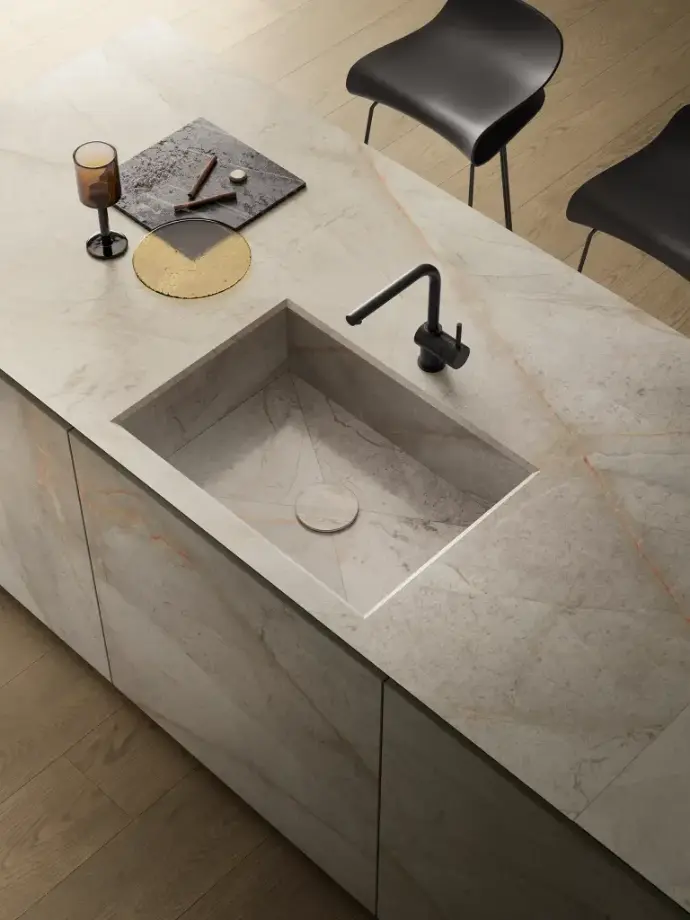
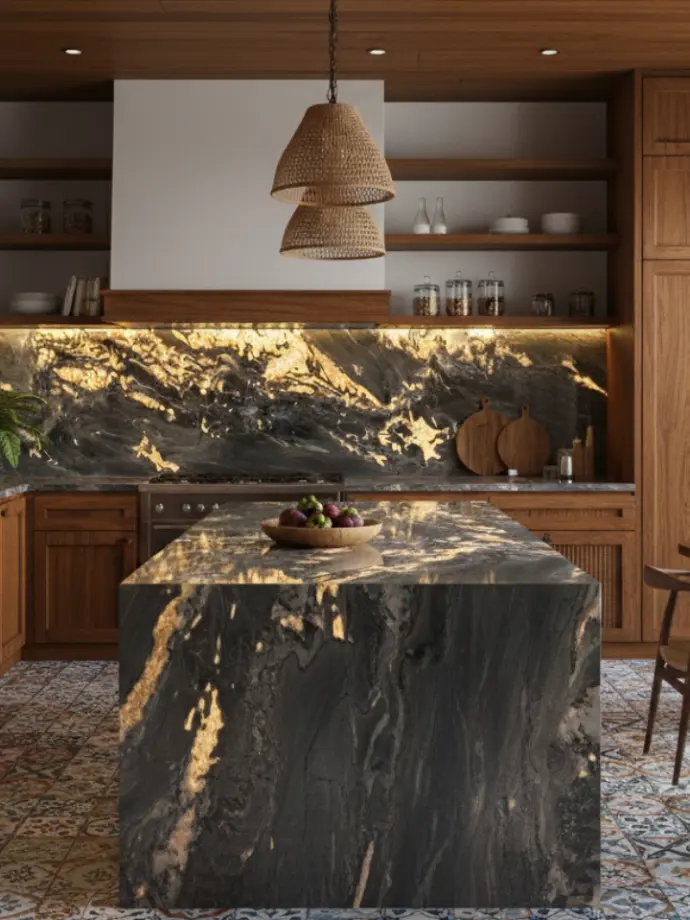
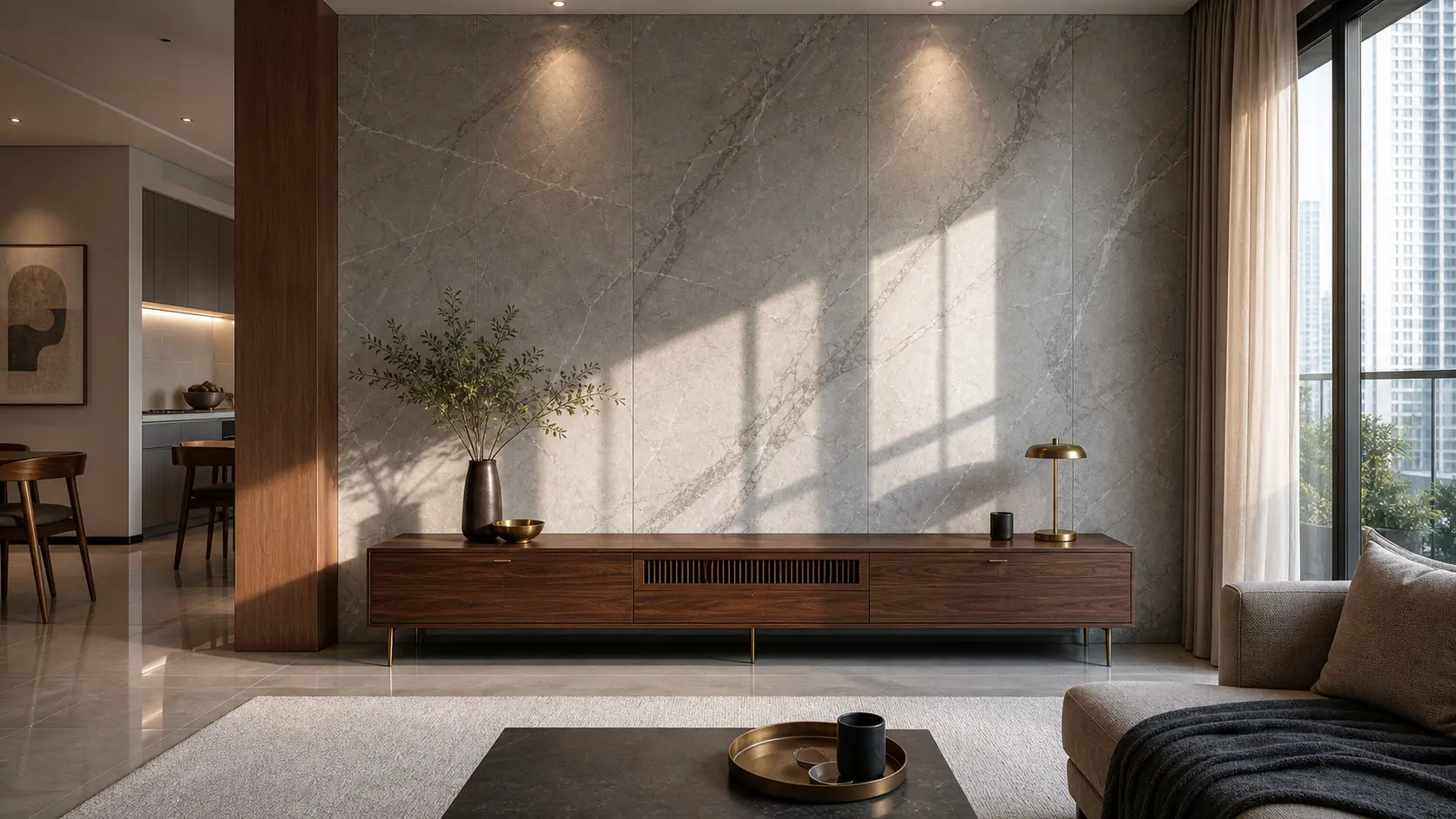
Scroll through any Malaysian renovation page and you'll see the same wall over and over — a dramatic slab of marble-look stone rising behind a TV console, its veining catching the light just so. It looks expensive. It usually is. So before you commit a five-figure sum to a single wall, it's worth asking the question honestly: is a sintered stone feature wall actually worth the money, or is it a trend you're paying a premium to follow?
The answer depends on what you're comparing it against, how long you plan to stay in the home, and which brand and finish you choose. This guide walks through real Malaysian pricing, what that price actually buys you, and where the investment pays off — and where it doesn't.
What Makes a Sintered Stone Feature Wall Different
Sintered stone is made by compressing natural mineral powders under extreme heat and pressure, replicating — and accelerating — the geological process that forms natural stone. The result is a dense, non-porous slab available in jumbo formats, which matters enormously for wall applications: fewer joints mean a cleaner, more continuous visual across a large surface.
If you're new to the material altogether, our guide on the science behind sintered stone explains how it's manufactured and why that process gives it properties that paint, wallpaper, and even natural stone struggle to match. For a broader look at wall cladding as a category — including porcelain slab and compressed marble alternatives — see our guide on what stone wall cladding is.
The Real Cost of a Sintered Stone Feature Wall in Malaysia
This is where most homeowners get surprised — in both directions. Unlike countertops, which are usually quoted as a single supply-and-install rate per square foot, feature walls are priced differently: you pay for the slab itself, then fabrication, then installation, as three separate line items. Understanding each one is the key to understanding the final figure on your quote.
Moca Compact: The Accessible Entry Point
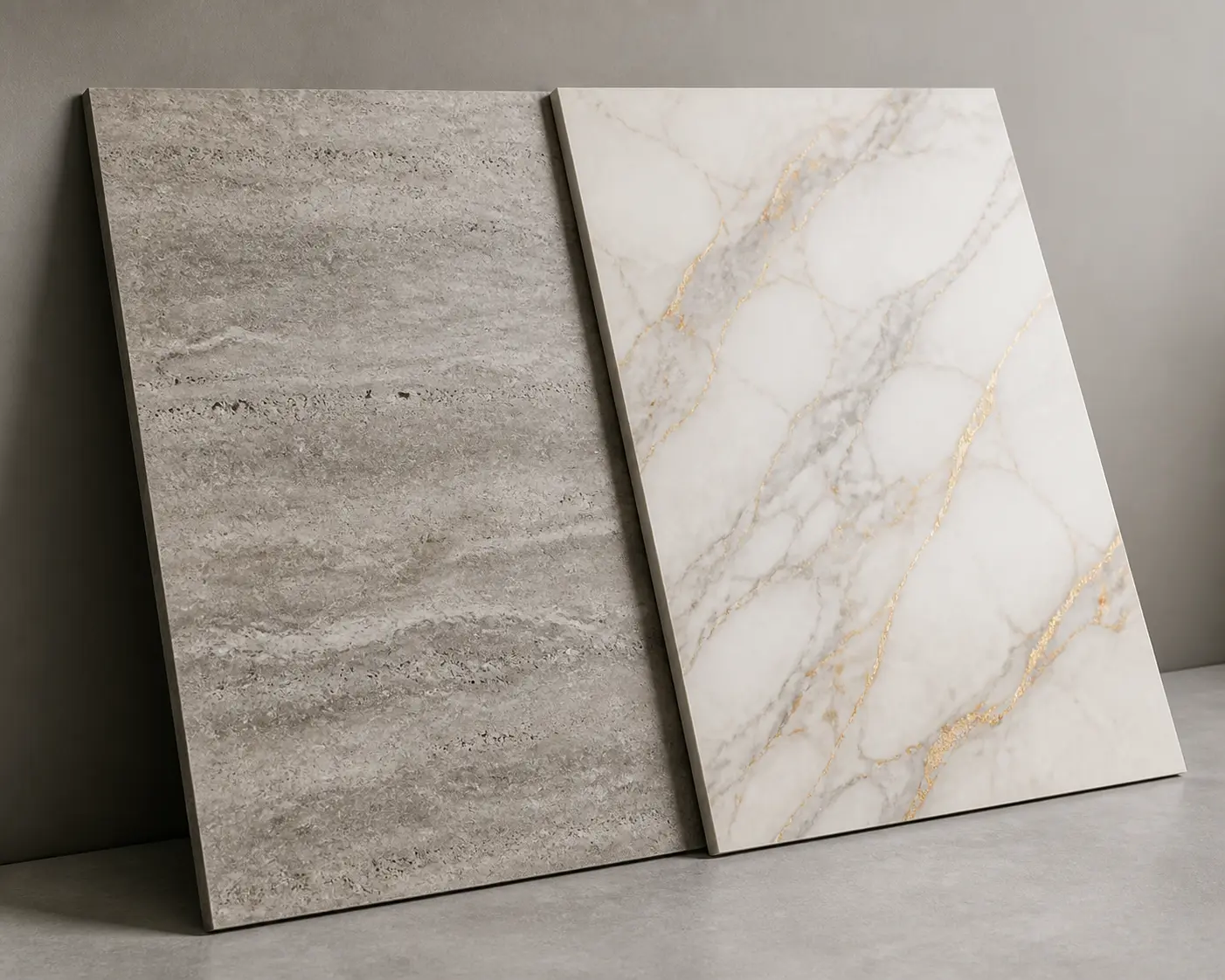
Moca Compact is Sinno's own house brand of sintered stone, sourced from China and offered at a more accessible price point than European imports. Slabs start from RM1,400 to RM2,000 each, depending on the range you choose — Regular, Leather, Jumbo, or Homogeneous.
Dekton: The Premium Import
Dekton, manufactured by Cosentino in Spain, is priced by design group. Slabs run from RM3,000 to RM9,600 each, spanning Groups 1 through 5 — the higher groups covering the brand's most sought-after marble-look and bookmatched patterns.
Fabrication and Installation
On top of the slab cost, every feature wall carries two further charges, both calculated per square foot of wall area:
- Fabrication: RM20 per square foot
- Installation: RM30 per square foot
These cover cutting the slab to size, finishing the edges, and fixing the panels to the wall.
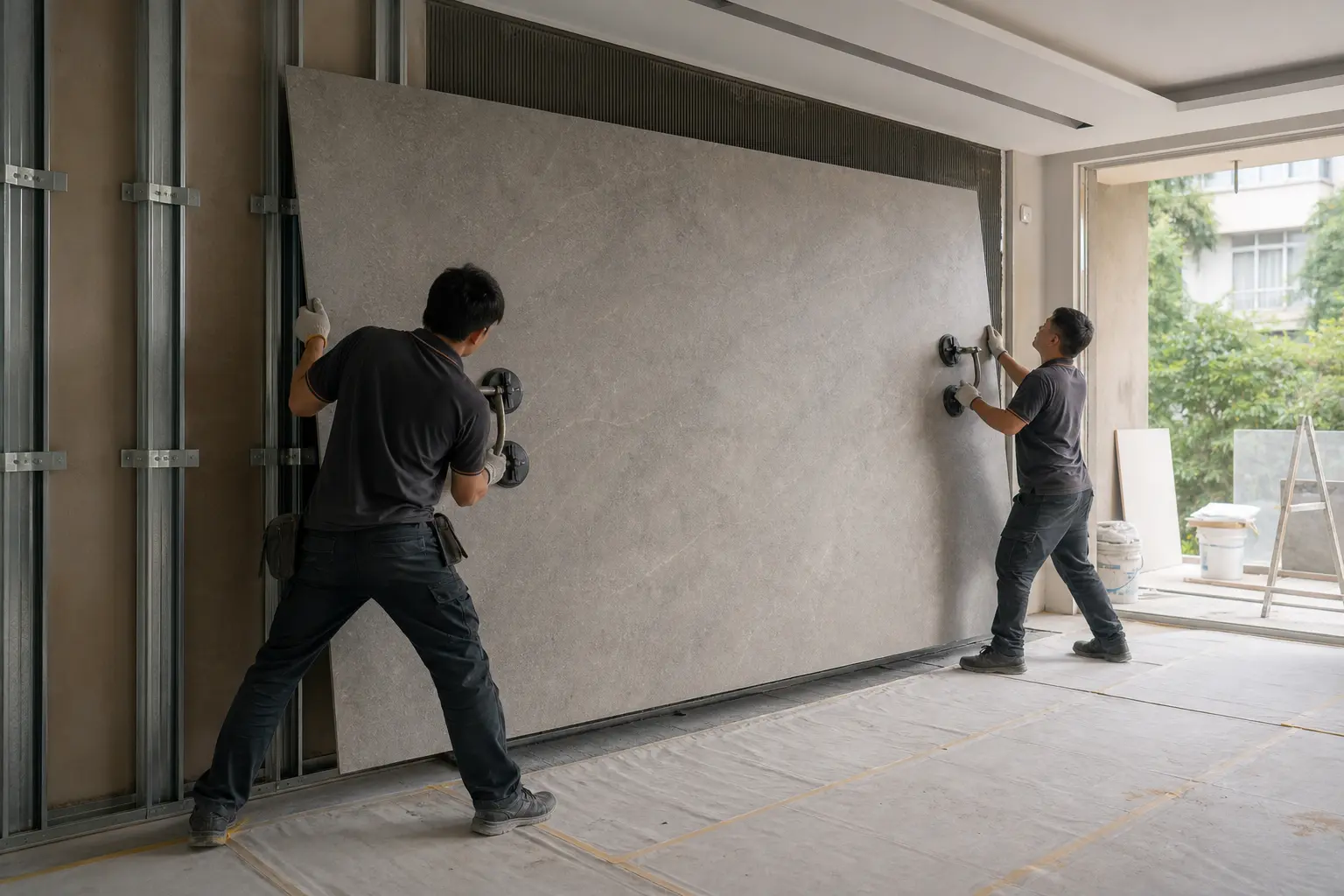
The installation method itself matters more than most homeowners expect, and it's worth discussing openly with your supplier. Sintered stone contains no resin, so despite its hardness, it isn't naturally impact resistant — a hard enough knock can still crack the slab. Dry-fix methods, such as a point cladding system, leave the back of the slab hollow and unsupported, which makes it more prone to cracking under impact. Fully bonding the slab to the wall with cement adhesive gives it continuous support across its entire surface, significantly reducing the chance of a crack — but it costs more, and it requires the underlying wall to be flattened first if it isn't already even. Ask your installer which method is being quoted, since it changes both the price and the wall's real-world durability.
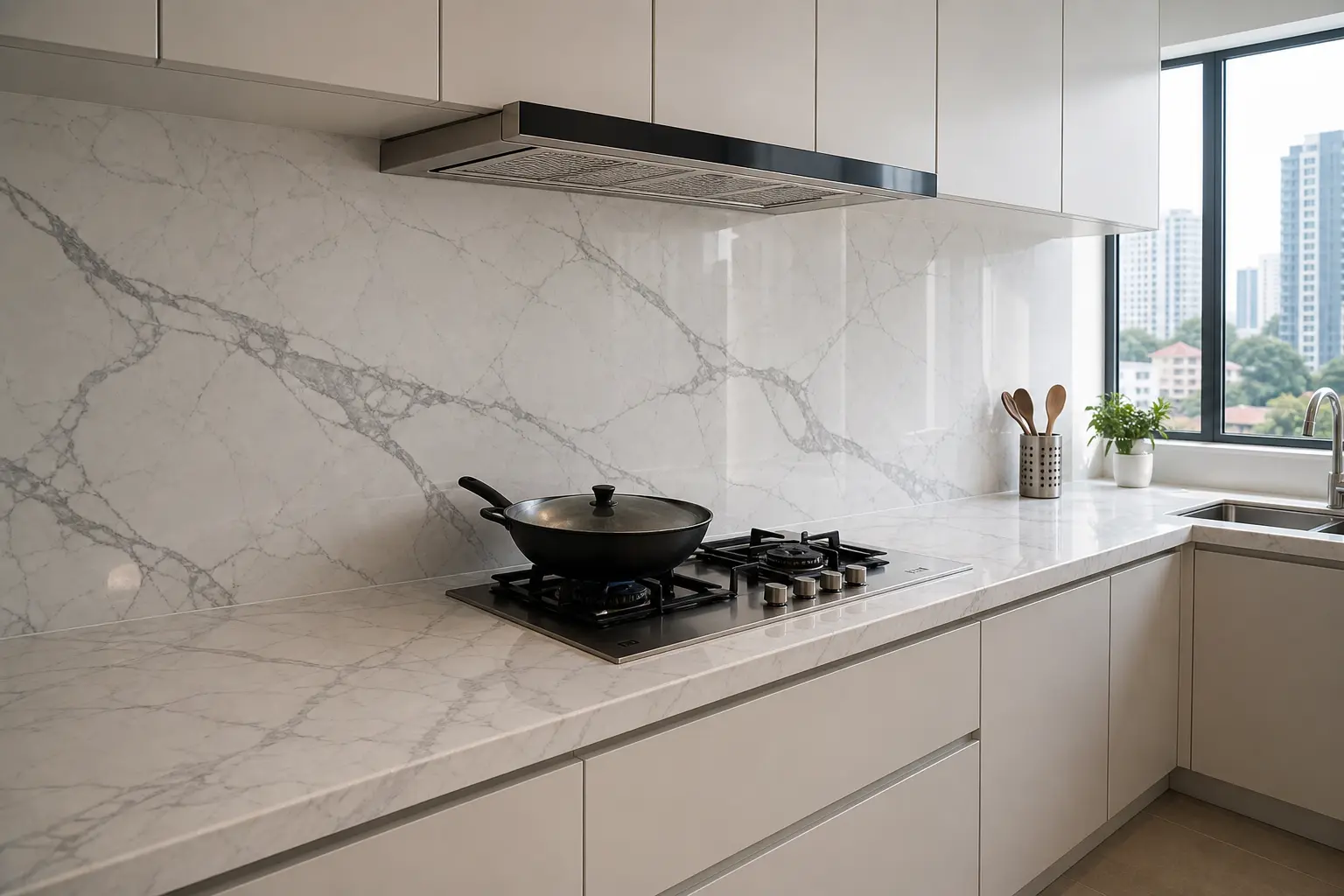
Kitchen backsplashes matched to the countertop. When the wall material matches the countertop, the veining can run continuously from bench to backsplash. It's one of the more convincing ways to make a kitchen look considerably more expensive than it cost — provided the countertop was already sintered stone, since you're not paying for an entirely new material category.
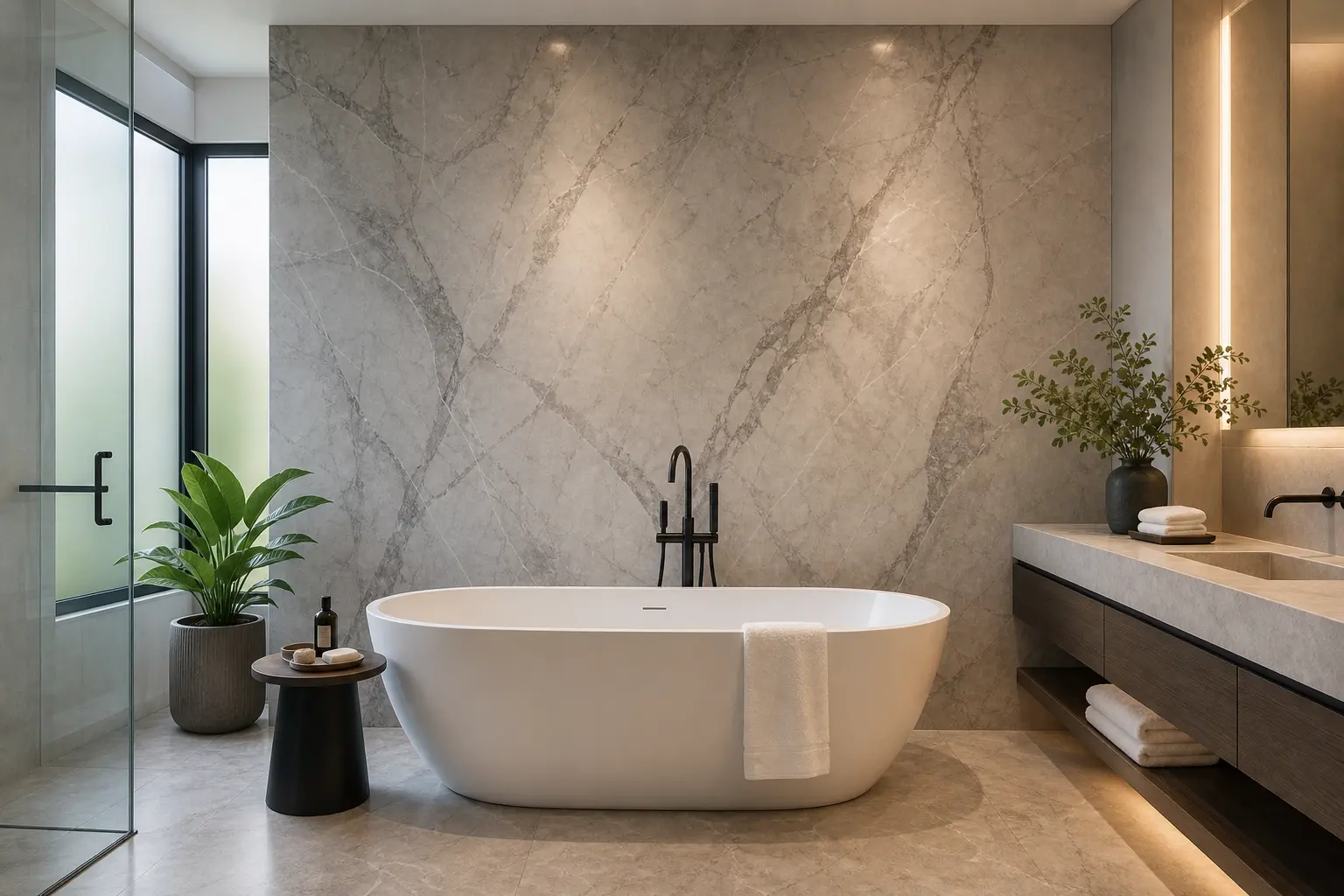
High-humidity zones. Bathroom walls and any surface regularly exposed to moisture get the most functional value out of sintered stone's non-porosity, on top of the visual upgrade.
What This Looks Like on an Actual Wall
Most Malaysian living room feature walls — the kind that runs behind a TV console or frames a seating area — measure somewhere around 100 square feet. A wall this size typically needs around two slabs, allowing for cutting and wastage. Using that as a reference point:
- Moca Compact: 2 slabs (RM1,400–2,000 each) = RM2,800–4,000, plus fabrication (100 sqft x RM20 = RM2,000) and installation (100 sqft x RM30 = RM3,000) → roughly RM7,800 to RM9,000 in total
- Dekton: 2 slabs (RM3,000–9,600 each) = RM6,000–19,200, plus the same fabrication and installation → roughly RM11,000 to RM24,200 in total
That's a wide range even within a single brand, since the slab price is driven almost entirely by design group.
A note on these figures: all pricing above is for 12mm sintered stone only, and is for reference purposes. Your actual quote will depend on factors including stone thickness, wall height, installation difficulty, site location, and site access — for example, whether the building has a service lift or slabs need to be carried up manually. Always confirm final pricing with a stone specialist who has assessed your specific wall.
What You're Actually Paying For
A five-figure wall is a hard sell if all it does is look nice. Here's what the price is actually buying beyond aesthetics.
Zero porosity. Sintered stone doesn't absorb moisture, which matters more in Malaysia than almost anywhere else. A feature wall in a humid living room, or a full-height bathroom wall, won't develop the damp patches or mould lines that plague painted plaster over time.
UV stability. Unlike paint, which chalks and fades under direct sunlight, sintered stone holds its colour indefinitely — a genuine advantage for west-facing walls that catch the harsh afternoon sun common across Kuala Lumpur, Penang, and Johor Bahru.
Scratch resistance. Sintered stone sits high on the hardness scale, meaning the surface itself shrugs off the everyday marks — furniture shifts, curious kids, the occasional errant vacuum cleaner — that scuff or scratch painted drywall. If you'd like to understand why this matters at a material level, our guide on the Mohs hardness scale breaks down how different materials compare.
Impact resistance depends on how it's installed. This is worth being honest about: sintered stone contains no resin, so a hard, sharp knock can crack the slab regardless of how hard the surface is. How much risk you're actually taking on comes down to the installation method — covered in more detail below.
Zero recurring cost. Once installed, a sintered stone wall needs nothing more than a wipe-down. No repainting, no resealing, no touch-ups.
Feature Wall vs Paint or Wallpaper: Weighing the Long-Term Value
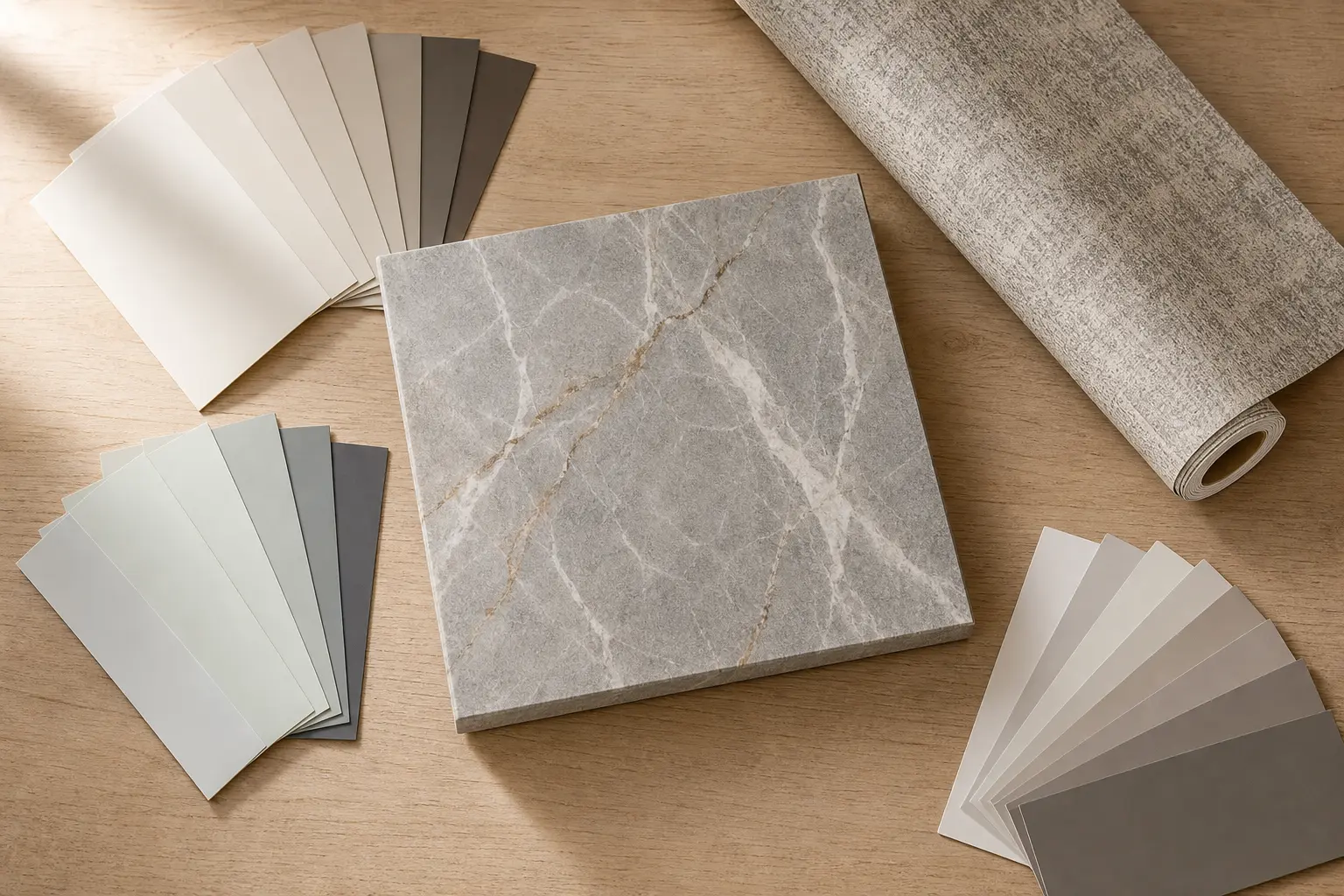
Paint costs a fraction of stone cladding upfront — and for many walls, that's the right call. But it isn't a one-time cost. Malaysia's humidity means painted feature walls typically need repainting well before natural wear alone would demand it, and accent-wall paint jobs with textured finishes or multiple colours cost more to redo each time than a simple wall did to begin with. Wallpaper faces a similar problem: seams lift in humid conditions, and glossy or textured wallpaper designs — the kind used to mimic marble or stone — are rarely cheap to replace once they start peeling at the edges.
Sintered stone flips this equation. The upfront cost is higher, sometimes considerably so, but there's no repeat spend. Over the years you'd otherwise spend repainting or replacing wallpaper, a stone wall simply sits there looking the same as the day it was installed. Whether that trade-off is "worth it" depends on how long you intend to stay in the home — which brings us to the next question.
Where a Sintered Stone Feature Wall Delivers the Best Return
Living room feature walls in a forever home. If you're not moving anytime soon, the maths favours stone. You'll never repaint this wall, and it becomes a permanent design anchor for the room.
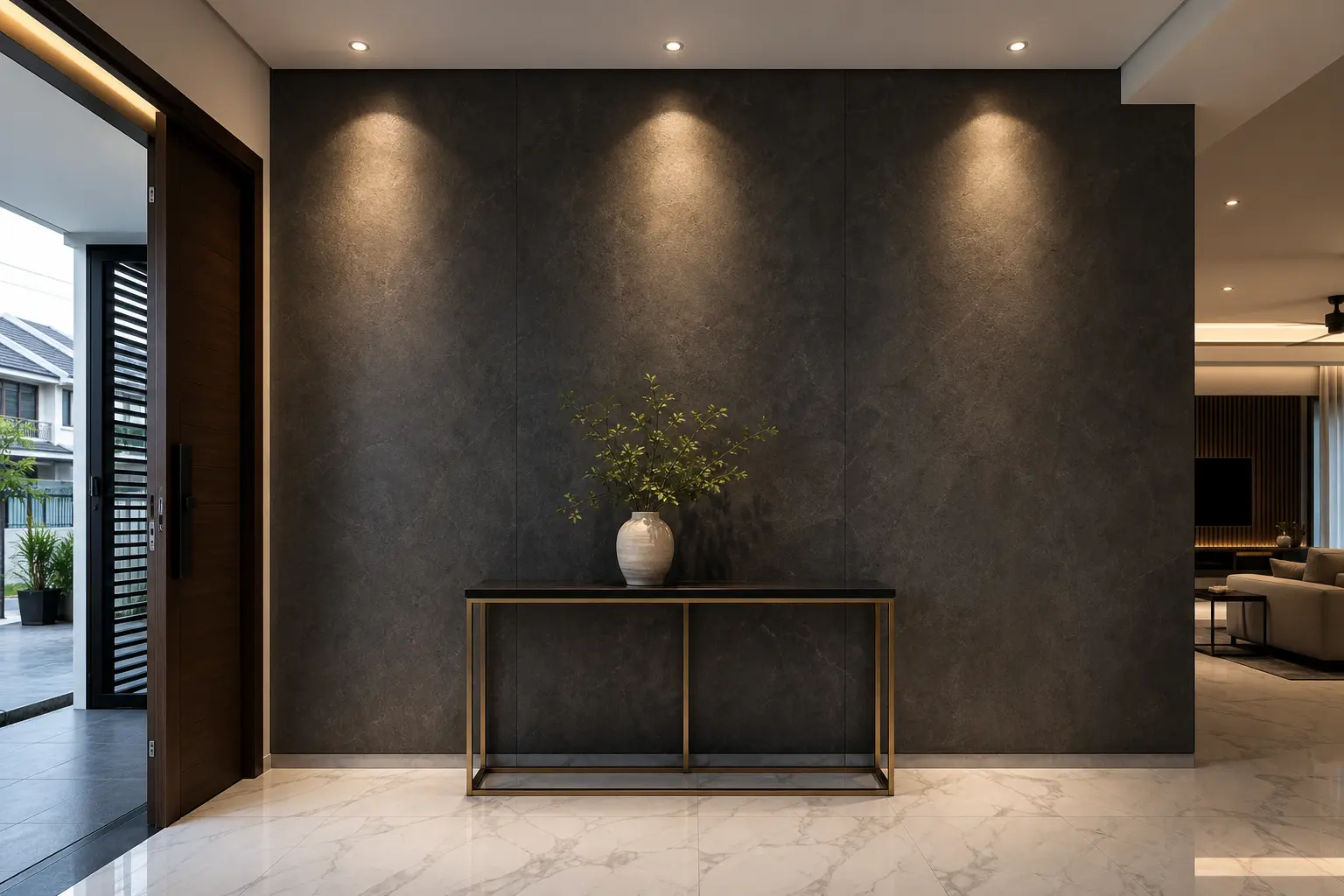
Entrance foyers. This is the first wall guests see. A dramatic, joint-free slab makes a stronger first impression than paint ever could, and foyers are typically compact enough that the total cost stays manageable even with a premium Dekton design.
Kitchen backsplashes matched to the countertop. When the wall material matches the countertop, the veining can run continuously from bench to backsplash. It's one of the more convincing ways to make a kitchen look considerably more expensive than it cost — provided the countertop was already sintered stone, since you're not paying for an entirely new material category.
High-humidity zones. Bathroom walls and any surface regularly exposed to moisture get the most functional value out of sintered stone's non-porosity, on top of the visual upgrade.
When It Might Not Be Worth It
Rented properties. If you don't own the unit, a permanent stone installation isn't something you can take with you, and the return on investment doesn't belong to you either.
Very tight renovation budgets. If a stone feature wall means cutting corners elsewhere in the renovation — a cheaper hob, a lower-grade countertop, skipping proper waterproofing — it's not worth it. A feature wall is a design flourish, not a structural necessity, and the rest of the home should come first.
Small, low-visibility accent areas. Because feature walls are priced per slab rather than purely per square foot, a tiny 10 square foot nook behind a shoe cabinet can end up costing almost as much as a much larger wall — you're still buying a full slab, plus fabrication and installation, even if most of the material ends up as offcuts. In these cases, a less expensive material like porcelain slab can achieve a similar look for meaningfully less. Our comparison of porcelain slab vs tiles for wall cladding is a useful next read if budget is the deciding factor.
Sintered Stone vs Porcelain Slab: A Quick Cost Check
Porcelain slab is the most common alternative homeowners weigh against sintered stone for wall cladding, largely because it can achieve a visually similar large-format, low-joint look at a lower price point. The trade-off tends to come down to long-term durability and design range rather than day-to-day appearance — sintered stone generally offers a wider selection of jumbo formats and bookmatched patterns, particularly at the Dekton end of the market.
If you're also considering extending the same material onto the floor for a continuous look, our guide on sintered stone flooring in Malaysia covers what changes when the material moves from a vertical to a horizontal surface.
So, Is It Worth the Investment?
If you're staying in the home for years, if the wall is in a room you actually spend time in, and if the rest of your renovation budget is already accounted for — yes. A sintered stone feature wall is one of the few renovation choices that looks as good in ten years as it did on installation day, with no repainting, no resealing, and no fading to worry about along the way.
If you're chasing a trend for a property you'll sell or move out of within a year or two, or if the budget would otherwise stretch to cover something more functional, it's harder to justify. The honest answer is that sintered stone rewards patience — it's an investment that pays out slowly, in avoided maintenance rather than an immediate return.
Conclusion
A sintered stone feature wall isn't cheap, and it shouldn't be sold to you as such. What it offers instead is permanence — a wall that doesn't ask anything of you again once it's installed, in a climate that's punishing on almost every other wall finish. Whether that's worth RM7,800 or RM24,200 to you depends on your home, your timeline, and how much you value never thinking about that wall again. Speak to a stone specialist who can walk you through actual slab options and an accurate quote for your specific wall dimensions before you decide.