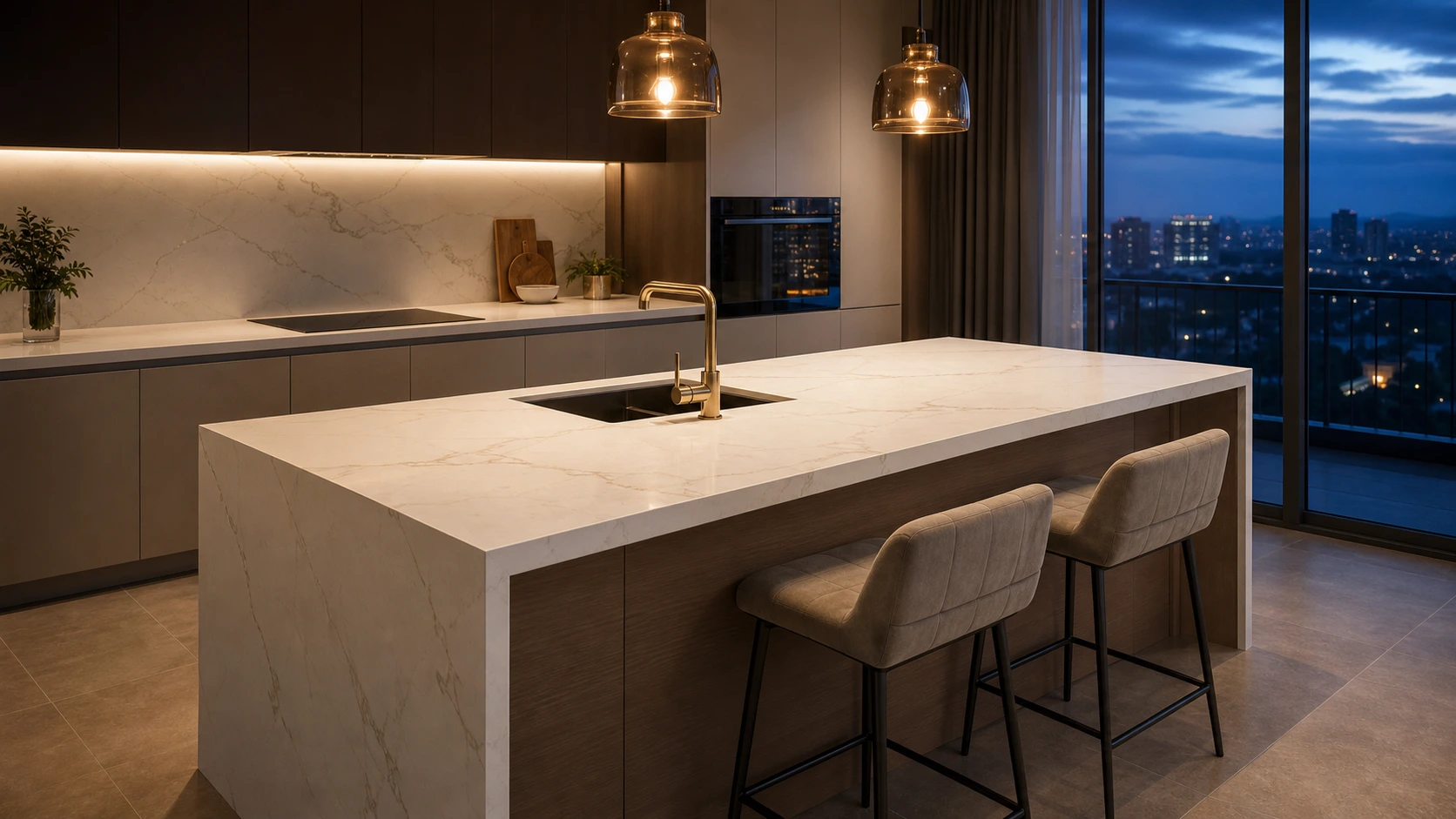
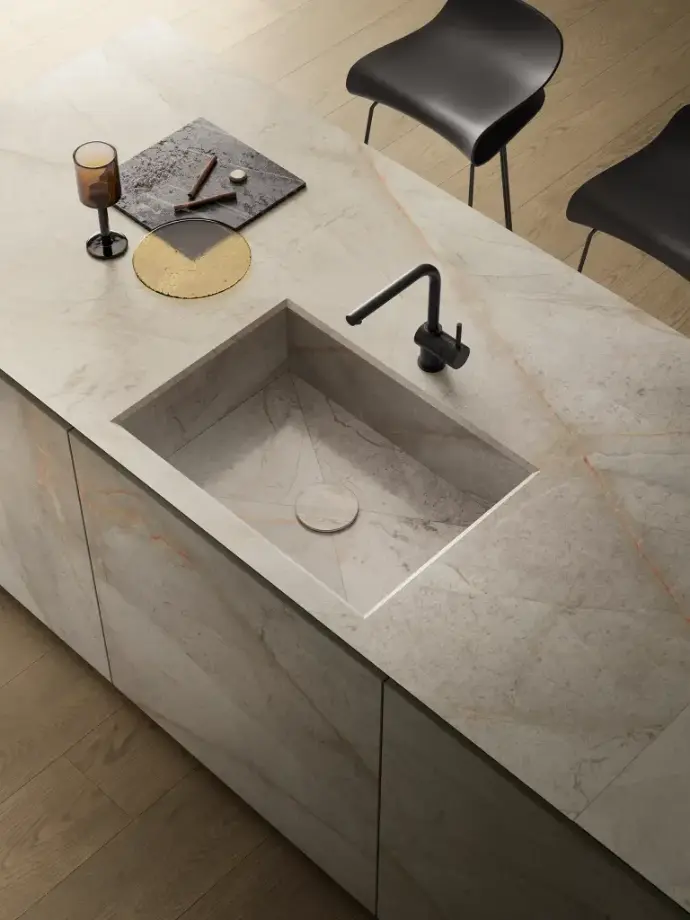
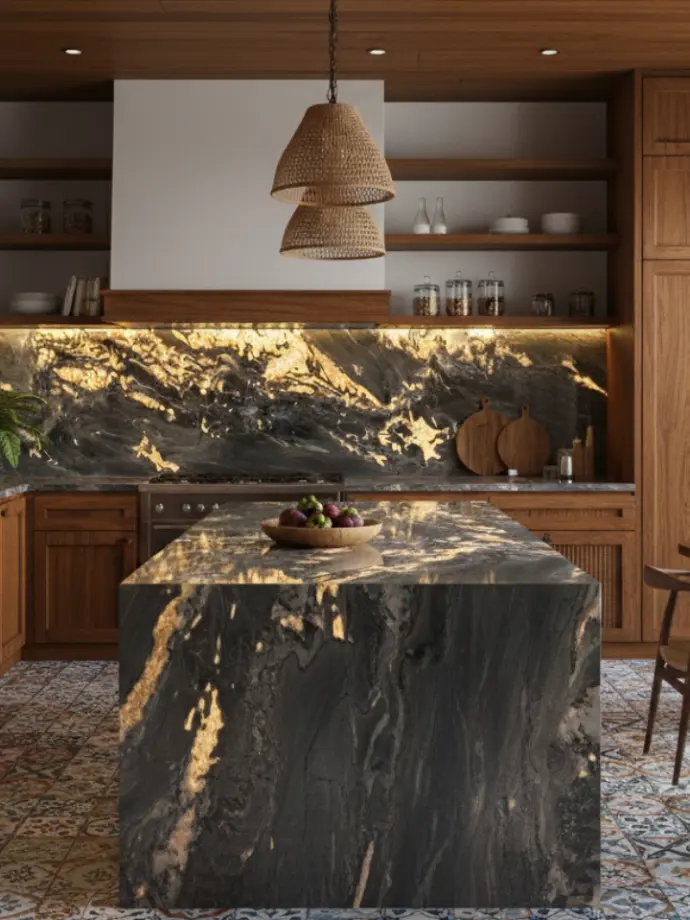
A clear-eyed look at what sintered stone gets right in a Malaysian kitchen, and where it genuinely falls short.
Sintered stone has become the material everyone name-drops when they want a kitchen countertop that can survive a hot wok, a splash of turmeric, and a decade of daily use without babying it. But "everyone's talking about it" isn't the same as "it's right for your kitchen." Sintered stone has real strengths and real limitations, and a supplier who only tells you one side isn't doing you any favours.
This guide lays out both sides plainly, so you can decide whether sintered stone earns its place in your renovation budget.
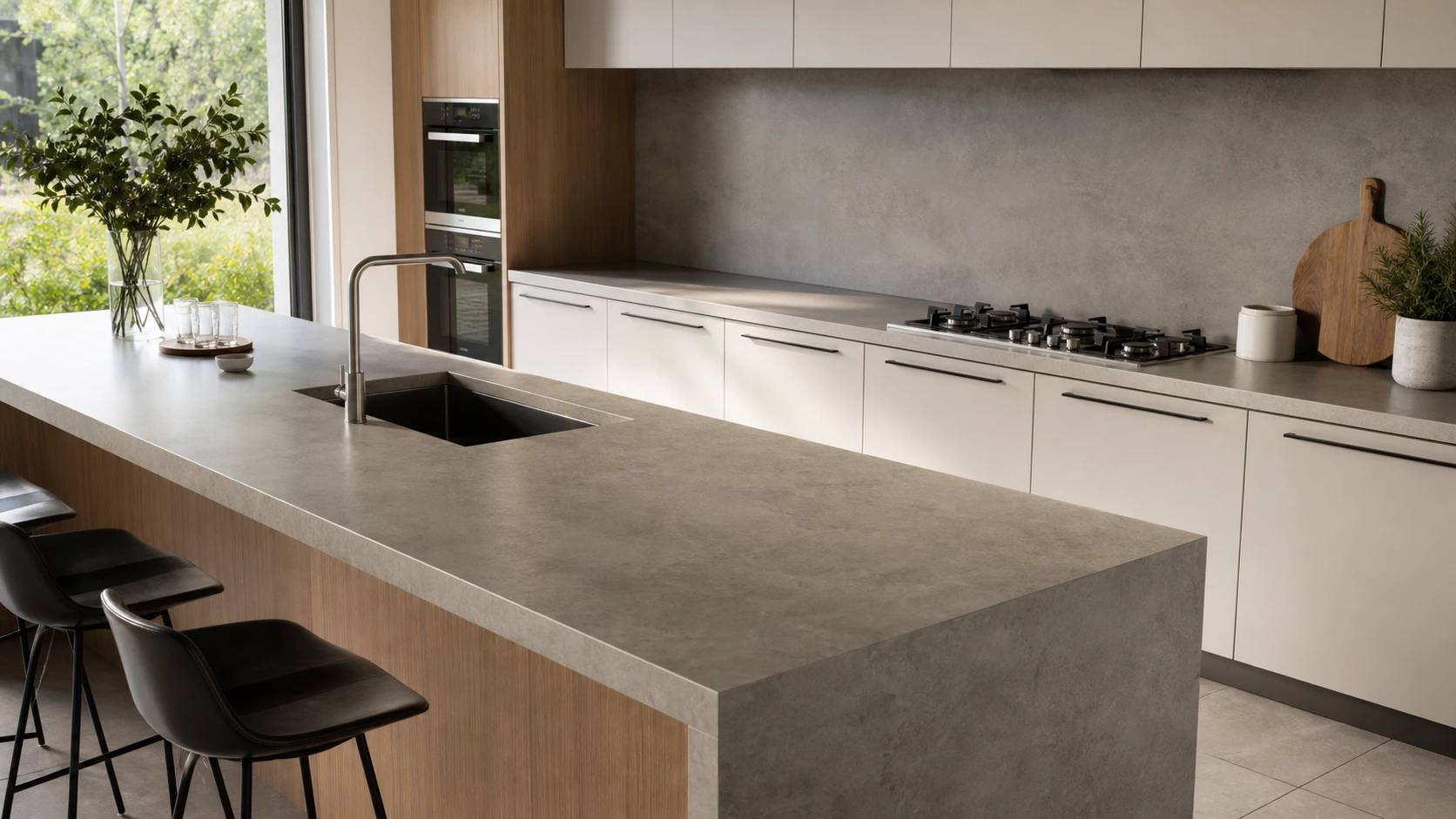
What Is Sintered Stone, Exactly?
Sintered stone is made by compressing natural mineral powders (quartz, feldspar, clay, and mineral oxides) under extreme heat and pressure, replicating in hours what takes stone millions of years to form underground. The result is an extremely dense, non-porous slab with no resin binder — unlike quartz, which is roughly 90% natural quartz held together with polyester resin.
That resin-free composition is the root of almost every pro and con on this list. If you want the full manufacturing breakdown, The Science Behind Sintered Stone covers it in detail. Brands available through Sinno Stone include Dekton (Spain, by Cosentino) and Moca Compact, Sinno Stone's own house brand sourced from China at a more accessible price point.
The Pros of Sintered Stone Kitchen Countertops
Excellent Heat Resistance
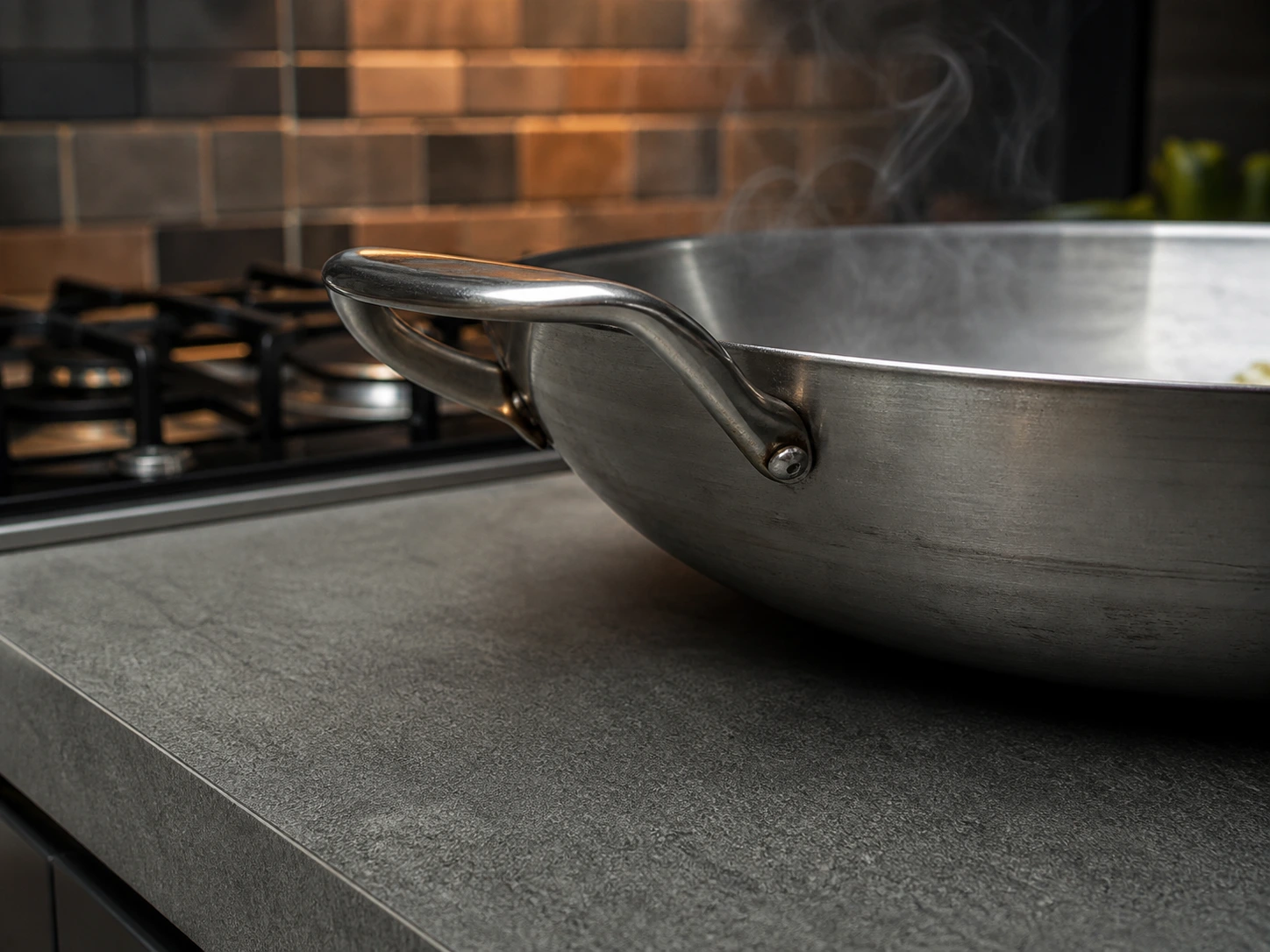
Because sintered stone is fired at temperatures above 1,200°C during manufacturing, it shrugs off heat that would damage other surfaces. A hot wok straight off the stove, a pot fresh from a rolling boil — sintered stone handles it without scorching or discolouring. This matters in a Malaysian kitchen where high-heat wok cooking is standard, not occasional. For the full picture on limits and technique, see Can You Put a Hot Pan on a Sintered Stone Countertop? Heat Resistance Explained.
Strong Scratch and Stain Resistance
Sintered stone sits near the top of the Mohs hardness scale, which translates to genuine scratch resistance during everyday slicing, sliding pots, or a careless knife stroke. It's also non-porous, so turmeric, soy sauce, and belacan don't sink in and stain the way they can on unsealed natural stone.
UV Stability
Unlike quartz, which contains resin that can yellow under prolonged direct sunlight, sintered stone is fully UV-stable. This makes it a strong choice for bright, sun-facing kitchens with large windows, or for outdoor kitchen counters and wet kitchens with skylights — a genuine consideration in Malaysia's intense year-round sun.
Large Slab Sizes Mean Fewer Seams
Sintered stone slabs run large — Dekton slabs measure up to 3200mm x 1400mm, and some Moca Compact formats reach 3200mm x 1800mm. For most Malaysian kitchen layouts, this means an island or a long countertop run can be fabricated with minimal or no visible seams, which matters both for hygiene (fewer joints for grime to collect in) and for a cleaner overall look.
Low Maintenance
No sealing, no polishing, no annual upkeep routine. A damp cloth and mild dish soap handle daily cleaning. That's a genuine time saver for busy households, and it holds up whether the countertop is the wall-run at 600mm depth or a deeper island counter with a breakfast bar.
Virtually Unlimited Colour and Pattern Options
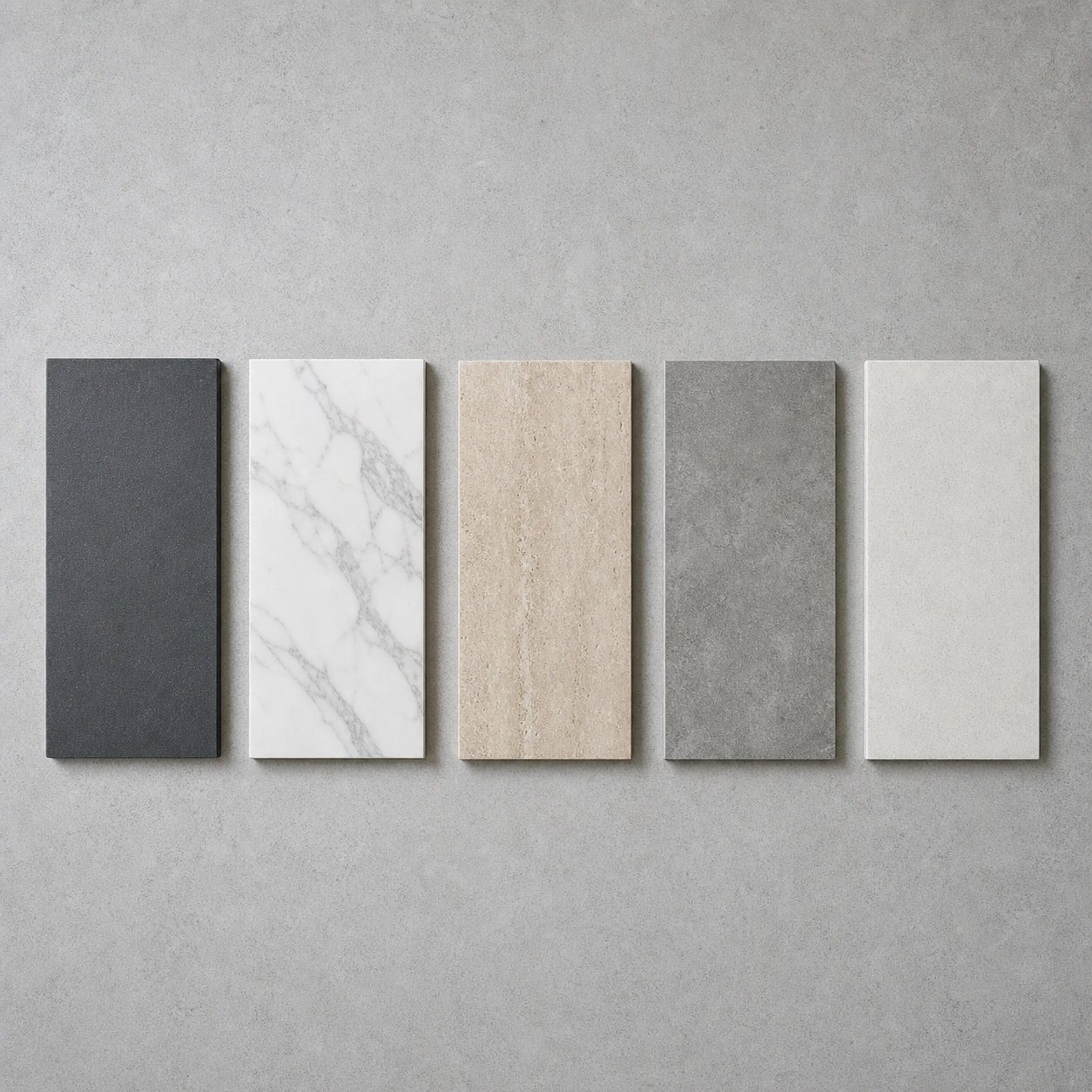
Sintered stone uses digital stone-printing technology, so the range of colours, patterns, and veins isn't constrained the way pigment-mixed materials are. Brands like Dekton and Moca Compact cover everything from marble-look and concrete-look to travertine textures and bold solid colours, often matching or exceeding what quartz offers. The one practical catch is stock — because slabs are imported and popular designs sell through fast, a specific colourway shown in the catalogue isn't always sitting in the warehouse, and lead times can stretch if a slab has to be ordered in.
The Cons of Sintered Stone Kitchen Countertops
It Is Not Impact-Proof
This is the trade-off that comes with having no resin binder: sintered stone gains its scratch resistance from raw hardness, but that same rigidity means it has less give under a sharp, concentrated impact. A dropped cast iron pot on a corner, or a hard knock during transport and installation, can chip or crack the slab — something a resin-backed material like quartz absorbs more forgivingly. Corners and areas near sinks or hobs, where cutouts leave less supporting material, are the most vulnerable points. Full support underneath from a properly levelled cabinet carcass reduces this risk considerably, but it doesn't eliminate it. Don't mistake "scratch resistant" for "indestructible" — see What Are the Disadvantages of Sintered Stone? A Malaysian Homeowner's Honest Guide for more on this.
Sink Choice Is More Restricted, Especially Wide Top-Mount Sinks
This follows directly from the impact risk above. Sintered stone's lack of give means the edge of a sink cutout needs a healthy margin of solid slab around it, and wide top-mount multi-purpose sinks — the popular deep single-basin type sized for washing large pots — are where this bites hardest. As a rule of thumb, if the gap between the sink edge and the backsplash or front edge drops below about 50mm, crack risk climbs sharply. On a standard 600mm-deep countertop, a 530mm-wide sink leaves only 70mm to split across front and back — well under that margin on at least one side. Press down while rinsing a tall glass or lean on the basin edge, and that's exactly where the load concentrates on the thinnest, least-supported strip of slab. If a wide multi-purpose sink is non-negotiable, talk to your fabricator early about depth and layout options before the slab is cut.
"Polished" Sintered Stone Isn't a True Polish
A common misconception, sometimes repeated by exhibitors at home expos, is that "polished" sintered stone is polished the same way granite or marble is. It isn't. What's marketed as a polished finish (Dekton's Group 4, for example) is a gloss coating applied under high heat so it fuses into roughly the top 1mm of the surface, rather than a mechanical polish of the stone itself. That coating can fade with wear over the years, and once it does, faint hairline scratches in the underlying surface start to show through — most noticeable from certain angles where a light source reflects off the countertop, not head-on. In some cases these hairline scratches are already present at installation, simply hidden under the fresh coating. You won't feel them by running a finger across the surface; they only show up visually, usually when you're standing and viewing the counter at an angle rather than looking straight down. If a genuine polished look matters to you, ask your supplier directly whether a finish is a true mechanical polish or a heat-fused gloss coating, and how it's expected to wear.
Fabrication Demands More Skill
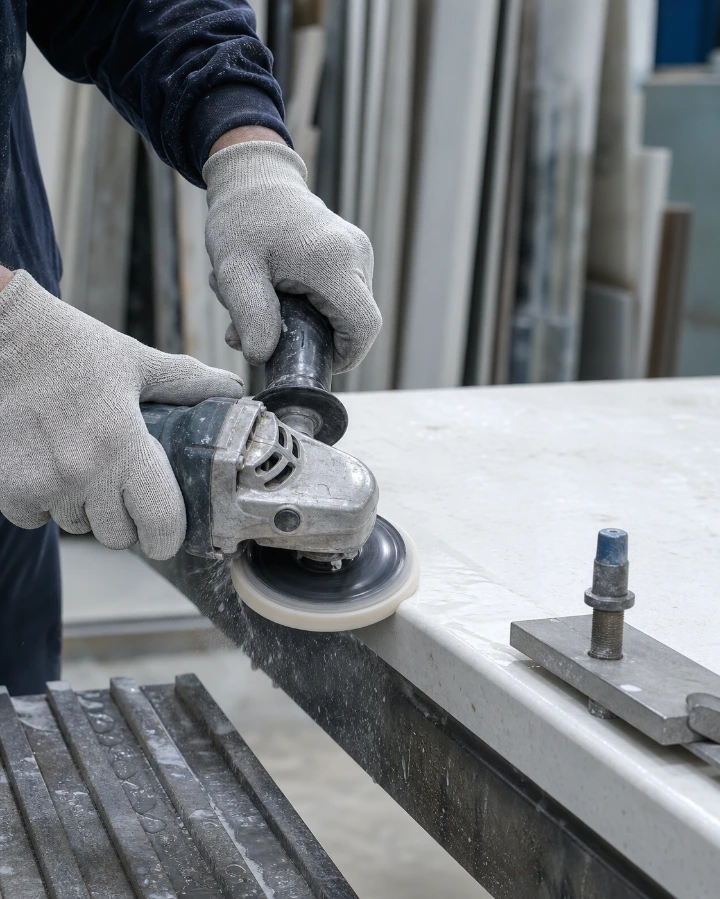
Sintered stone is harder to cut, polish, and edge than quartz or granite. Cutouts for sinks and hobs, mitred edges, and seam joints all require experience and the right equipment — a fabricator learning on the job risks chipped edges or a poor seam match. This is one reason sourcing matters: slabs bought cheaply and handed to a general tiler or carpenter often come back with visible fabrication flaws.
Edge Profile Choices Are More Limited
Because sintered stone is harder and has no resin binder to absorb grinding stress, some of the deeper decorative edge profiles common on quartz or granite — a full bullnose or an ogee curve — generally aren't achievable without a high risk of chipping during fabrication. What works well instead is a pencil edge with a 3mm chamfer, or an eased edge with a 2mm round; both take just enough off the sharp corner to reduce chip risk without demanding an aggressive grind. If you insist on a near-sharp edge with only a 1mm round for a minimalist look, understand that the less rounding there is, the higher the chance of chipping from an ordinary knock — even something as light as a glass sauce bottle catching the edge can chip the stone, while the bottle itself comes away undamaged. For most Malaysian kitchens, a 2–3mm eased or chamfered edge is the practical sweet spot between look and durability.
It Costs More Than Quartz, Brand for Brand
Premium sintered stone (Dekton) typically sits above equivalent-tier quartz on price. Sinno Stone's own house brand, Moca Compact, narrows that gap considerably — see the pricing section below for exact figures. If budget is the deciding factor, this is where the conversation usually lands.
Limited to Slab Applications for DIY Buyers
Because fabrication is more specialised, sintered stone isn't a realistic DIY or general-tiler project the way tiles are. If you're comparing sourcing routes, 3 Ways to Source Your Kitchen Countertop in Malaysia — And Which One to Avoid explains why this matters for sintered stone specifically.
Sintered Stone vs Quartz: The Short Version
Homeowners weighing sintered stone almost always end up comparing it to quartz, since both are engineered, low-maintenance, and widely available in Malaysia. The short version: quartz has slightly better impact tolerance thanks to its resin content, while sintered stone wins on heat resistance, UV stability, and — thanks to digital stone-printing — just as broad a colour and pattern range. Neither is objectively "better" — it depends on your kitchen's sun exposure, cooking style, and budget. The full comparison, including a real cost breakdown, is in Quartz vs Sintered Stone: Don't Make This RM20,000 Mistake in Your Malaysian Kitchen.
How Much Does a Sintered Stone Countertop Cost in Malaysia?
Pricing depends heavily on brand and colour group. Based on Sinno Stone's current 2026 price list, supply and install pricing (per square foot) breaks down as follows:
Dekton (Cosentino, Spain):
- Group 0 colours: RM248/sqft
- Group 1 colours: RM320/sqft
- Group 2 colours: RM351/sqft
- Group 3 colours: RM400/sqft
- Group 4 (polished) colours: RM469/sqft
Moca Compact (Sinno Stone's house brand, sourced from China):
- Regular finishes: RM110/sqft
- Jumbo-format slabs: RM120/sqft
- Leathered finishes: RM130/sqft
- Homogeneous finishes: RM150/sqft
The gap between the two brands is significant — Moca Compact makes sintered stone accessible to a much wider range of budgets, while Dekton sits at the premium end with a wider colour library and established European manufacturing pedigree. For a full breakdown across all materials Sinno Stone carries, see How Much Does a Quality Stone Countertop Cost in Malaysia? (A 2026 Price Guide).
Is Sintered Stone Right for Your Kitchen?
Sintered stone makes the most sense if your kitchen sees serious heat exposure from wok cooking, sits under strong direct sunlight, or you simply want a countertop you never have to think about maintaining. It makes less sense if you need a specific colourway available immediately off the shelf, you're set on a wide top-mount multi-purpose sink that leaves little margin around the cutout, you're expecting a "polished" finish to behave like a true mechanical polish rather than a gloss coating that can wear over time, you want a full bullnose or ogee edge profile, are working with a tight budget and can't stretch to Dekton, or your household is genuinely rough on kitchen surfaces (heavy pots dropped often, corners taking regular knocks).
For a wider view of how sintered stone compares beyond the kitchen, or how it holds up specifically in high-moisture areas, What Is the Best Countertop for a Wet Kitchen in Malaysia? is worth a read before you finalise your decision.
Whatever you land on, get the fabrication done by a team that works with sintered stone regularly — the material rewards good workmanship and punishes bad workmanship more visibly than softer materials do.