You've finally shortlisted a few stone countertop suppliers. You send out requests for quotation, and three quotes come back — each looking completely different from the others. One charges by "foot run", another by "square foot". One has a line item for "cutouts", another doesn't mention it at all. The prices range from RM 1,800 to RM 4,500, and you have no idea why.
This is one of the most common frustrations Malaysian homeowners face when renovating their kitchen. The truth is, countertop quotes are not standardised — and without knowing what to look for, it's very easy to end up comparing apples with oranges.
This guide breaks down every line item you'll encounter in a stone countertop quotation, so you can compare quotes accurately, ask the right questions, and avoid unpleasant surprises when the invoice arrives.

Why Countertop Quotes Look So Different
Before diving into the line items, it helps to understand why quotes vary so much:
- Different pricing units — some fabricators quote by foot run, others by square foot
- Different inclusions — some bundle everything into one price; others itemise every component separately
- Different material tiers — an entry-level Malaysian-made quartz and a premium imported quartz can differ by hundreds of ringgit per square foot
- Different assumptions — a fabricator may assume a standard countertop depth, whilst another may have measured your actual kitchen layout
None of this means one quote is dishonest. It does mean you need to understand what each quote is actually saying before you can compare them properly.
Understanding the Pricing Unit: Foot Run vs Square Foot
The first thing to look at in any countertop quote is the unit of measurement. There are two you'll commonly encounter in Malaysia.
Foot Run (Linear Foot)
Foot run — sometimes called linear foot or running foot — measures length only, not area.
In Malaysia, foot run pricing is commonly used for standard kitchen countertops where the dimensions follow a consistent specification:
- Countertop depth: 600mm (approximately 2 feet)
- Front edging height: 50mm
- Backsplash height: 50mm
Because the depth is standardised, fabricators can factor it into the foot run rate without spelling it out separately. However, this only works when your countertop matches that standard. If your kitchen has a deeper section — such as an island, breakfast bar, or extended peninsula — foot run pricing may no longer apply, or there will be additional charges on top of the quoted rate.
Example: If your kitchen counter runs 10 feet along the wall and you're quoted RM 200 per foot run:
10 feet × RM 200 = RM 2,000
When Foot Run Pricing Applies — and When It Doesn't
Not every countertop automatically qualifies for foot run pricing. At Sinno, we apply foot run rates as long as the countertop depth does not exceed half the width of the standard slab. Slab widths vary by brand and material — you can always check the exact dimensions in the technical specifications on our online catalogue to confirm what applies to your chosen stone.
For most materials, this means foot run pricing applies up to a depth of roughly 600mm to 800mm, depending on the slab. Beyond that threshold, the pricing switches to square foot to accurately reflect the additional material being used.
There is also a rule at the other end of the scale: if your countertop depth is less than 550mm — a narrow breakfast bar ledge, a slim bathroom vanity, or a compact prep counter — we do not use foot run pricing. Instead, we calculate the cost both ways and apply whichever works out lower for you.
Example: Say your counter is 10 feet long, but only 550mm deep.
- Foot run rate: 10 ft × RM 200 = RM 2,000
- Square foot rate: 3,000mm × 550mm = ~18 sq ft × RM 110 = RM 1,980
In this case, we would quote RM 1,980 — the lower of the two calculations. This ensures you are never charged the full standard foot run rate for a counter that uses meaningfully less material than the standard specification.
Square Foot (Per Sq Ft)
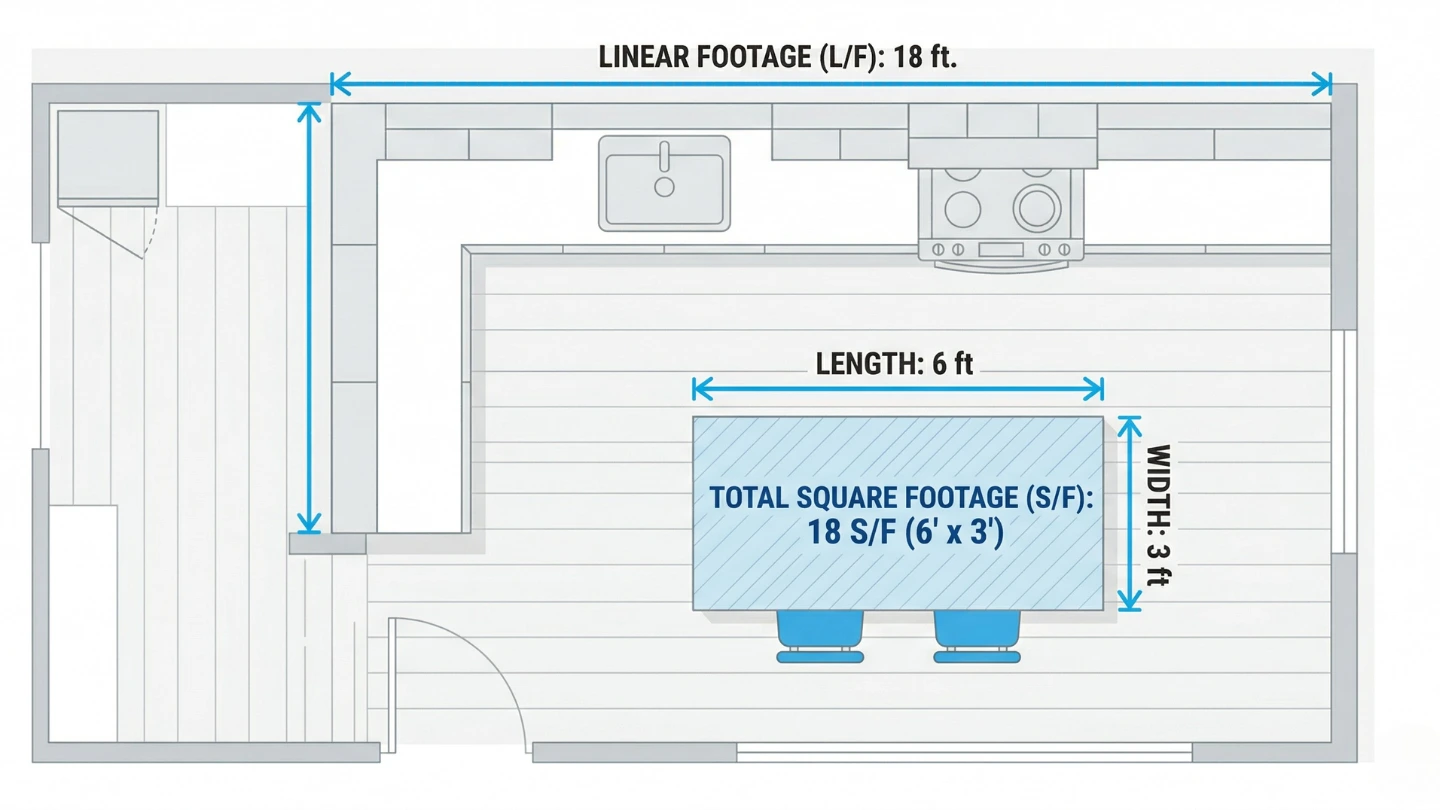
Square foot measures area — length multiplied by width. It is the more precise way to price countertops because it accounts for both dimensions of the surface.
Square foot pricing is typically used when:
- Countertop depth exceeds 700mm (islands, breakfast bars, extended work surfaces)
- The layout is non-standard or irregular (L-shapes, wraparound designs, peninsulas)
- There are multiple depth variations in one project
Example: If your countertop is 10 feet long and 3 feet deep:
10 ft × 3 ft = 30 square feet 30 sq ft × RM 110 = RM 3,300
The Six Line Items Every Countertop Quote Should Have
A transparent countertop quotation should clearly break down the following components. If any of these are missing, ask your fabricator to clarify what is included before you sign anything.
1. Material Cost
This covers the stone itself — the slab that will be cut, shaped, and installed as your countertop. A complete material line item should specify:
- Brand (e.g., Zenstone, Caesarstone, Silestone, Dekton)
- Series or collection (e.g., Classic, Premium, Supernatural)
- Colour name (e.g., Calacatta Gold, Jet Black 3100)
- Thickness (typically 12mm, 20mm, or 30mm)
- Finish (polished, honed, sandblasted, leather, etc.)
To give you a sense of how material prices vary in Malaysia, here are real supply-and-install price ranges (inclusive of fabrication, installation, and delivery to site):
| Brand | Tier | Price Range (per sq ft) |
|---|---|---|
| Zenstone (Malaysia) | Classic | From RM 110 |
| Zenstone (Malaysia) | Premium | From RM 130 |
| Zenstone (Malaysia) | Natural | From RM 155 |
| Caesarstone (USA) | Standard | From RM 327 |
| Caesarstone (USA) | Supernatural | From RM 427 |
| Caesarstone (USA) | Supernatural Premium | From RM 689 |
These are supply-and-install prices — they include the stone material, fabrication, and installation as a package. If a quote shows a material price significantly below these ranges with no clear explanation, ask what has been left out.
For a detailed breakdown of quartz pricing in Malaysia, read our guide on how much quartz stone costs in Malaysia.
2. Fabrication Cost
Fabrication refers to the skilled work done to transform a raw stone slab into a finished countertop. This includes:
- Cutting — sizing the stone to fit your exact kitchen layout
- Mitre cutting and jointing — for seamless corners and clean joints
- Polishing — finishing and smoothing all cut edges
- Edging — treating the front lip of the countertop
In most Malaysian supply-and-install quotations, fabrication is bundled together with the material and installation into a single per-square-foot or per-foot-run rate. However, some fabricators itemise it separately. If a quote shows only a material price with no mention of fabrication, ask directly whether it is included.
To understand what goes into making your countertop from start to finish, see From Slab to Surface: How Your Kitchen Countertop Is Made in Malaysia.
3. Installation Cost
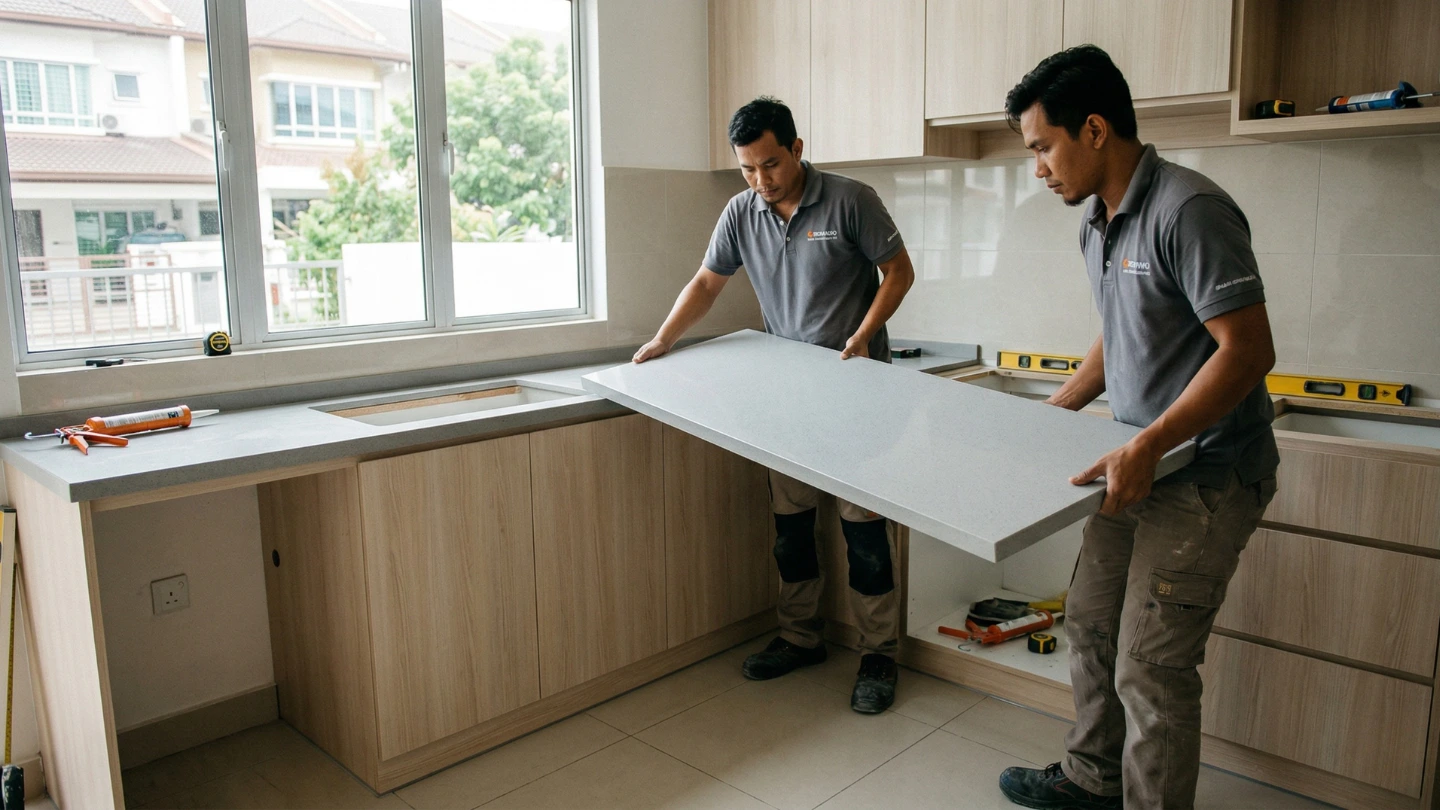
Installation covers everything that happens on-site on the day your countertop is fitted:
- Templating — a site visit to take precise measurements of your cabinet layout before fabrication begins; this ensures the stone is cut to your exact dimensions
- Delivery — transporting the fabricated stone panels from the workshop to your home
- Fitting — physically installing, positioning, siliconing, and securing the countertop onto your cabinets
Like fabrication, installation is often bundled into a single supply-and-install rate. Always confirm whether templating is included, as some fabricators charge for this separately — particularly if the project is outside their usual service area.
4. Transportation
Transportation is sometimes listed as a separate line item and covers the cost of physically moving the stone from the fabricator's workshop to your home. It is typically charged per foot run and varies depending on:
- Distance from the workshop to your site
- Total quantity of stone being transported
- Whether a special vehicle or equipment is required for access (e.g., narrow stairwell, no lift access)
This is one of the most commonly overlooked items in a countertop quotation. Always check whether transportation is included in the quoted rate or billed separately. In some quotes, it appears clearly; in others, it only surfaces on the final invoice.
5. Cutouts
Cutouts are the openings cut into your countertop for built-in appliances and fittings. The most common are:
- Sink cutout (undermount, top mount, or integrated)
- Hob cutout (induction, gas, ceramic, or domino)
- Tap hole (for countertop-mounted taps)
This is one of the most frequently missing items in countertop quotes. Some fabricators include standard cutouts in their base rate; others charge separately for each one. A single sink cutout can range from RM 100 to RM 300, depending on the material and the complexity of the cut. Undermount sinks, for instance, require more precise fabrication than top mount sinks.
Always ask:
- Are sink and hob cutouts included in this price?
- Is there an additional charge for the tap hole?
- Does the charge change for undermount versus top mount sinks?
- What if I need more than one cutout (e.g., a hob and a prep sink)?
6. Edge Profiling
Edge profiling refers to the shape and finish applied to the visible front edge of your countertop — the part you see from the front of your kitchen cabinets. Standard profiles are usually included in the quoted price, but more elaborate options attract additional charges.
| Edge Type | Typically Included? |
|---|---|
| Flat / eased edge | Yes |
| Bevelled edge | Yes |
| Bullnose edge | Yes |
| Ogee edge | Sometimes extra |
| Waterfall edge (full-height side panels) | Always extra |
| Mitre edge (for thicker appearance) | Always extra |
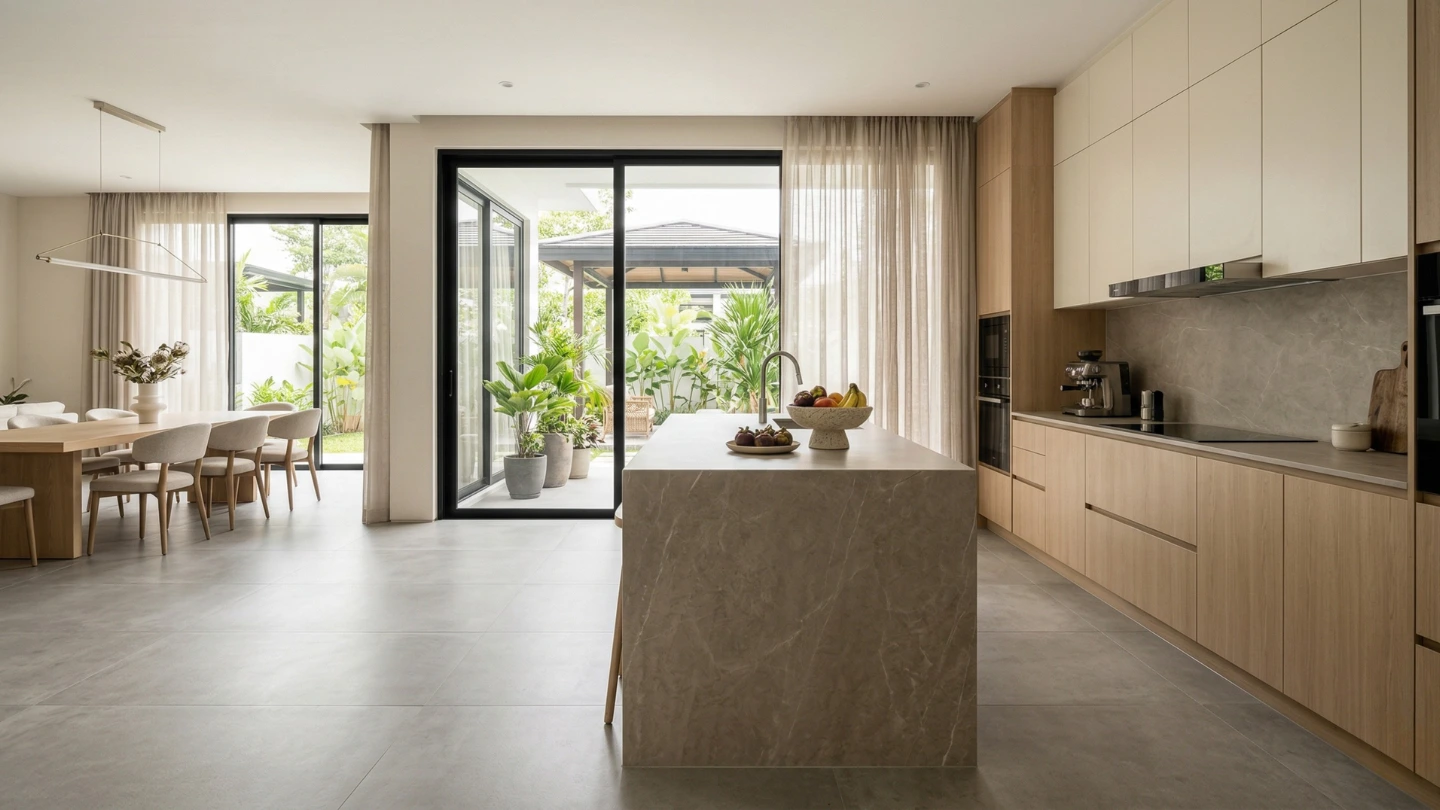
If you want a waterfall island or a mitre edge finish to make a 20mm slab appear thicker, expect a meaningful additional cost. Waterfall edges require a full-height slab panel on the side of the island, which adds both material and precision fabrication. Always clarify the included edge profile before accepting any quotation.
Red Flags: What to Watch Out For
Not all quotations are created equal. Here are warning signs that a quote may not be giving you the full picture.
1. Foot run pricing with no depth specified If a quote says "RM X per foot run" without stating the assumed depth, you have no way of knowing what you are actually paying for. A standard counter at 600mm depth and an island at 900mm depth have very different amounts of material — and the pricing should reflect that.
2. No brand or colour name specified "Quartz countertop — RM 1,500" tells you almost nothing. Without a brand, series, and colour name, you cannot verify what you are receiving. Unscrupulous suppliers have been known to pass off compressed marble or low-quality stone as genuine quartz — and a vague quotation makes this significantly easier for them to do.
3. A single "all-in" price with no breakdown A lump-sum quote with no itemisation makes it impossible to know what is and is not included. If the project scope changes — an extra cutout, a different edge profile, a deeper section — you will have no basis for negotiating the adjustment.
4. No mention of cutouts or transportation These two items are the most consistently omitted. If the quotation does not address them, they are either buried silently in the rate or they will surface as unexpected charges later.
How to Compare Quotes Side by Side
Once you have multiple quotes in hand, use this checklist to compare them on equal terms:
- Convert all quotes to the same pricing unit (all per sq ft or all per foot run)
- Confirm the assumed countertop depth behind any foot run rates
- Verify the brand, series, colour, thickness, and finish for each material quoted
- Check whether fabrication and installation are included in the rate
- Confirm whether transportation to site is included or billed separately
- Ask about cutout charges for sink, hob, and tap holes
- Clarify the edge profile included in the standard rate and what counts as extra
If you're unsure about how to source your countertop in the first place, read our breakdown of 3 ways to source your kitchen countertop in Malaysia — and which one to avoid.
Questions to Ask Your Fabricator
Before signing off on any quotation, ask these questions:
- What depth is assumed in your foot run pricing?
- Is fabrication included in this rate, or is it charged separately?
- Is installation and templating included?
- Are sink and hob cutouts included? How many are covered?
- Is transportation to my site included, or will it be billed separately?
- What edge profile is included, and what will cost extra?
- Does this price change if I choose a different colour within the same brand?
That last question matters more than most people realise. Selecting different stone colours for different countertops — say, a different shade for the island versus the perimeter counter — can add cost due to slab wastage and additional remnants that cannot be reused. You can read more about why choosing different colours for each countertop is more expensive.
Conclusion
A countertop quotation should be a clear, itemised document that tells you exactly what you are getting and exactly what you are paying for. When it is not, the confusion is not necessarily deliberate — it is often just the nature of an industry where there is no single standardised format.
The good news is that once you know what to look for — the pricing unit, the included line items, the edge profiling, the cutout charges, and the transportation — you can decode any quote and compare fairly. And if a fabricator cannot or will not provide a clear breakdown, that tells you something important too.
For a broader look at your material options before you commit, see The Complete Guide to Kitchen Countertop Materials in Malaysia: 14 Options Compared.
At Sinno, every quotation we provide is fully itemised and transparent — stone brand, series, colour, fabrication, installation, and any additional charges are all clearly listed. Get in touch for a free consultation and site measurement.