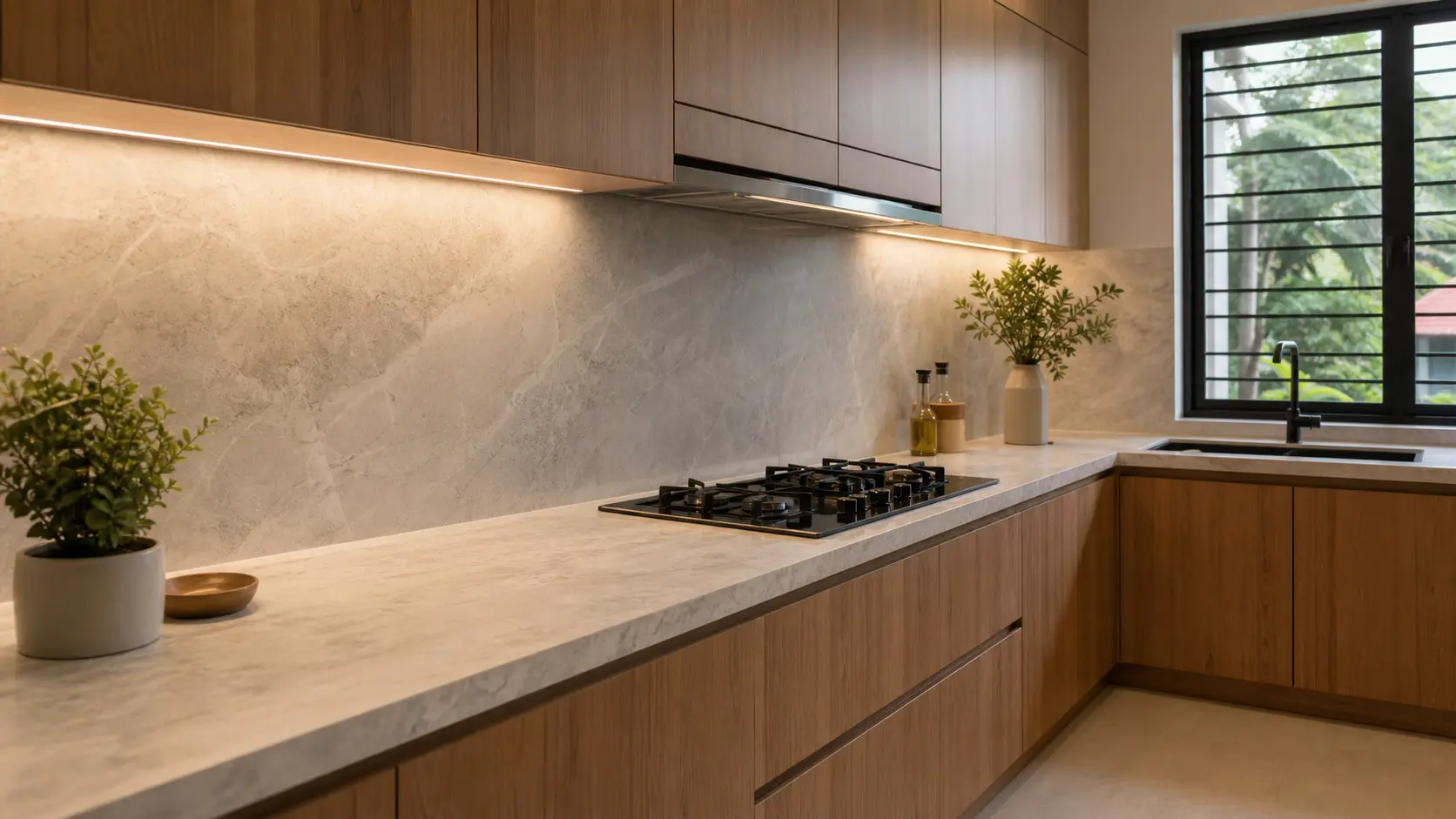
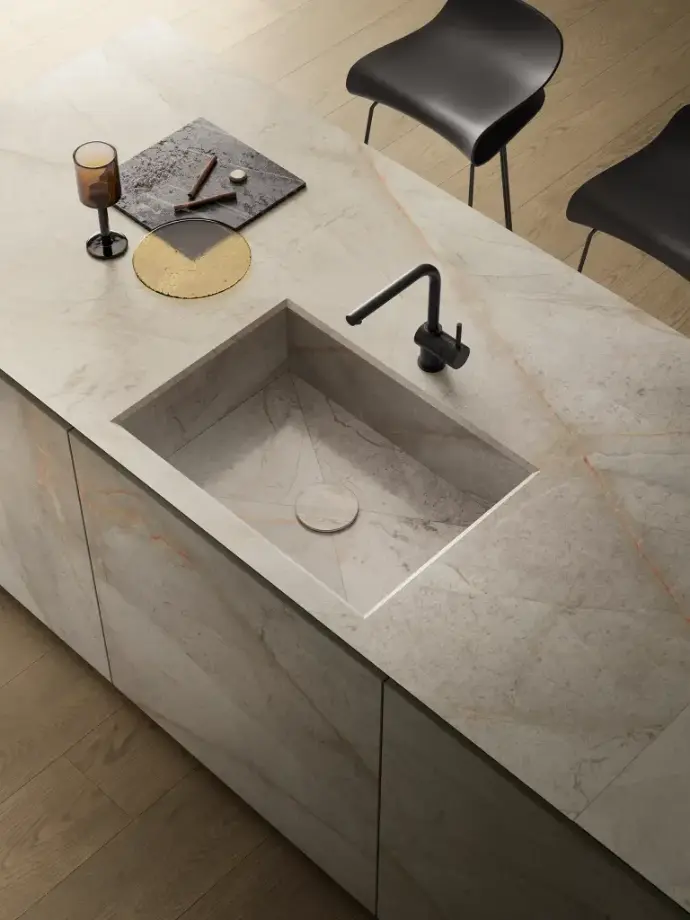
Sit down with a stone fabricator to discuss your kitchen top, and you will hear words that never come up anywhere else in life. Profile. Drop. Fascia. Cutout. Foot run. The installer rattles them off like everyone knows what a "waterfall" has to do with a kitchen island.
You do not need a diploma in fabrication to renovate your kitchen, but knowing these terms saves you from two common problems: agreeing to something you did not actually understand, and paying for something you never wanted. This glossary walks through the terms suppliers actually use in Malaysia — from the countertop itself to the sink cutout and the quotation line items — so you can walk into your next site visit and follow the conversation.
Countertop and Edge Terminology
Backsplash (Upstand, Skirting)
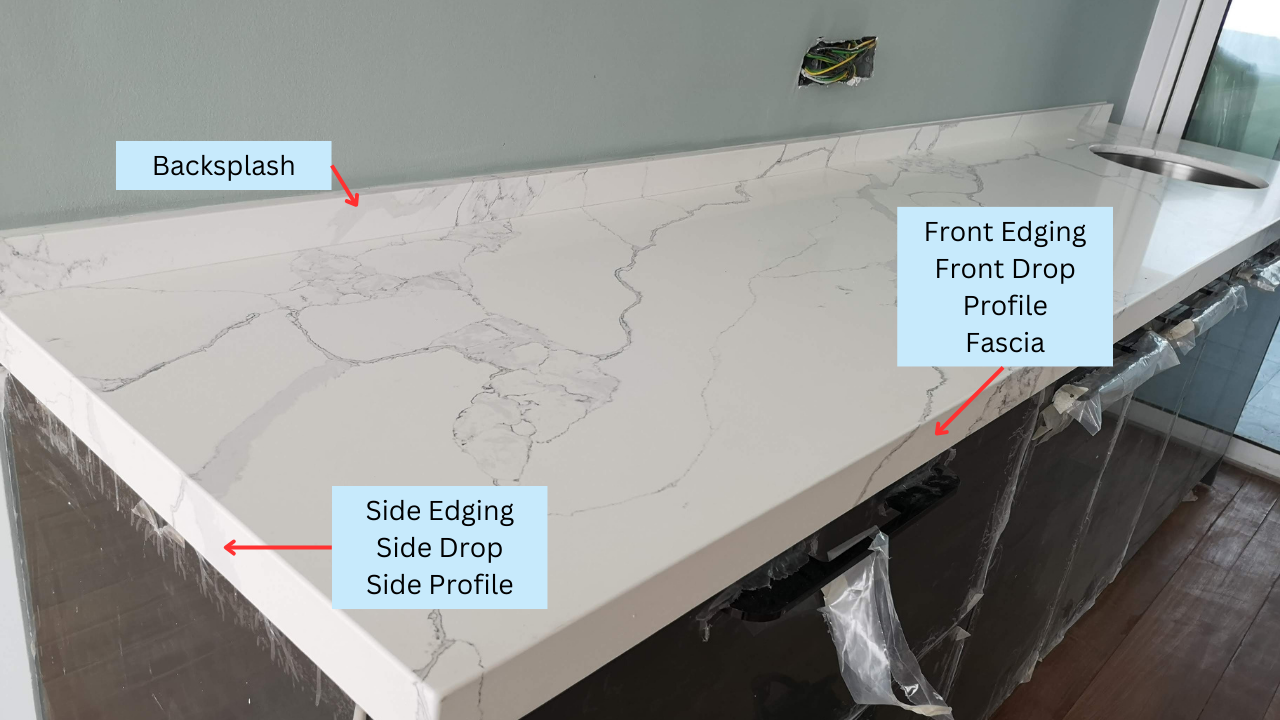
The backsplash — also called an upstand or skirting — is the raised strip of stone installed at the rear of the countertop, usually against the wall. Its job is to stop water, oil, and splashes from cooking or dishwashing from seeping down behind the counter and into the cabinet carcass. Backsplashes typically stand 50 to 100 millimetres tall, though full-height versions are increasingly common in Malaysian kitchens. Not sure whether yours needs one at all? Do You Actually Need a Kitchen Backsplash? breaks down when it is worth it and when it is not.
Profile (Front Edging, Front Drop, Front Apron, Fascia)
Profile refers to the finished edge at the front or side of a countertop, covering the raw cabinet wood underneath while creating the illusion of a thicker slab. You will hear this same feature called by different names depending on who you are speaking to:
- Drop / Front Drop — the informal term installers use on site, usually when confirming a measurement. Don't be surprised if the question comes out in Manglish: "Your front want to drop how many mm?" — they are simply asking how tall the front edge profile should be.
- Edging / Front Edging — a general alternative name for the same feature
- Front Apron — another alternative name, referring to the same finished front edge
- Fascia — the more professional term architects and interior designers typically use in drawings and specifications
All of these describe the same physical piece of stone. Knowing the synonyms means you will not get confused when your ID uses one word and your fabricator uses another.
Edge Profile Shapes
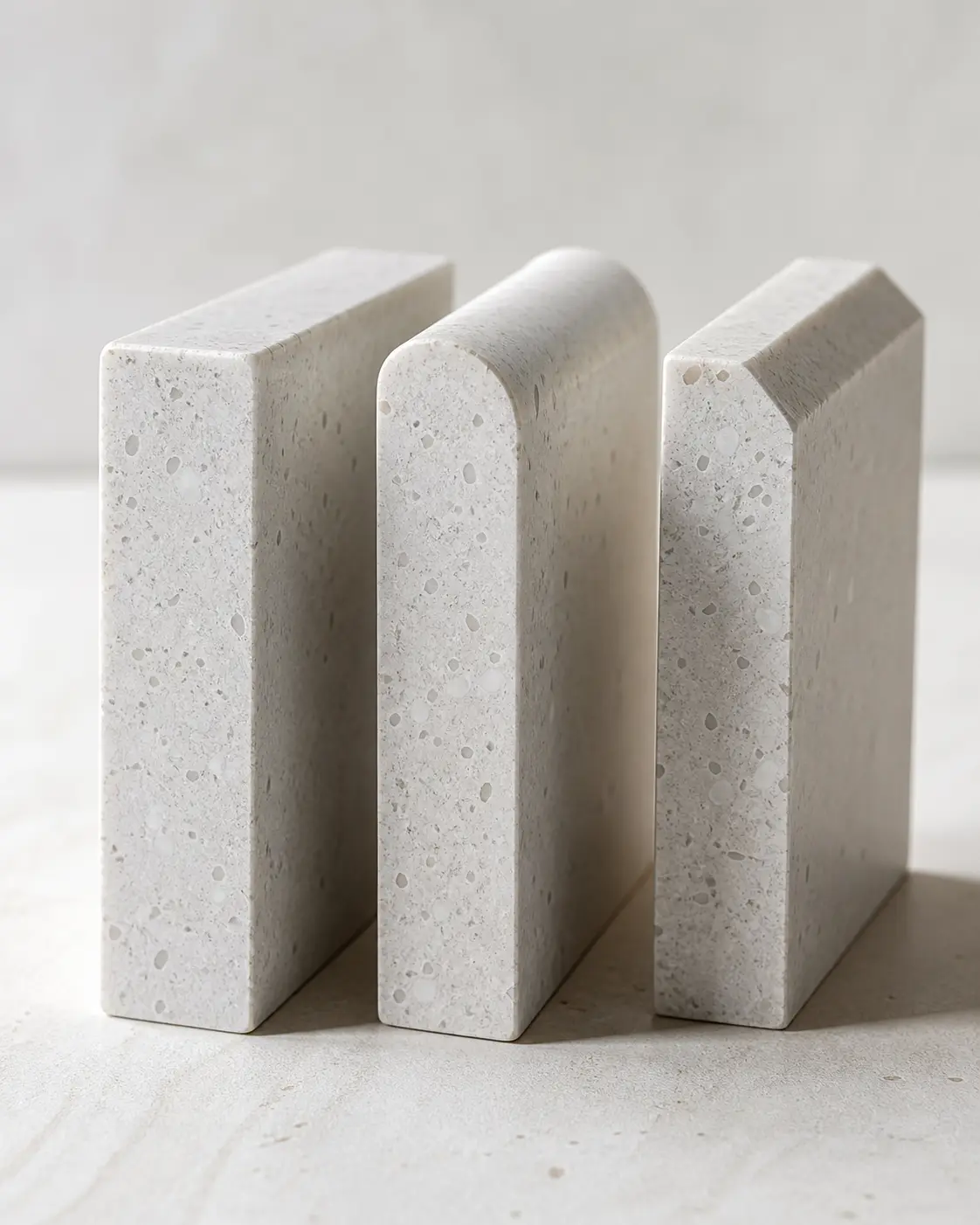
Beyond the flat "drop," the front edge of your profile can be shaped. Common options offered by Malaysian fabricators include:
- Eased edge — a straight edge with the sharp top corner lightly softened; the standard, no-cost option
- Bullnose — a fully rounded, half-circle edge, popular for kitchens with young children
- Bevel — a flat, angled edge cut at roughly 45 degrees
- Ogee — a decorative S-shaped curve, more traditional in style and less common in modern Malaysian kitchens
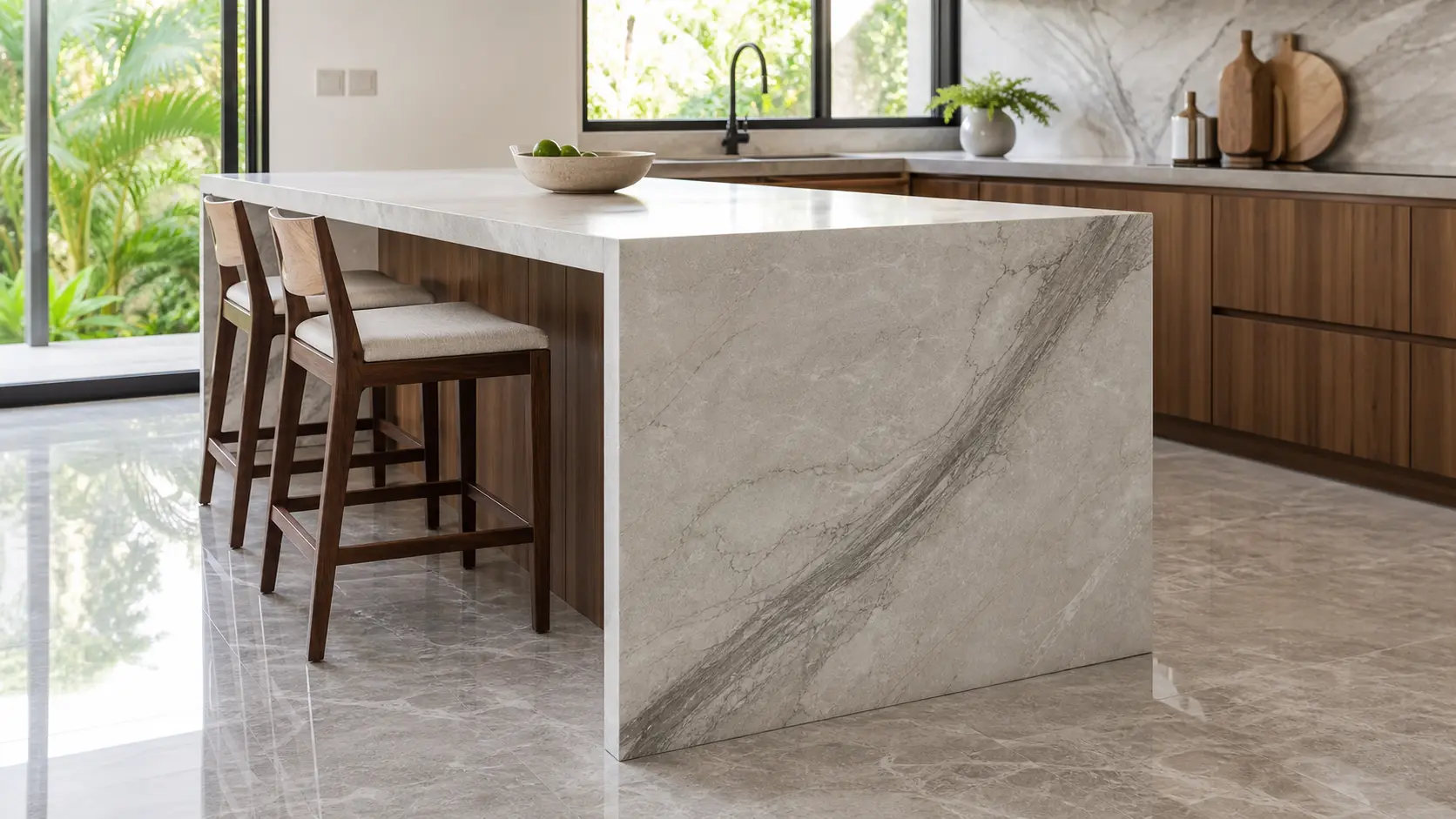
- Waterfall edge — the stone continues past the countertop surface and runs straight down the side of an island to the floor, with no visible cabinet underneath
Overhang
The overhang is the distance the countertop extends past the cabinet or the wall it sits on. A standard front overhang is around 5 to 10mm, mainly to allow drip water to fall clear of the cabinet door. A wider overhang — sometimes 200mm or more — is what creates seating space at a kitchen island or peninsula.
Reveal (also called "Overhang" on site)
Reveal describes how the stone edge sits relative to the sink lip once the countertop is installed, and it only applies to undermount sinks. In Malaysia, the standard is a negative reveal — the stone edge sits slightly proud of the sink, covering the rim by a small margin — and installers or sales advisors will often just call this the "overhang" too, even though it has nothing to do with the front overhang described above. Always clarify which one is being discussed.
The exact negative reveal depends on your sink shape:
- Standard square or round undermount sinks — 5 to 10mm, which leaves the silicone sealant line visible along the join
- Oval undermount sinks — 10 to 15mm, since the curved rim needs a deeper overlap to seal cleanly
If your fabricator asks how much "overhang" you want on the sink, this negative reveal measurement is what they are referring to, not the cabinet-edge overhang.
Island and Panel Terminology
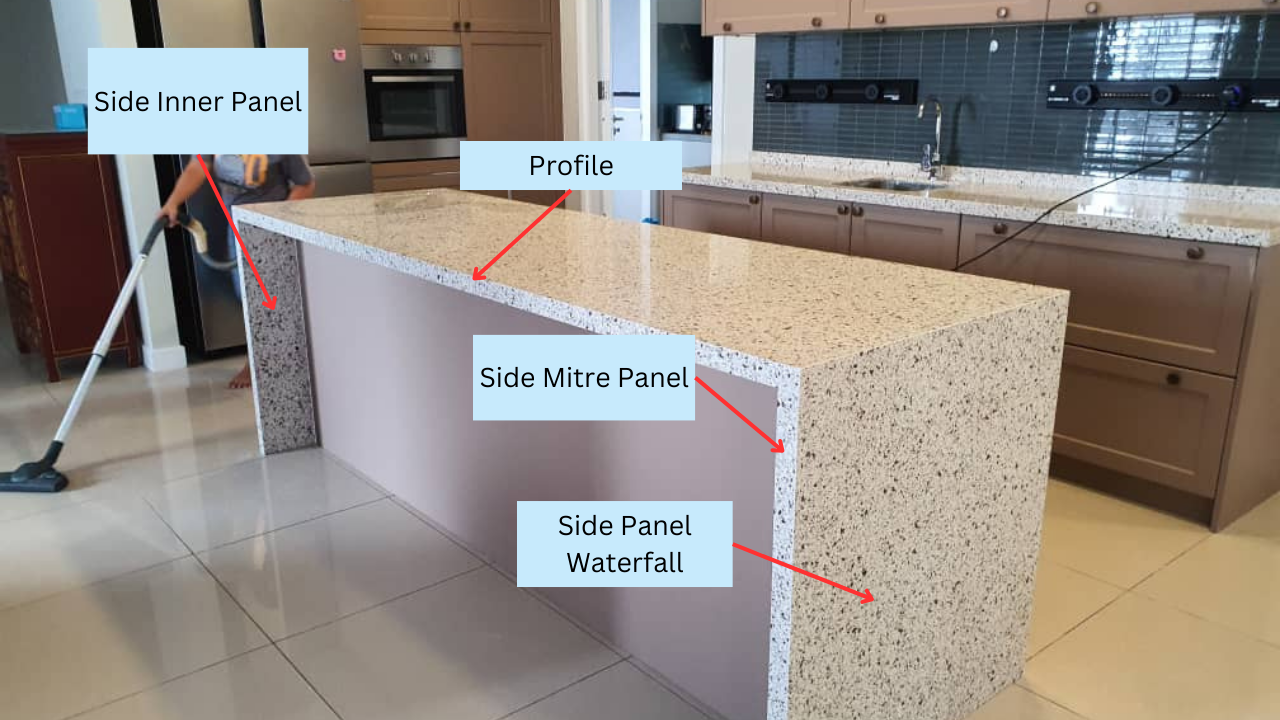
An island top has extra faces that a standard L-shaped or straight countertop does not, so it comes with its own vocabulary.
Side Inner Panel
The side inner panel is the return panel that wraps around and covers the back face of the cabinet carcass — essentially an internal finishing panel that most people never see once cabinetry is fully closed up.
Side Mitre Panel
A side mitre panel is the strip of stone that covers the thickness of the cabinet at a mitred (angled) joint, giving the corner a seamless, continuous look rather than an exposed edge.
Side Panel
The side panel covers the entire exposed side of an island, from the countertop surface down to the floor or the base of the cabinet. It is what gives an island a finished, all-stone appearance from every angle.
Waterfall
Waterfall is the everyday Malaysian term for the side panel — specifically when the same slab pattern flows continuously from the countertop surface down the side, so the veining lines up without an obvious seam. It is the same feature described technically as a "waterfall edge" above; homeowners and salespeople in Malaysia almost always just call it a waterfall.
Sink and Cutout Terminology
Cutout
A cutout is any opening cut into the stone slab — most commonly for a sink, a cooker hob, or a soap dispenser. Cutouts are usually quoted separately from the base countertop price, so check your quotation carefully for how many are included. Stone Countertop Quote Decoded explains exactly how fabricators price cutouts and other common line items.
Undermount vs Top Mount
These two terms describe how the sink attaches to the countertop. An undermount sink is fixed beneath the stone, so the countertop edge is visible and the sink sits flush without a lip — this is the more common choice for quartz and sintered stone tops. A top mount (or drop-in) sink sits inside the cutout with its rim resting on top of the stone. For the full comparison, including which suits Malaysian kitchens better, see Sink Type: Top Mount vs Under Mount.
Fabrication and Installation Terms
Template / Templating
Templating is the site visit where the fabricator measures your cabinets precisely — usually with a digital scanner or a physical template — before cutting the stone. This step only happens once your cabinets are fully installed, since cutting from inaccurate measurements risks a slab that does not fit. How Long Does Countertop Installation Take in Malaysia? walks through where templating sits in the overall installation timeline.
Slab and Remnant
A slab is a full, uncut piece of stone as it arrives from the factory, typically around 3200mm by 1600mm for quartz and sintered stone. A remnant is the leftover offcut from a slab after your main countertop pieces are cut — often enough for a small vanity top or shelf, and sometimes sold at a discount.
Seam
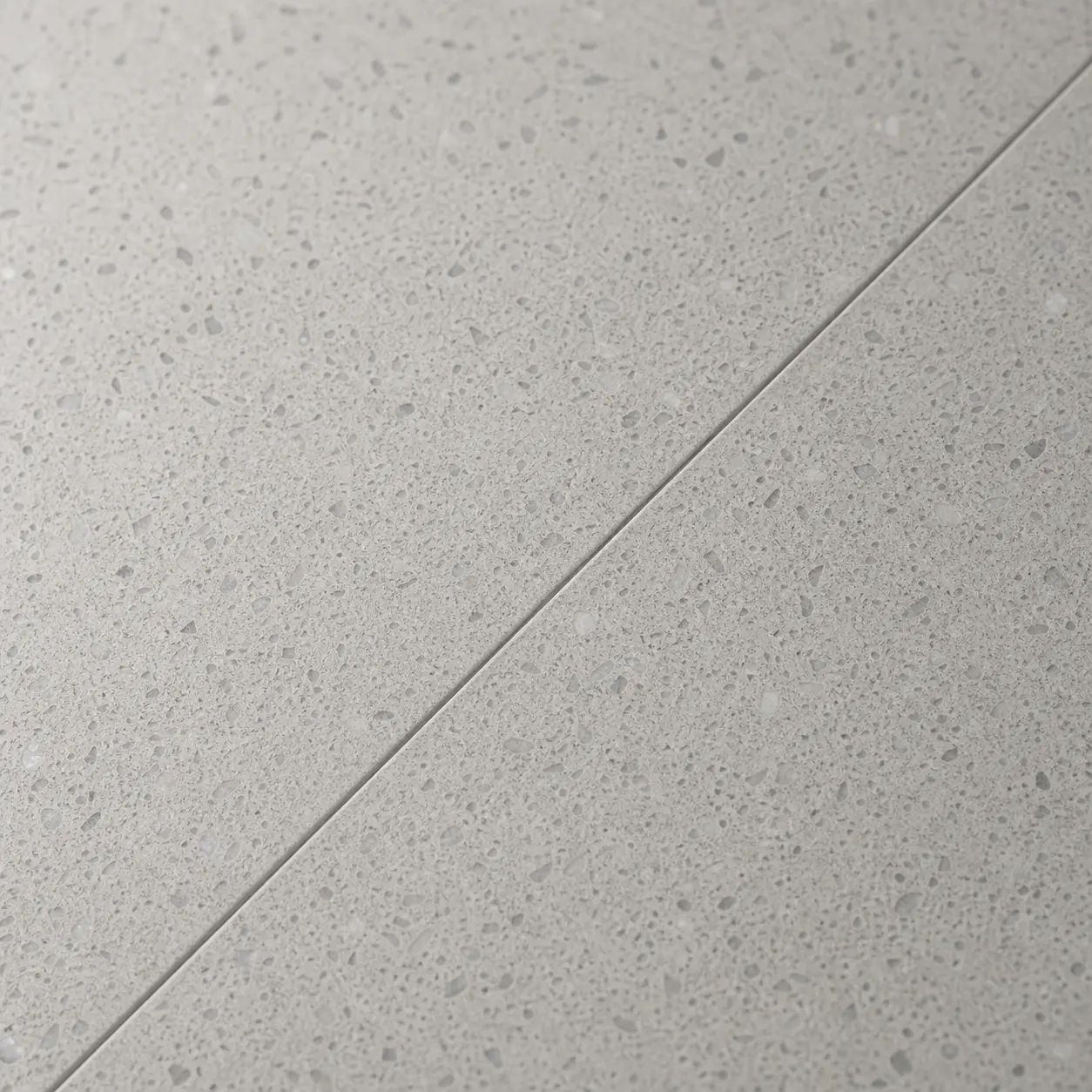
A seam is the joint where two pieces of stone meet, usually because your countertop layout is too large to cut from a single slab. Fabricators try to place seams in the least visible spots, such as beside a hob or sink, rather than in the middle of an open run.
Foot Run
Foot run (or linear foot) is a pricing method that measures the countertop by its length along the front edge, rather than by total surface area. Some suppliers use foot run pricing for simple straight runs; most quartz and sintered stone quotations in Malaysia, however, are priced per square foot. Either way, always check which method your quotation uses before comparing prices between suppliers.
Finish
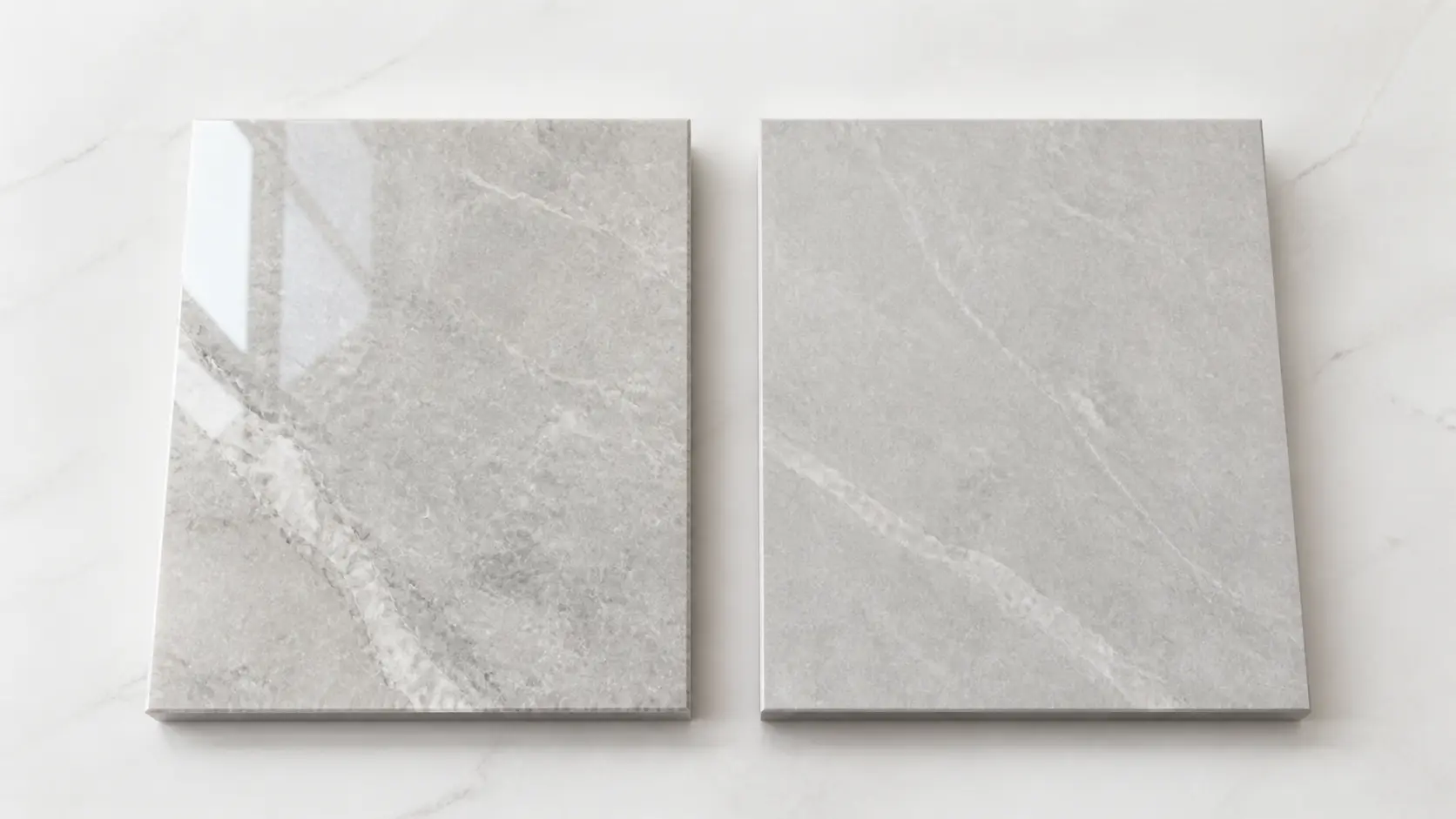
Finish refers to the surface texture applied to the stone after cutting — polished (glossy and reflective), honed (matte and smooth), or leather (textured with a subtle grain). Each finish affects how the countertop looks, feels, and hides fingerprints or watermarks. Polished vs Honed vs Leather vs Gloss covers the differences in full.
Why These Terms Matter When You Get a Quotation
A quotation full of unfamiliar words is easy to skim past and hard to question. Once you know what a cutout, a seam, and a foot run actually refer to, you can read a quote line by line and ask specific questions — how many cutouts are included, where the seams will fall, whether the backsplash is priced separately. How to Read a Countertop Quotation in Malaysia goes deeper into spotting hidden costs before you sign anything.
Conclusion
Stone countertop terminology is not complicated once someone actually explains it — the problem is that most suppliers assume you already know it. Whether you are discussing an island waterfall, choosing between an undermount and top mount sink, or checking how many cutouts are on your quotation, this glossary gives you the vocabulary to have that conversation on equal footing. Bring these terms to your next site visit, and you will spend less time nodding along and more time making decisions you actually understand.