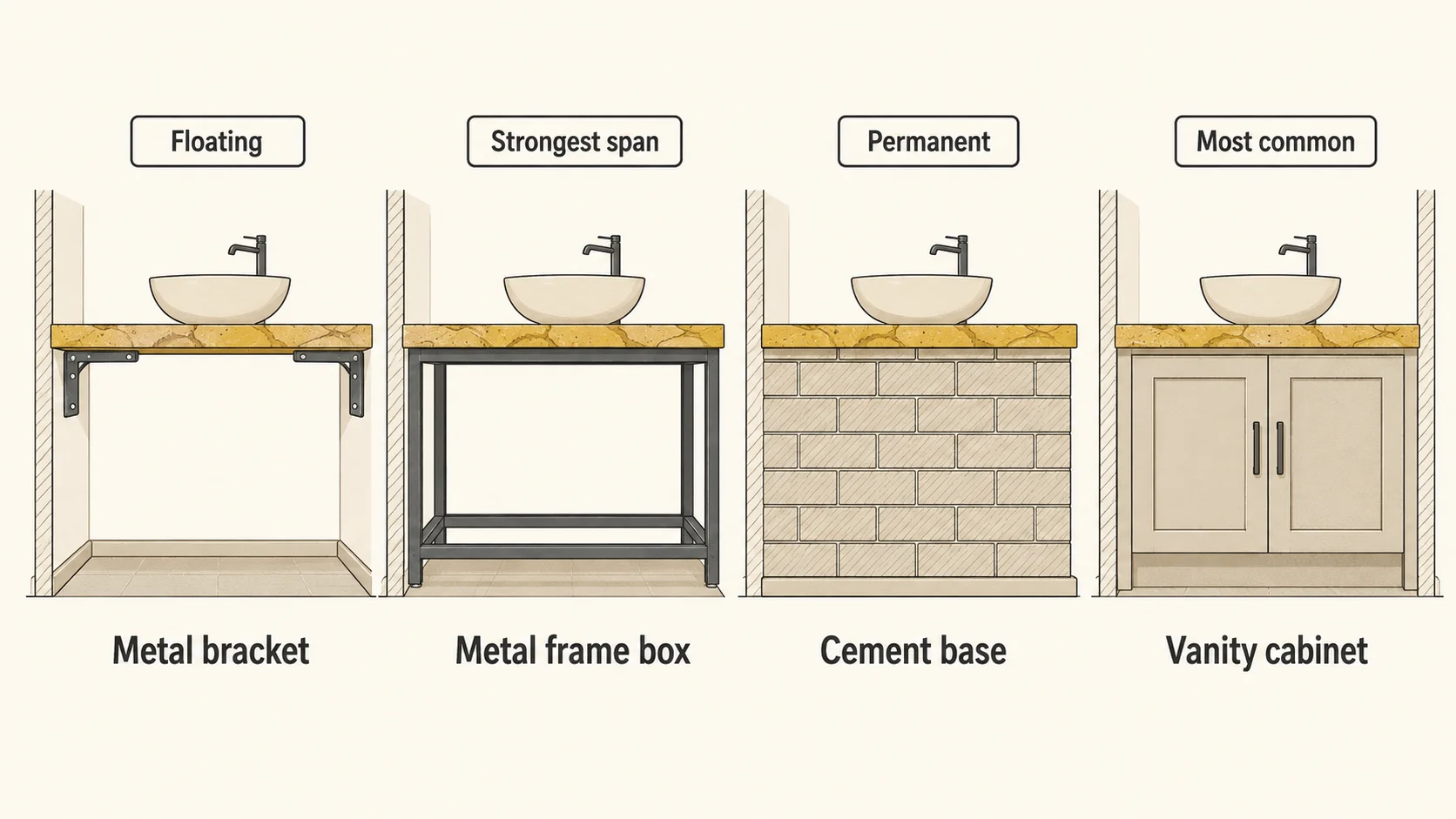
A vanity stone top can sit on four different bases in a Malaysian bathroom: wall-mounted metal brackets, a welded metal frame box, a cement or brick plinth, or a vanity cabinet. All four work when they are built properly. The cabinet is the safest default, brackets give you the floating look, a frame box carries the heaviest and longest tops, and cement is the most permanent of the lot.
Most homeowners spend weeks choosing between quartz and sintered stone, then let the contractor decide what holds it up. That is backwards. Stone does not fail because it was the wrong colour. It fails because something underneath it moved, sagged, rusted or was never level in the first place.
Key Takeaways
- A vanity cabinet is the default choice for most Malaysian bathrooms because it supports the whole footprint, hides the plumbing and stays serviceable.
- Metal brackets give you a floating vanity, but only on a solid brick or concrete wall, and only with stainless or hot-dip galvanised steel in a wet bathroom.
- A metal frame box is the right answer for long double-basin tops, waterfall ends and anywhere the wall cannot be trusted to carry a cantilever.
- A cement or brick base is rock solid and immune to damp, but it is permanent, heavy, and buries your plumbing behind masonry.
- Whatever the base, the stone needs continuous, level bearing. Flatness matters more than raw strength.
Why does the base matter more than the stone you choose?
Because stone is strong in compression and weak in bending. A slab supported evenly across its whole footprint will carry far more than you will ever put on a bathroom vanity. The same slab bridging a gap, resting on a base that has twisted a few millimetres, or cantilevering off two brackets that were never rated for the load, is a different object entirely.
Three things go wrong when the base is not right.
The top cracks at the basin cutout. The narrowest part of any vanity top is the strip of stone in front of an undermount basin, sometimes only 60mm to 80mm wide. That strip is where every bit of movement in the base concentrates. Cracks almost never start in the open field of the slab. They start there.
The top rocks or sits proud along the wall. A base that is level in one direction and out in the other leaves the slab bearing on three points instead of four. It will not sit flat, and silicone will not fix it.
The base itself fails before the stone does. Untreated mild steel in a Malaysian bathroom rusts. Chipboard and MDF carcasses swell and delaminate. Both take years rather than months, which is exactly why nobody connects the failure back to the decision that caused it.
Your fabricator will template off whatever base is standing there on the day. Templating captures the shape, not the strength. If the base is wrong, the stone gets cut to fit a problem.
When does a metal bracket work for a vanity top?
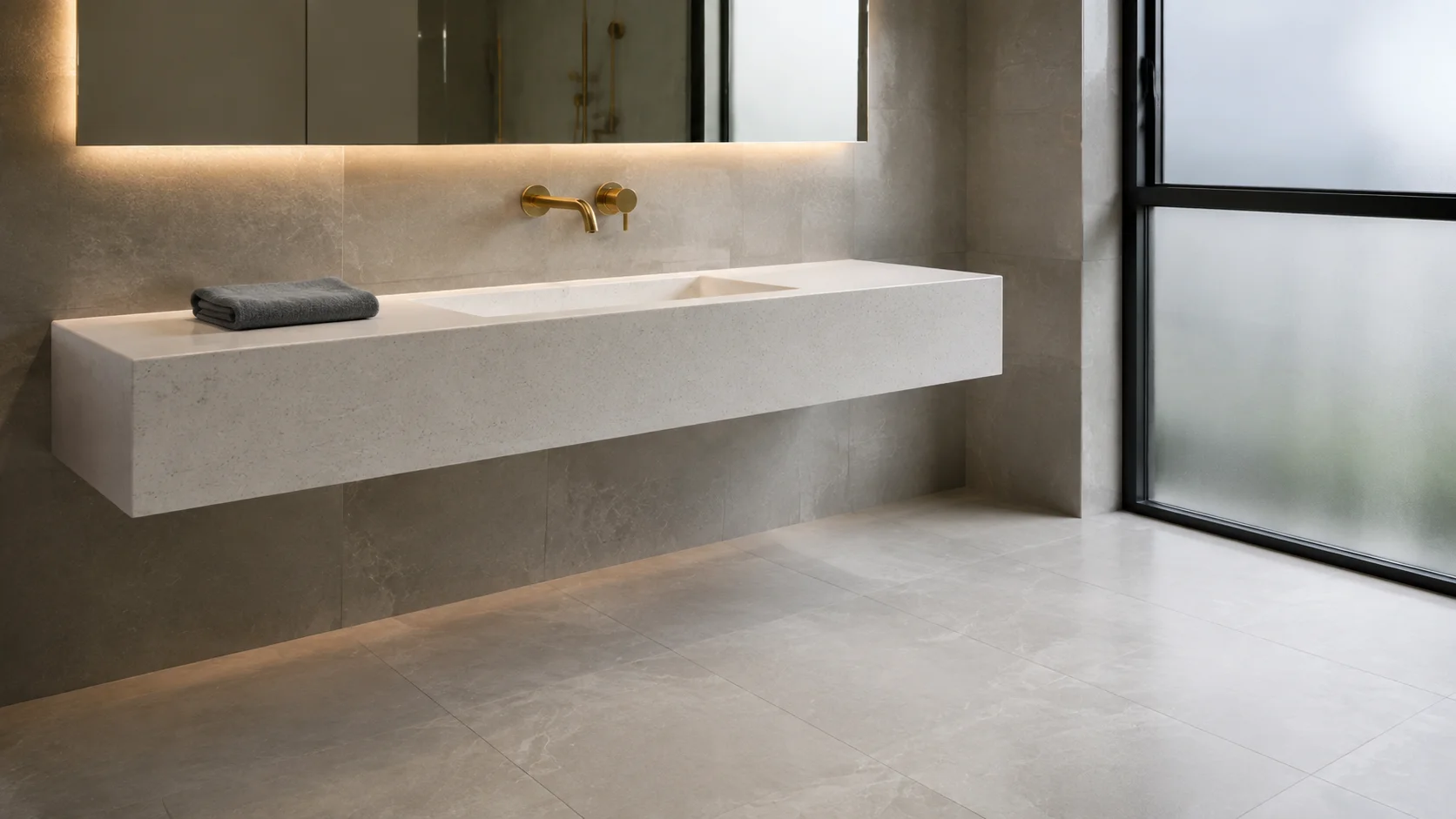
Metal brackets work when you want a floating vanity and the wall behind it is solid brick or reinforced concrete. They are the only base that gives you clear, open floor underneath, which is why they dominate small condo bathrooms and hotel-style ensuites.
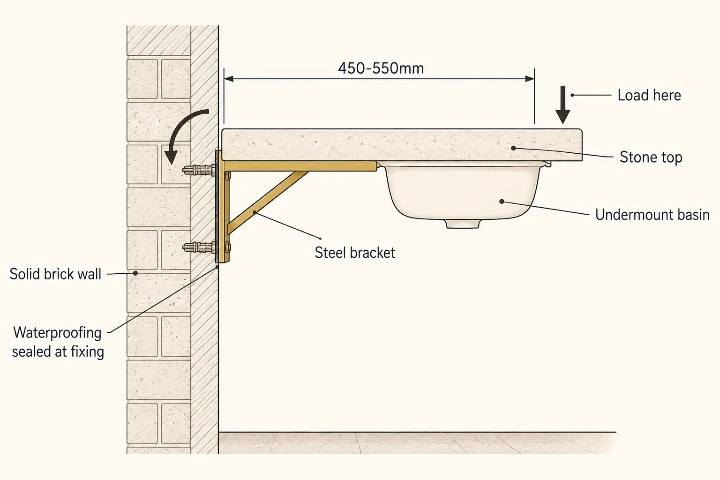
A bracket setup is a cantilever. The load hangs off the wall, and everything the vanity carries turns into a bending force at the fixing points. That has consequences worth knowing before you commit.
The wall has to be the right wall. Solid brickwork or concrete is fine. A hollow block partition, a dry wall, or a stud wall without proper noggins behind the plasterboard is not, no matter what anchor your contractor produces. If your bathroom wall was built as a lightweight partition, brackets are off the table or need a steel backing plate spanning to something structural.
The steel has to survive a wet bathroom. Powder-coated mild steel looks identical to stainless on installation day. Two years later, rust bleeds out of the fixing holes and stains the wall below. Specify stainless steel or hot-dip galvanised, and treat any cut end or drilled hole as a fresh rust site that needs sealing.
Depth and spacing are not guesswork. A typical Malaysian vanity top runs 450mm to 550mm deep. Brackets need to reach far enough back that the slab is not tipping on a short lever, and they are usually set every 400mm to 600mm along the run. Your fabricator should confirm both against the actual slab weight.
Waterproofing gets drilled. Bathroom walls are waterproofed before tiling. Every bracket fixing punches through that membrane. Each hole needs sealing properly, or you have just built a water path into the wall behind a vanity you cannot easily remove.
Basin choice changes the maths. A countertop or vessel basin sits on top and spreads its weight onto the slab. An undermount basin hangs from it, adding load in exactly the weakest spot. If you want an undermount basin on a floating vanity, the brackets need to be sized for it and the slab needs support close to the cutout. Our guide on undermount versus top mount sinks covers how the two mounting styles differ.
Best for: short to medium single-basin vanities, floating designs, small bathrooms where floor space is tight. Avoid when: the wall is a light partition, the top is long or double-basin, or the slab is a heavy 30mm stone.
What is a metal frame box, and when is it the better choice?
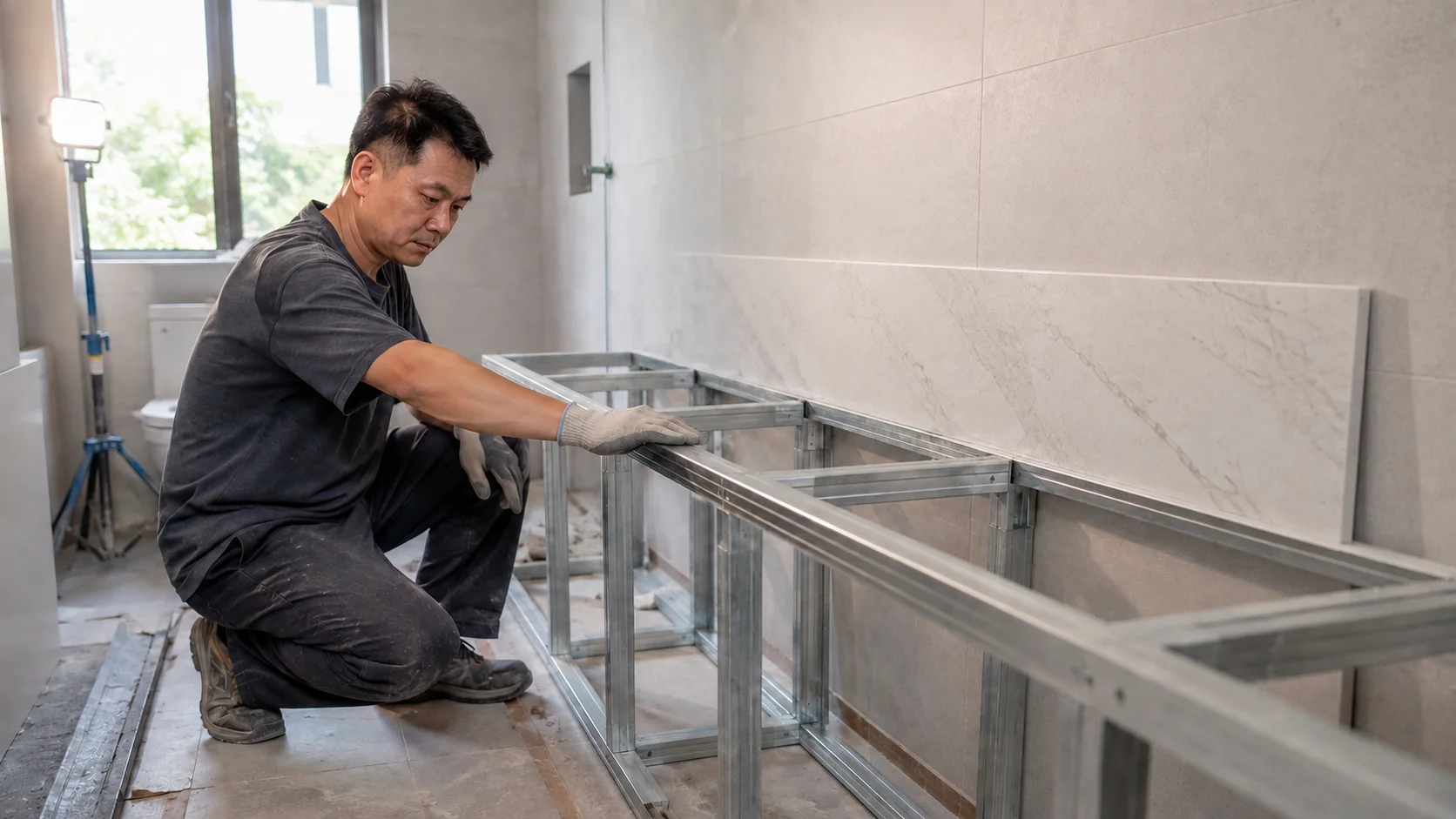
A metal frame box, often written "framebox" on Malaysian quotations, is a welded steel frame built to the exact shape of the vanity, usually from hollow section tube. It either stands on the floor, anchors to the wall, or both. The stone top sits on the frame, and the sides are commonly clad in the same stone, tile or a laminate panel.
Where brackets hang everything off the wall, a frame box carries the load through its own structure. That single difference solves most of the problems brackets have.
It handles long spans and heavy tops. A 2.4-metre double-basin top is a lot of stone. A frame box supports it continuously along the front and back rails instead of at a handful of bracket points.
It does not depend on the wall. If the bathroom has a light partition wall, or the vanity sits in a corner where you cannot get a clean run of fixings, a floor-standing frame box sidesteps the problem entirely.
It can still float. A wall-anchored frame box tucked back from the front edge gives you a floating appearance with far more support than brackets alone. This is how most well-built "floating" hotel vanities are actually made.
It supports a waterfall end. If you want the stone to turn down the side to the floor, that vertical panel needs something to bond to. A frame box gives it a substrate; brackets give it nothing.
The trade-offs are real, though. A frame box is fabricated work, so it costs more than brackets and takes longer than a carpenter screwing in a cabinet. It also has to be dead square and dead level, because any cladding wrapped around it will show every deviation. And stone does not bond reliably to galvanised steel, because the surface is smooth and alkaline-reactive, so a clad frame needs a cement board or plywood substrate screwed on first. Skip that layer and the cladding lets go a few years later.
Is a galvanised frame box enough to stop it rusting?
Only if you know which kind of galvanising you are getting, because two very different things are sold under the same word.
Most frame boxes in Malaysian bathrooms are welded from pre-galvanised GI hollow section, the standard tube any hardware supplier stocks. Its zinc layer is thin, typically somewhere in the region of 10 to 20 microns, and it goes on at the mill, before anyone cuts the tube. Hot-dip galvanising after fabrication reverses the order: the frame is welded first, then dipped whole, which leaves a coating several times thicker that covers the welds as well as the tube.
That ordering is the whole difference, and it shows up in four places.
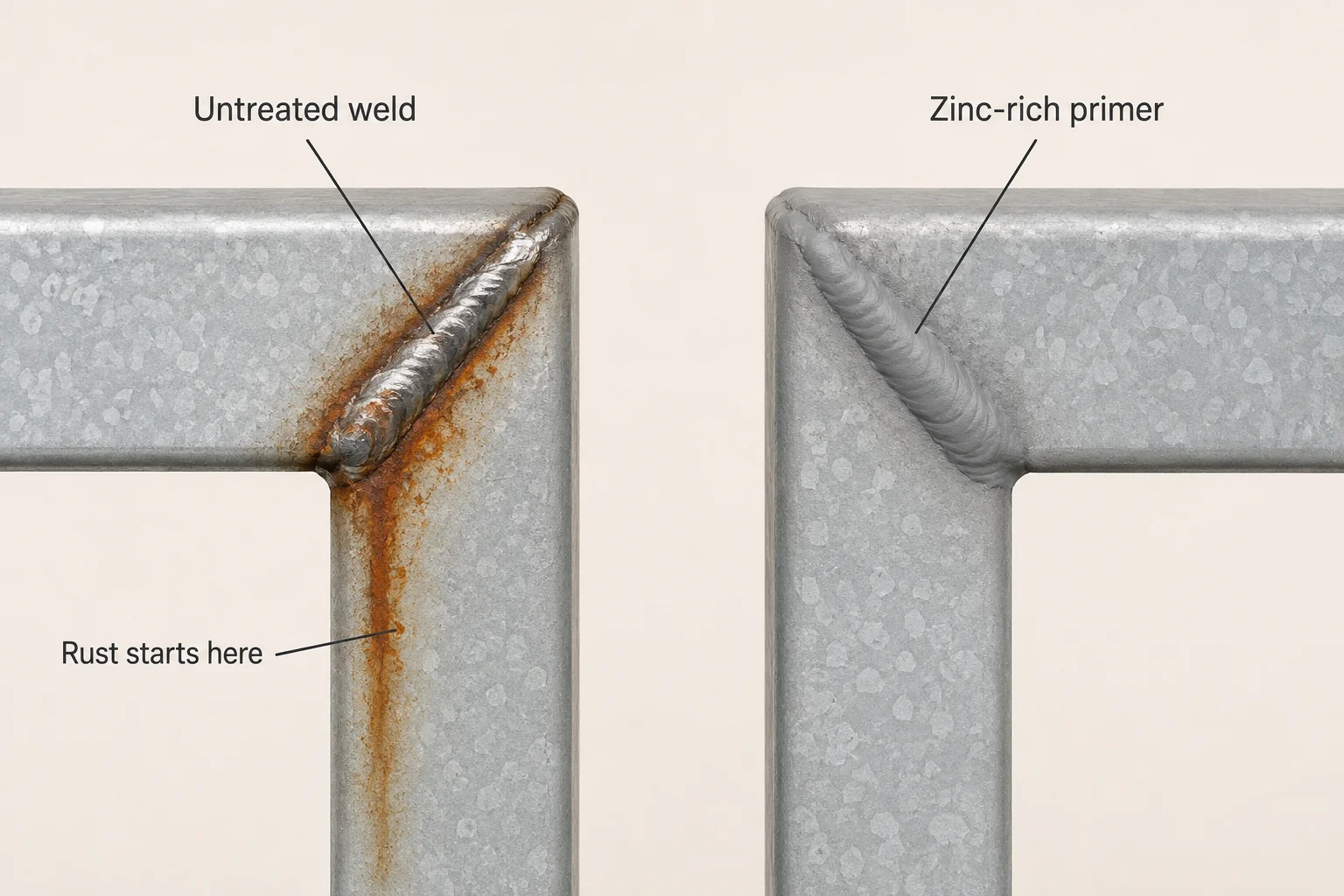
The welds. Zinc boils at 907°C and a welding arc runs far hotter, so every bead is bare steel with the coating burnt back on both sides. This is why rust on a frame box appears in neat lines rather than patches.
The cut ends. Pre-galvanised tube is coated on the outside. Every cut opens a raw edge and a bare bore.
The feet. Water ponds on a bathroom floor, and corrosion works upward from the base long before it shows anywhere else. Nylon glides or stainless pads under the frame are a small detail that buys years.
Site-drilled holes, oddly, are the least of it. Zinc protects small bare areas sacrificially for a few millimetres, so a drilled hole largely looks after itself. A 60mm weld bead does not.
Two further traps are worth knowing. Fresh cement render is strongly alkaline and attacks zinc, so a frame packed tight against wet mortar corrodes along the contact line. And stainless steel screws driven into a galvanised frame in a wet bathroom form a galvanic couple, in which the zinc is the one that gets sacrificed. Matched fixings or isolating washers solve it.
If you take one line from this section onto your quotation, make it this: hot-dip galvanised after fabrication, or failing that, pre-galvanised tube with all welds and cut ends treated with two coats of zinc-rich cold galvanising primer. Add the section size and wall thickness while you are there. Tube at 1.0mm wall is furniture-grade, and a long double-basin stone top is not furniture.
One practical note if you do go for hot-dipping. Hollow sections need vent and drainage holes designed in before they go anywhere near a 450°C zinc bath, and thin frames can come out slightly out of square. Check the frame is still flat before your fabricator templates off it.
Best for: long or double-basin tops, waterfall ends, light partition walls, heavier 30mm slabs. Avoid when: the budget is tight and a cabinet would do the same job.
Is a cement or brick base still a good idea in a Malaysian bathroom?
A cement or brick base is the most stable option of the four, and in a wet bathroom it is completely immune to the damp that eventually gets to steel and timber. It is the traditional Malaysian build, and your tiler can put one up while already on site.
It is built as a low dwarf wall in brick or cement board, plastered, sometimes tiled, with the stone top laid over it. Once cured, it does not move, does not rust, does not swell and does not sag. For a heavy stone top in a wet bathroom, nothing beats it on pure stability.
So why is it not the automatic answer? Four reasons.
It is permanent. Changing your mind means hacking. That is dust, debris, a skip, and in a condo, likely a permit from building management and a booked service lift.
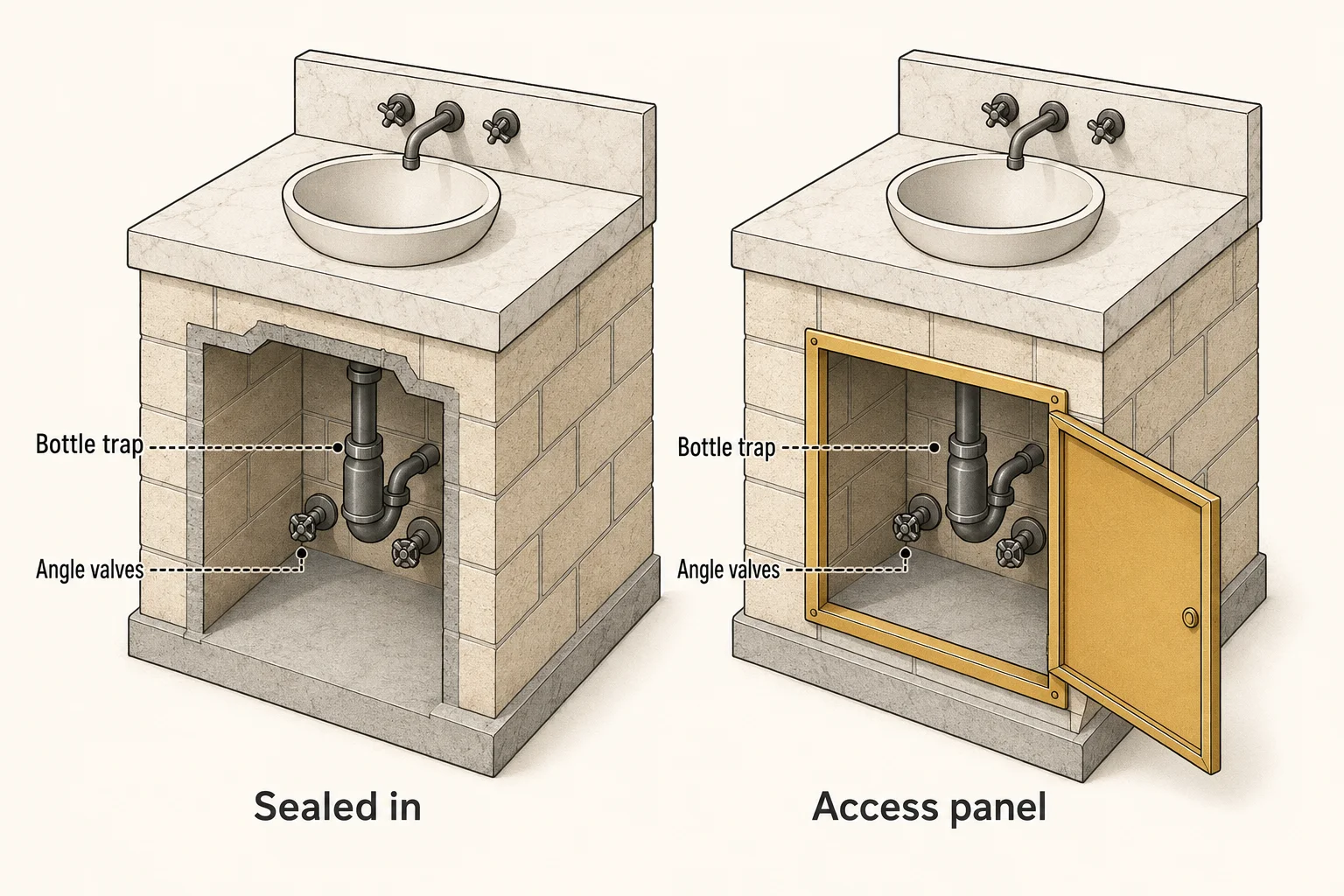
It buries the plumbing. The bottle trap, the angle valves and the water feed all end up behind masonry. When a trap starts weeping in year seven, and eventually one will, access means breaking the base open. A cabinet takes thirty seconds to open.
It is heavy. On an upper floor of a landed house or in an apartment, a brick plinth plus a stone top plus a basin full of water is a meaningful dead load in one small area. Worth a thought before you build it into a condo bathroom.
It needs time and it needs to be flat. Masonry has to cure before the top goes on, and the plastered top surface has to be genuinely flat, not just visually straight. Stone laid over a base with a hump in the middle bears on the hump. That is a slow-motion crack waiting for someone to lean on the front edge.
There is a middle path worth knowing about. Some Malaysian bathrooms use a cement or brick base for the wet corner and a cabinet for the rest, or leave an open service panel in the masonry directly behind the trap. If you like the solidity of cement but want to keep the plumbing reachable, ask your contractor to build that access in from day one.
Best for: wet bathrooms, heavy slabs, ground-floor landed homes, anywhere durability outranks flexibility. Avoid when: you are in a condo, you want the plumbing accessible, or there is any chance you will reconfigure the bathroom later.
Should you just use a vanity cabinet?
For most Malaysian bathrooms, yes. A vanity cabinet supports the entire footprint of the stone, hides the plumbing while keeping it accessible, gives you storage, and is the base every stone fabricator is used to templating and fitting onto. It is the default for good reasons.
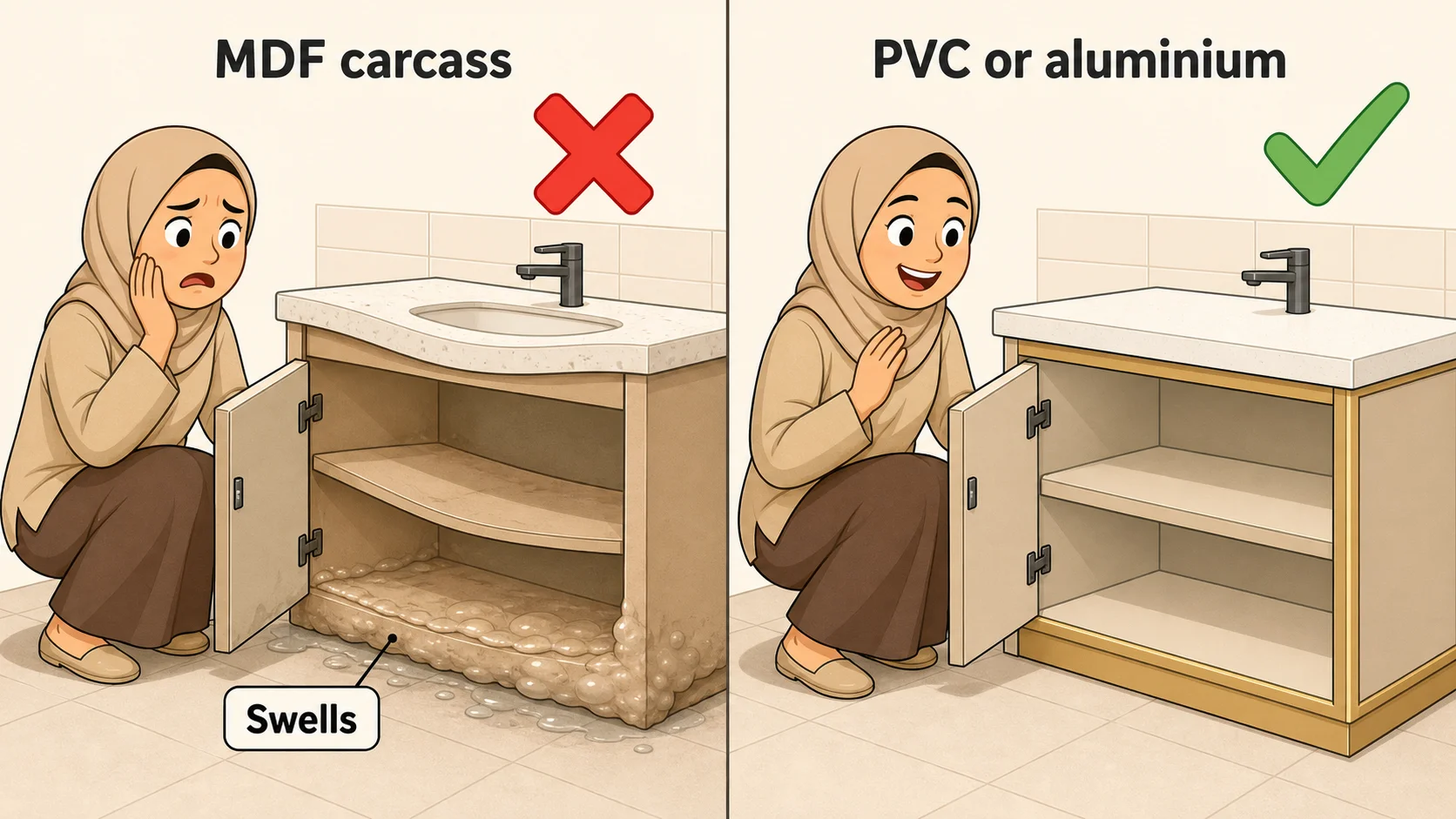
The one thing that matters is what the carcass is made of. A Malaysian bathroom sits near saturation for hours after every shower, and that exposure runs for the life of the vanity.
| Carcass material | How it holds up in a Malaysian bathroom |
|---|---|
| PVC / WPC | Immune to water. Common in wet bathrooms. Lighter duty, so check the top rails are strong enough for a stone slab |
| Aluminium | Immune to water, rigid, carries stone well. Higher cost |
| Marine or moisture-resistant plywood | Good, provided every cut edge is sealed. This is where most plywood vanities actually fail |
| Stainless steel | Excellent, though usually reserved for commercial jobs |
| MDF or chipboard | Swells, delaminates and sags. It has no business in a bathroom, and it is the cheapest thing in the showroom |
The other point people miss is that a cabinet has to be fixed and level before templating, not just standing in position. A carcass sitting loose on an uneven tiled floor will shift when the stone goes on, and any twist gets transferred straight into the slab. Fix it to the wall, level it in both directions, and let it settle. The same sequencing logic applies here as in the kitchen, which we covered in do you need to install cabinets before ordering a stone countertop.
One more thing on flimsy carcasses. A thin cabinet may hold the slab's weight fine but still flex when someone leans on the vanity edge. Flex is movement, and movement is what cracks stone at the basin cutout. If you can rock the empty cabinet with one hand, it is not ready for stone.
Best for: almost every standard bathroom vanity. Avoid when: you specifically want a floating look with clear floor underneath.
How do the four bases compare side by side?
Each base wins on something different. Here is the honest comparison.
| Metal bracket | Metal frame box | Cement / brick | Vanity cabinet | |
|---|---|---|---|---|
| Floating look | Yes | Yes, if wall-anchored | No | No |
| Load capacity | Moderate | High | Very high | Moderate to high |
| Max practical top length | Short to medium | Long | Long | Medium |
| Plumbing access | Excellent, fully open | Good | Poor unless designed in | Excellent |
| Moisture resistance | Good if stainless or galvanised | Good if properly treated | Excellent | Depends entirely on carcass |
| Storage | None | None unless doors added | None | Yes |
| Reversible later | Yes | Yes | No | Yes |
| Depends on wall strength | Completely | Partly or not at all | No | No |
| Relative cost | Lowest | Highest | Low to moderate | Moderate |
Does the base change depending on which stone you pick?
Yes, and this is the part most homeowners never hear. The thinner and more brittle the slab, the more continuous the support underneath needs to be.
Quartz stone at 20mm is the most forgiving. It has some flex before it fails, and a properly built cabinet or frame box carries it without extra help. Overhangs beyond roughly 300mm still want a bracket or a corbel, and your fabricator should say so on the quotation.
Sintered stone and porcelain slab at 12mm are hard but brittle. They resist scratching better than anything else on the market and snap more readily under a point load or a twist. A 12mm slab generally wants a full substrate beneath it, typically plywood or cement board bonded to the top of the base, so the load spreads evenly instead of concentrating wherever the base happens to touch. If you are weighing these two materials up for a vanity, our comparison of quartz versus sintered stone for your bathroom vanity top covers the day-to-day differences.
Granite and natural stone at 20mm are heavy. Weight is the constraint, not flex. Check that brackets are rated for it, and be more careful about lightweight PVC carcasses.
There is a common misreading here, which is that thicker stone means you can skip proper support. It does not work that way. Thickness buys you a little more span between supports, not permission to build a worse base. We unpacked what thickness actually changes in why stone thickness doesn't matter (much) in Malaysian kitchens.
Ask your fabricator one specific question: given this material and this thickness, what support do you need under it? A fabricator who has cut the material before will answer in seconds.
What goes wrong most often with vanity top bases in Malaysia?
The same handful of things, over and over.
Untreated mild steel, or untouched welds. Brackets or a frame box in ordinary steel with a thin coat of paint. It looks perfect for two years and then bleeds rust down a white wall. A galvanised frame whose welds were never primed does exactly the same thing, just in neater lines.
Brackets on the wrong wall. Fixings into a hollow partition, holding fine until someone puts real weight on the front edge of the vanity.
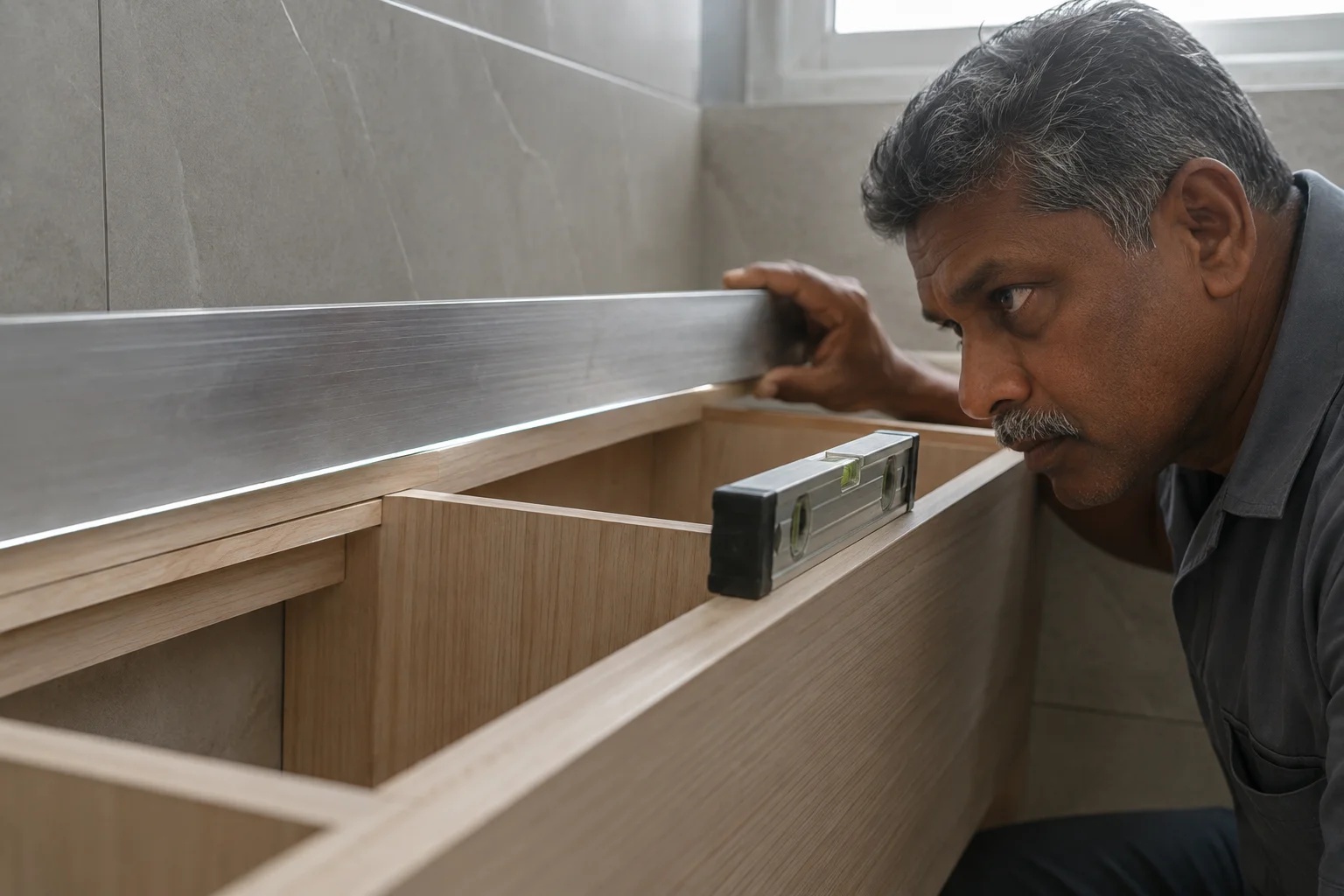
A base that is level but not flat. Two different things. A spirit level tells you the base is not tilted. It does not tell you whether the middle is high. Stone bears on high points, and high points crack slabs.
Nobody owns the coordination. In most Malaysian renovations the base is built by the tiler, the carpenter or the ID's contractor, and the stone is supplied by a separate fabricator. Neither party thinks the support spec is their job. Ask the question yourself, before either of them starts.
Plumbing sealed in behind masonry. Not a problem on day one. A big one when the trap starts weeping.
A carcass that flexes. Cheap material, thin rails, and no fixing back to the wall. The slab is only as steady as what it sits on.
Which base should you choose?
Match the base to the bathroom you actually have, not the reference photo.
Choose a vanity cabinet if you want the straightforward, serviceable answer, which covers most bathrooms. Specify PVC, aluminium or properly sealed moisture-resistant plywood. Never chipboard or MDF.
Choose metal brackets if you want a floating vanity, the wall behind is solid brick or concrete, and the top is a single-basin run. Insist on stainless or hot-dip galvanised steel, and get the waterproofing resealed at every fixing.
Choose a metal frame box if the top is long or double-basin, you want a waterfall end, the wall cannot carry a cantilever, or the slab is heavy. It costs more and it is worth it on those jobs.
Choose a cement or brick base if durability outranks everything else, the bathroom is properly wet, and you are certain the layout is final. Build in a plumbing access panel while you still can.
Whatever you pick, get the base built, fixed and level before your fabricator comes to template. That order of operations is the same one that governs a kitchen countertop, and it is what stops a good slab being cut to fit a bad base.
FAQ
What is the best base for a bathroom vanity stone top in Malaysia? A moisture-rated vanity cabinet in PVC, aluminium or sealed marine plywood is the best all-round base for most Malaysian bathrooms, because it supports the full footprint of the slab, hides the plumbing while keeping it accessible, and can be replaced later. Metal brackets are the right pick when you specifically want a floating vanity on a solid wall, and a metal frame box takes over on long, double-basin or waterfall tops.
Can a stone vanity top be installed on metal brackets alone? Yes, provided the wall is solid brick or concrete, the brackets are stainless or hot-dip galvanised, and they are sized and spaced for the actual weight of the slab and basin. Brackets are not suitable on hollow partition or dry walls without a steel backing plate fixed to something structural, and they are a poor match for long double-basin tops or heavy 30mm slabs.
Will a galvanised metal frame box rust in a Malaysian bathroom? A galvanised frame box still rusts at the welds if it was welded up from pre-galvanised GI tube, because the arc burns the zinc away at every bead and every cut end. Specify hot-dip galvanising after fabrication, which coats the finished welds too, or ask for pre-galvanised tube with all welds and cut ends treated with two coats of zinc-rich cold galvanising primer. Nylon or stainless feet matter as well, since corrosion starts at floor level where water ponds.
Is a cement base better than a cabinet for a vanity top? A cement or brick base is more stable and more moisture-proof than any cabinet, but it is permanent, heavy and it seals your plumbing behind masonry. Choose it when durability matters more than flexibility and the layout is final, and ask your contractor to build in an access panel behind the trap.
Does a 12mm sintered stone vanity top need a substrate under it? Generally yes. A 12mm sintered stone or porcelain slab is hard but brittle, so it wants continuous support from a plywood or cement board substrate bonded across the top of the base rather than bearing on isolated points. Confirm the exact requirement with the fabricator cutting your material, because it varies by slab and by span.
Who builds the vanity base, the fabricator or the contractor? In most Malaysian renovations the base is built by the tiler, carpenter or ID's contractor, and the stone fabricator only supplies and fits the top. That split is exactly why support specs get missed, so ask your fabricator what support the slab needs and pass it to whoever is building the base, before they start.
Conclusion
The stone gets all the attention because it is the part you see. The base is the part that decides whether the stone is still perfect in year fifteen.
A moisture-rated cabinet is the sensible default for most Malaysian bathrooms. Brackets buy you the floating look, on a solid wall and in the right steel. A frame box earns its cost on long tops, waterfall ends and walls you cannot lean on. Cement is the most permanent option and the least forgiving of a change of mind. In every case, the slab needs even, level, flat bearing, and it needs the base finished before anyone templates.
Entry-level quartz for a vanity starts from RM 110 per square foot supplied and installed, so on a 5 square foot top, the stone is rarely the expensive mistake. The base under it is. For the full material picture, our guide to the 5 best stone materials for bathroom vanity tops covers what to put on top once the base is sorted.
If you are planning a vanity and are not sure what your bathroom can carry, send us the layout and tell us which base your contractor has in mind. We will tell you straight whether the slab you want will work on it.