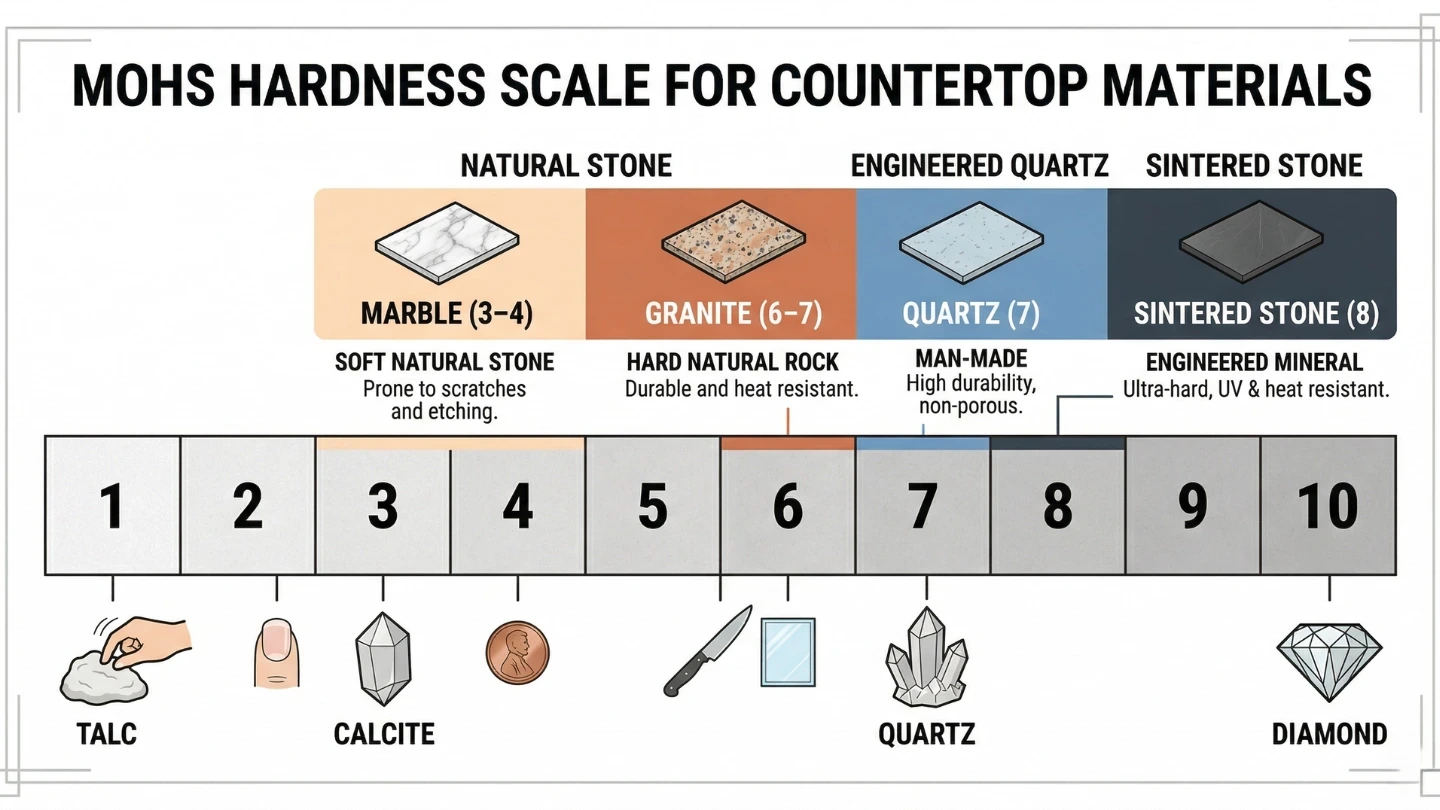
You've probably heard the word "hardness" thrown around when shopping for countertops. A sales consultant tells you quartz scores a 7, sintered stone scores an 8, marble is a soft 3 — and suddenly you're nodding along as if this all makes perfect sense.
But what does any of it actually mean? And more importantly, how should it shape the countertop decision you're about to make for your home?
This guide explains the Mohs hardness scale in plain English — what it measures, where common countertop materials sit on it, and how stone fabricators in Malaysia actually use this information when selecting and working with stone. By the end, you'll understand not just the number, but what it means for your kitchen on a daily basis.
What Is the Mohs Hardness Scale?
The Mohs hardness scale was developed in 1812 by German mineralogist Friedrich Mohs. His insight was elegantly simple: rather than measuring hardness in abstract units, he ranked minerals by whether one could scratch another.
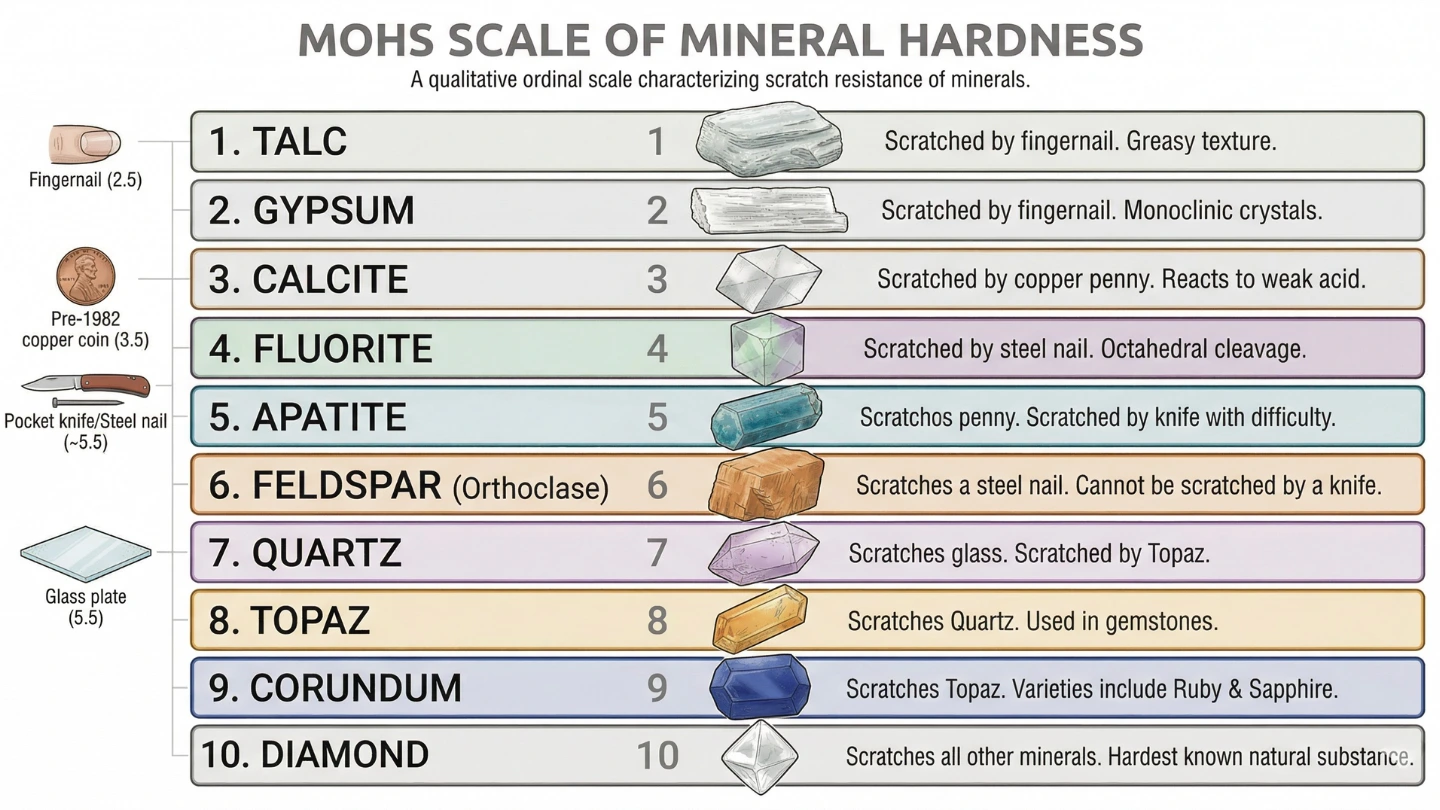
The scale runs from 1 to 10:
- 1 — Talc: The softest mineral known. You can scratch it with your fingernail.
- 2 — Gypsum: Soft enough to scratch with a fingernail under pressure.
- 3 — Calcite: Can be scratched with a copper coin.
- 4 — Fluorite: Scratched easily with a steel knife.
- 5 — Apatite: Just barely scratched by a steel knife.
- 5.5 — Glass: A useful reference point — harder than a knife blade, but not by much.
- 6 — Orthoclase Feldspar: Can scratch glass, resists a steel knife.
- 7 — Quartz: Scratches glass easily; this is where engineered quartz countertops sit.
- 8 — Topaz: Harder than quartz; sintered stone and porcelain slab sit around this range.
- 9 — Corundum (Sapphire/Ruby): Extremely hard.
- 10 — Diamond: The hardest natural material known.
The key principle: a material with a higher Mohs score will scratch any material below it. A material with a lower score cannot scratch one above it. Simple, but enormously useful.
What the Scale Does Not Measure
Here is something that surprises many homeowners: Mohs hardness measures scratch resistance only. It says nothing about:
- Brittleness — A material can be very hard yet shatter easily under impact. Diamonds are a perfect example; they score a 10 on Mohs but can crack if struck sharply.
- Porosity — How readily a stone absorbs liquids has nothing to do with its hardness.
- Stain resistance — A soft marble can be sealed to resist staining; a hard granite can still absorb oil if left unsealed.
- Heat resistance — A material's ability to withstand hot pans is determined by its thermal properties, not its hardness.
- Toughness — The ability to resist cracking under stress is a separate property entirely.
This distinction matters enormously when choosing a countertop for a Malaysian kitchen — and we'll come back to it.
Where Common Countertop Materials Sit on the Scale
Let's place the most common Malaysian countertop materials on the Mohs scale:
| Material | Mohs Hardness | Notes |
|---|---|---|
| Marble | 3–4 | Calcite-based; scratches relatively easily |
| Compressed marble | 3–4 | Similar base material to natural marble |
| Granite | 6–7 | Varies by mineral composition |
| Engineered quartz | 7 | Consistent due to engineered production |
| Quartzite (natural) | 7–8 | Often harder than granite |
| Porcelain slab | 7–8 | Dense fired ceramic; very hard surface |
| Sintered stone (e.g. Dekton) | 8 | Among the hardest countertop materials |
| Diamond (reference) | 10 | Hardest known natural material |
Natural Marble: Beautiful but Vulnerable
Marble sits at just 3 to 4 on the Mohs scale — meaning it is relatively soft for a countertop material. This is why marble countertops scratch over time, especially in busy kitchens. A metal utensil dragged across marble will leave fine scratches. Acidic liquids like lemon juice, vinegar, or tamarind water — common in Malaysian cooking — will etch into the surface even without scratching it, creating dull patches.
This doesn't make marble a poor choice. Its timeless beauty, unique veining, and luxurious feel make it genuinely desirable for the right spaces and the right homeowners. But understanding its low Mohs rating helps you manage expectations honestly.
For a detailed look at how marble compares to quartz in Malaysian kitchens, including how each handles our cooking habits and climate, our comparison guide covers everything you need to know.
Granite: Naturally Hard but Variable
Natural granite sits between 6 and 7 on the Mohs scale. This variability is important — granite is not a single mineral but a mix of several, primarily quartz, feldspar, and mica. The exact hardness depends on the mineral composition of that particular slab.
Granite is hard enough that your kitchen knives (typically Mohs 5.5–6) will not scratch it. This makes it genuinely durable for everyday kitchen use. However, its natural porosity means it requires sealing to resist stains — which is a different issue from hardness entirely.
To understand how granite performs as a countertop choice for Malaysian kitchens and whether it still makes sense in 2025, our guide gives you an honest, up-to-date assessment.
Engineered Quartz: Consistent at 7
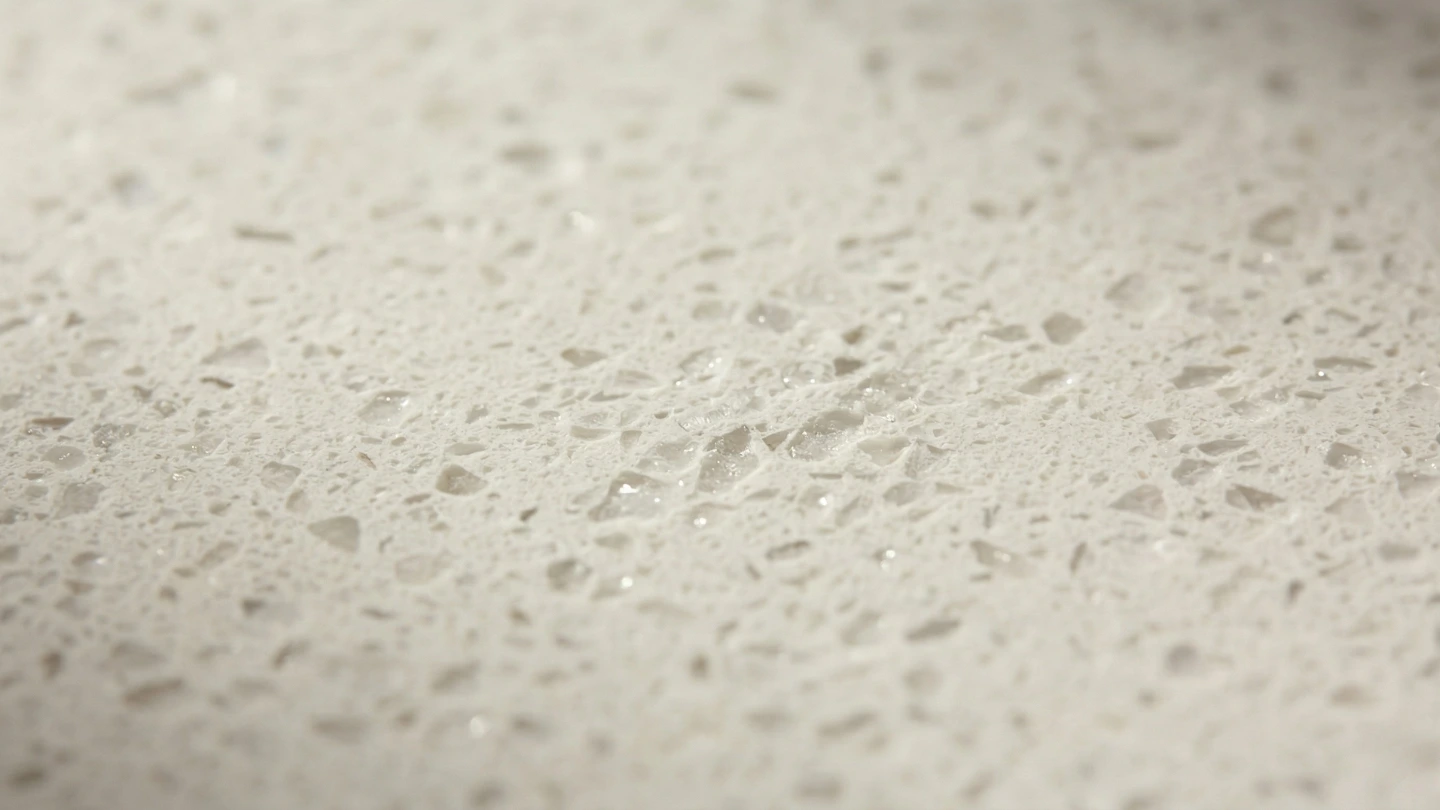
Engineered quartz countertops — from brands like Caesarstone, Silestone, and Zenstone — sit consistently at Mohs 7. Because quartz is an engineered product made from crushed natural quartz crystals (typically 90–93% quartz content) bound with resin, its hardness is predictable and uniform across the entire slab.
At Mohs 7, quartz will not be scratched by most kitchen utensils, steel cutlery, or everyday objects. It is also harder than glass (Mohs 5.5), which is why the glass scratch test works as a basic authenticity check — genuine quartz should scratch glass, not the other way around.
Importantly, the resin binder in engineered quartz adds a property that pure hardness cannot: toughness. The resin gives quartz a degree of flexibility that helps it absorb impact without cracking. This is one reason quartz resists chipping better than materials that score higher on the Mohs scale.
For more on what quartz stone is and how it is made, including the engineering behind its durability, our complete guide explains the manufacturing process in detail.
Sintered Stone: Hard at 8 — but Brittle
Sintered stone — the category to which Dekton belongs — sits at approximately Mohs 8. This makes it one of the hardest countertop surfaces available in Malaysia.
However, this is precisely where the distinction between hardness and brittleness becomes critical.
Sintered stone's extreme density, which gives it that Mohs 8 rating, also makes it more brittle than quartz. It has no resin content — the material is purely mineral, fused under extreme heat and pressure. This means that whilst sintered stone resists scratching exceptionally well, it is more susceptible to chipping at edges and corners when struck sharply. A heavy cast iron pan dropped near the edge of a sintered stone countertop poses more risk than the same pan dropped on quartz.
As we discuss in detail in our guide on the disadvantages of sintered stone for Malaysian homeowners, this hardness-versus-brittleness trade-off is one of the most important things to understand before choosing the material.
Porcelain Slab: Hard but Thin
Porcelain slabs sit in a similar hardness range to sintered stone, around Mohs 7 to 8, due to the high-temperature firing process that densifies the ceramic body. Like sintered stone, porcelain's hardness does not mean it is immune to breakage — on the contrary, porcelain's thin profile and ceramic composition make it quite vulnerable to sharp impact from overhead.
In a Malaysian wet kitchen where heavy pots and pans are regularly in use, a heavy object falling from overhead onto a porcelain countertop can crack it — a risk that quartz, with its resin content, handles more forgivingly.
How Stone Fabricators Use the Mohs Scale
Understanding where a material sits on the Mohs scale is not just useful for homeowners — it directly shapes how fabricators work with stone every single day.
Selecting the Right Cutting Tools
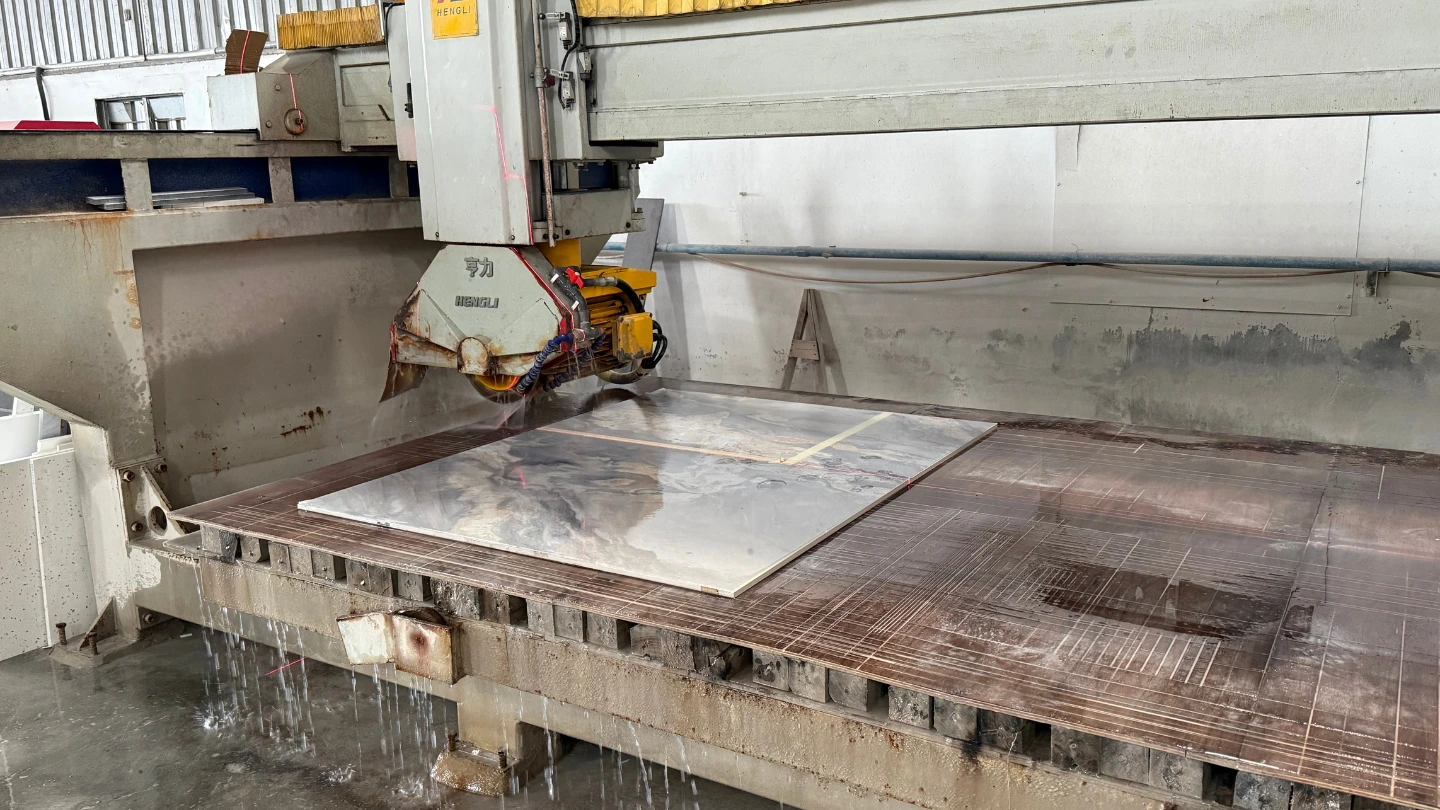
The most direct application of Mohs hardness in fabrication is tool selection. The fundamental rule: your cutting tool must be harder than the material you are cutting.
Diamond blades — used in bridge saw machines for primary slab cuts — work because diamond (Mohs 10) is harder than every countertop material, including sintered stone at Mohs 8. The diamond particles on the blade edge abrade through the stone surface continuously as the cut progresses.
But not all diamond blades are equal. A blade designed for cutting quartz (Mohs 7) will wear down significantly faster when used on sintered stone (Mohs 8). The harder the material being cut, the faster blade wear occurs, and the higher the risk of heat build-up that can cause micro-cracks in the stone or an uneven cut edge.
This is why experienced fabricators use different blade specifications for different materials:
- Quartz: Standard diamond blades work well; continuous rim blades preferred for clean edge finish.
- Sintered stone: Requires blades with a higher diamond concentration and softer bond matrix, allowing worn diamond particles to shed and expose fresh cutting edges more readily.
- Porcelain slab: Similar blade requirements to sintered stone; cutting speed must be carefully managed to prevent chipping at the cut edge.
- Marble and granite: These vary more by specific composition; fabricators often test cutting speed and water flow to find the right balance for each slab.
Getting this wrong has real consequences. A fabricator using the wrong blade on sintered stone risks producing rough, chipped cut edges — or worse, stress cracks that propagate from the cut line inward into the slab.
CNC Milling for Sink Holes: Hardness Matters Here Too
When cutting sink openings or hob cutouts, Malaysian fabricators use CNC machines with router bits rather than the bridge saw. Again, Mohs hardness determines the appropriate bit selection and cutting speed.
For quartz and softer stones, standard diamond router bits cut efficiently at reasonable speeds. For sintered stone and porcelain, the harder surface means slower feed speeds, more frequent bit inspection, and higher coolant water flow to manage heat.
A rushed or poorly equipped fabricator cutting a sink opening in sintered stone without the right CNC setup is a common source of cracking — and it is one reason why not every fabricator in Malaysia should be working with these harder materials.
To understand how a countertop goes from raw slab to your finished kitchen surface, our fabrication guide walks through every step of the process in detail.
Edge Polishing: The Harder the Stone, the More Effort Required
Edge profiles — mitre joints, chamfered edges, bullnose — require polishing after cutting to achieve a smooth, finished surface. Here, Mohs hardness has a direct practical implication: harder materials require more abrasive steps and more polishing time to achieve the same quality of finish.
Marble, at Mohs 3 to 4, polishes relatively easily. Its softness allows abrasive pads to cut through surface irregularities quickly, producing a high-gloss finish with less effort.
Quartz at Mohs 7 requires a full progression of diamond polishing pads — typically moving through multiple grits from coarse to ultra-fine — to achieve a smooth, glossy edge. The process is more time-consuming than marble but well-established.
Sintered stone at Mohs 8 requires even more polishing steps and more aggressive abrasive pads. This is one reason sintered stone fabrication costs more than quartz; the additional tooling time and consumable costs are real.
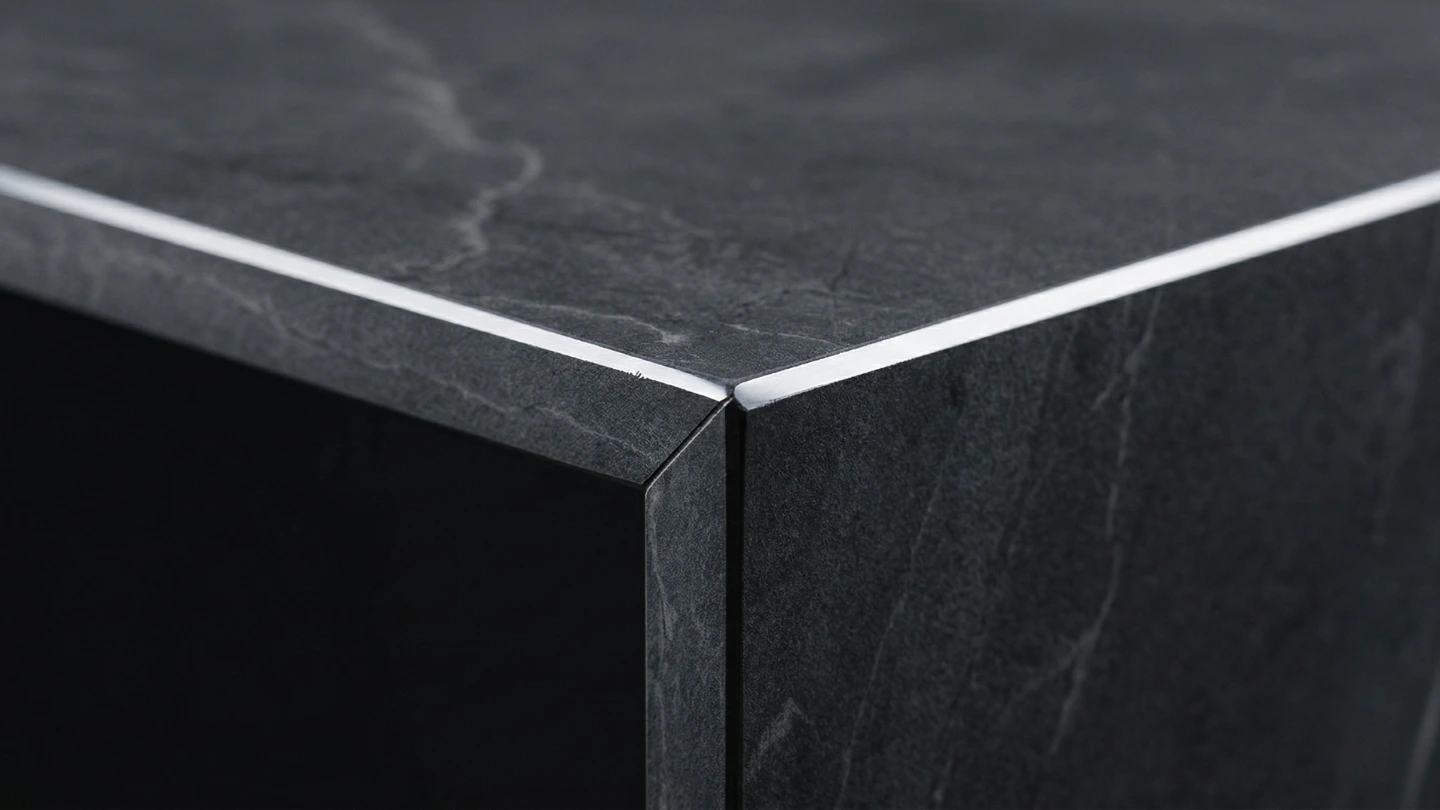
At Sinno Stone, our mitre edges receive a 3mm chamfered polish on all joints — a refinement we upgraded in 2022 after consulting with Spanish fabrication technicians. This detail, which adds time to every job, virtually eliminated the edge chipping complaints that can occur with a sharper 1mm chamfer on harder materials.
Assessing Scratch Risk During Installation
Hardness knowledge also helps fabricators protect surfaces during installation. A common concern: will the installation process itself scratch the countertop?
The answer depends on what comes into contact with the surface. Most installation tools and brackets are steel, sitting at roughly Mohs 5.5 to 6. This means:
- Against marble (Mohs 3–4): Steel tools can easily scratch the surface. Protective padding is essential.
- Against quartz (Mohs 7): Steel cannot scratch quartz; the risk reverses — quartz can scratch the steel tools.
- Against sintered stone (Mohs 8): Even less scratch risk from steel; however, the brittleness concern shifts attention to impact protection instead.
This understanding shapes how slabs are handled, transported, and placed during installation — an often-overlooked dimension of quality fabrication.
What Mohs Hardness Means for Your Malaysian Kitchen
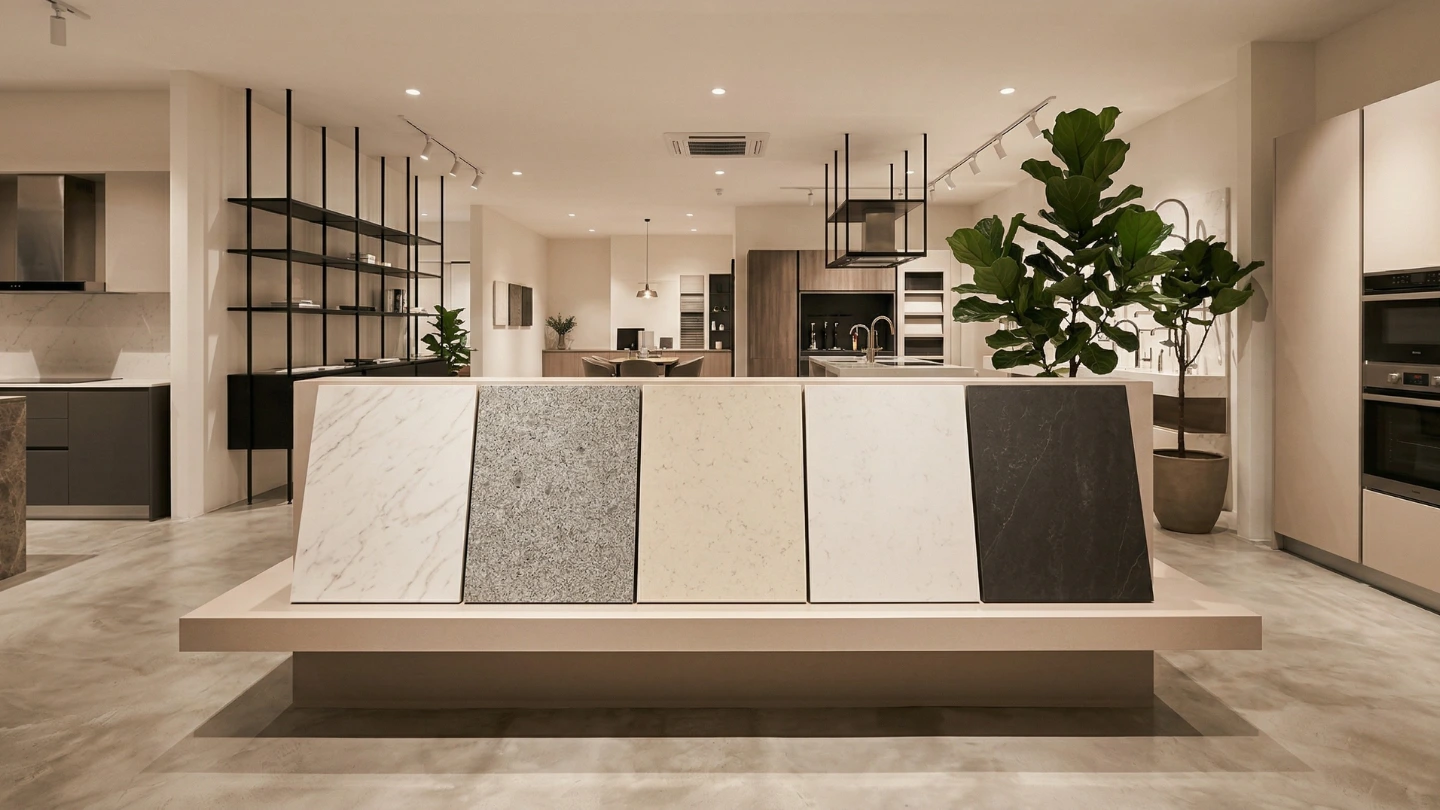
With all of this technical context established, let's bring it back to what actually matters: your countertop, your kitchen, and your daily cooking life.
The Wet Kitchen Reality
Malaysian cooking is intense. Wok cooking generates high heat, constant movement of pots and pans, splashing of oils, and regular use of acidic ingredients — tamarind, lime, vinegar — alongside vibrantly coloured spices like turmeric, belacan, and sambal.
In a typical Malaysian wet kitchen, scratch resistance (Mohs score) matters, but it's rarely the deciding factor. Here is why:
First, most scratching in a kitchen comes from dragging objects across the surface — chopping directly on the countertop, sliding heavy pots, or cutting near the edge. All modern countertop materials above Mohs 6 will resist scratching from steel utensils and everyday kitchen use perfectly well. The difference between a Mohs 7 and a Mohs 8 surface is not something you will notice during normal cooking.
Second, what actually damages Malaysian kitchen countertops most often is not scratching — it is impact (dropped items from overhead cabinets), chemical exposure (drain cleaners, harsh acids), heat (hot pans placed directly on surfaces without trivets), and staining from highly pigmented cooking ingredients. None of these are measured by Mohs hardness.
What Should Actually Drive Your Decision
Here is a practical framework based on how Mohs hardness interacts with real Malaysian kitchen conditions:
If you have a wet kitchen with heavy daily cooking: Prioritise toughness (impact resistance) over raw hardness. Quartz at Mohs 7 with its resin binder absorbs impact better than the harder but more brittle sintered stone at Mohs 8. For a busy wet kitchen where pots are frequently dropped and moved, quartz's combination of hardness and toughness is often the better fit.
If you want the absolute hardest, most scratch-proof surface: Sintered stone (Dekton) and porcelain slab at Mohs 8 offer the highest scratch resistance available. These are excellent choices for homeowners who prioritise this property, particularly for outdoor kitchens or surfaces exposed to UV and direct sunlight — where sintered stone's additional performance advantages compound.
If you love marble but are worried about scratching: Marble's Mohs 3 to 4 rating is a genuine limitation, particularly for a wet kitchen. If you are set on marble aesthetics, consider using natural marble for a dry kitchen or bathroom vanity — lower traffic spaces where its softness is less of a practical concern. Alternatively, explore quartz options designed to replicate marble appearances, which deliver the look at Mohs 7 durability.
If you are comparing natural stone options: Granite (Mohs 6 to 7) and quartzite (Mohs 7 to 8) both offer strong natural stone options with respectable hardness. The key difference is not hardness but porosity — granite requires sealing to resist staining, whilst quartzite similarly needs protection despite its harder rating.
For a full side-by-side look at the complete range of countertop materials available for Malaysian kitchens, including pricing, maintenance, and suitability for different spaces, our comprehensive guide covers all 14 options in detail.
The Fake Quartz Problem — Where Mohs Helps Homeowners
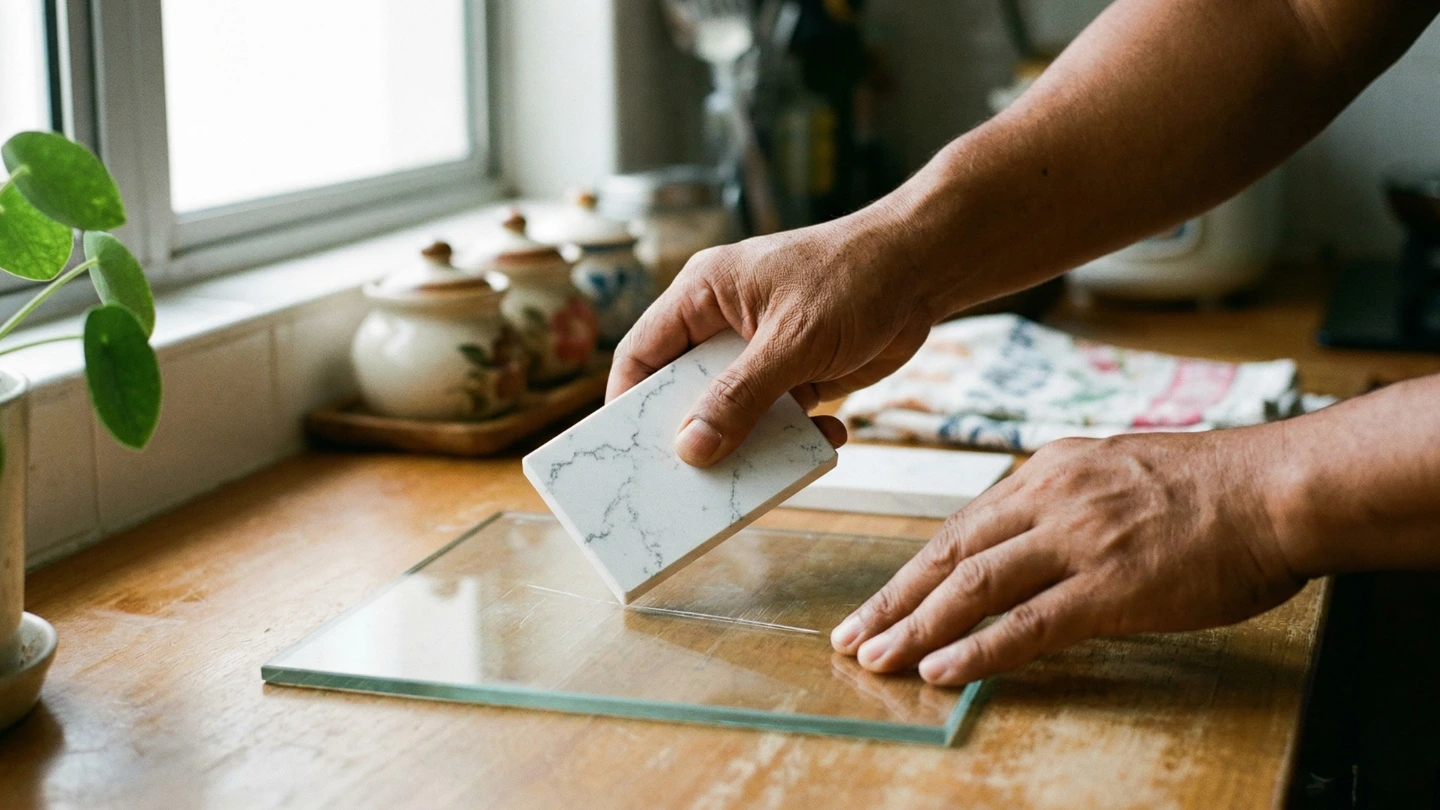
One genuinely useful application of Mohs knowledge for Malaysian homeowners is identifying fake quartz. As discussed in our guide on how to spot fake quartz and protect your renovation investment, a simple glass scratch test leverages Mohs science directly.
Genuine engineered quartz (Mohs 7) should scratch glass (Mohs 5.5). If a "quartz" sample cannot scratch a glass tile, its quartz content is likely far lower than advertised — meaning you are looking at compressed marble, resin-heavy imitation stone, or another inferior product dressed up as quartz.
This is one of the few situations where knowing the Mohs number arms you with a practical, hands-on verification tool before you spend RM20,000 on a countertop.
A Word on Hardness vs Toughness: The Most Common Misconception
Before we close, it is worth addressing the single most common misconception about countertop hardness: harder does not mean stronger.
Strength and hardness are different properties. Hardness measures resistance to surface scratching. Strength (or toughness) measures resistance to fracture or breaking under force.
A diamond (Mohs 10) can be shattered with a hammer. It is the hardest naturally occurring material, but it is not the toughest.
Similarly, sintered stone (Mohs 8) is harder than quartz (Mohs 7) — but quartz is tougher. The resin in quartz gives it flexibility and impact absorption that pure mineral sintered stone lacks. This is why quartz countertops resist chipping at edges better than sintered stone in most real-world kitchen conditions, even though sintered stone scores higher on Mohs.
For Malaysian homeowners, this means:
- A higher Mohs number is not automatically "better"
- The right hardness level depends on your specific usage patterns
- Toughness, chemical resistance, heat tolerance, and stain resistance are all separate considerations
Understanding all of these properties together — not just hardness in isolation — is what leads to a countertop decision you will be genuinely happy with a decade from now.
Choosing the Right Material With Confidence
The Mohs hardness scale is a powerful tool, but it is one dimension of a multi-dimensional decision. For Malaysian kitchens, hardness matters — but so does toughness, chemical resistance, sealing requirements, fabrication quality, and the specific conditions of your cooking environment.
Here is a quick summary of where the key materials stand:
- Marble (Mohs 3–4): Beautiful and unique; best for dry kitchens, bathrooms, or low-traffic surfaces. Requires careful maintenance.
- Granite (Mohs 6–7): Reliable natural stone with good hardness; requires sealing against staining.
- Engineered quartz (Mohs 7): The all-rounder — hard enough to resist scratching, tough enough to absorb impact, non-porous, and available in hundreds of designs. Ideal for most Malaysian wet kitchens.
- Porcelain slab (Mohs 7–8): Very hard surface but brittle; requires experienced fabrication and careful daily use.
- Sintered stone / Dekton (Mohs 8): The hardest countertop option; exceptional for outdoor use and UV exposure, but premium pricing and brittleness at edges are real trade-offs.
Whichever material appeals to you, choose a fabricator who understands it thoroughly — someone who knows not just the Mohs number, but what it means for how the slab is cut, polished, handled, and installed in your specific kitchen.
For information on what quartz stone is made of and how it is engineered for durability, or to explore how sintered stone compares to quartz for Malaysian kitchens, our guides give you the in-depth material comparisons to make a confident, well-informed decision.