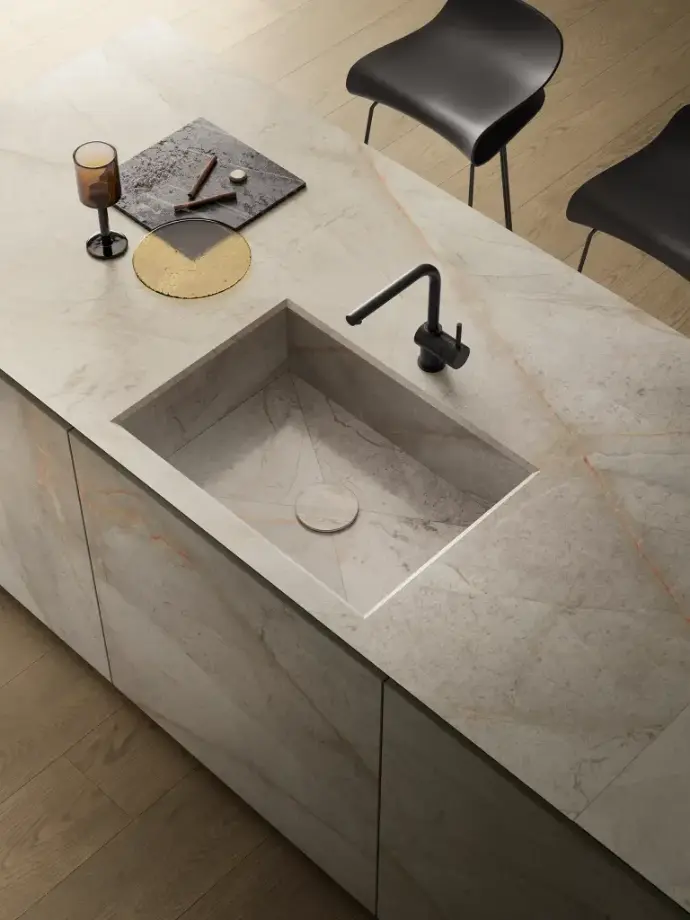
When you visit a stone showroom and select a beautiful Calacatta-veined quartz or sleek sintered stone slab, it’s easy to assume the hard part is over. You’ve made your choice, signed off on the colour, and now you wait for installation day. But between that moment and the stunning countertop gracing your Malaysian kitchen lies a fascinating transformation that most homeowners never see.
Understanding this journey from raw slab to finished surface isn’t just interesting—it’s essential. Knowing what happens behind the scenes helps you appreciate why professional fabrication costs what it does, why timelines exist, and why choosing the right fabricator matters as much as choosing the right stone.
The Starting Point: Your Stone Slab
Every kitchen countertop begins as a large rectangular slab, typically measuring around 3,000mm x 1,400mm for quartz stone or up to 3,200mm x 1,600mm for sintered stone materials. These slabs arrive at fabrication facilities in Malaysia after being manufactured in facilities across the globe—quartz from plants in the US, Spain, or China, and sintered stone primarily from Italian and Spanish manufacturers.
The slab you selected at the showroom isn’t just a pretty face. Each material type—whether quartz stone, sintered stone, or porcelain slab—has distinct properties that affect how it must be handled, cut, and finished. Quartz contains resin binders that make it somewhat flexible and forgiving during fabrication. Sintered stone, fired at temperatures exceeding 1,200°C, is incredibly hard but requires careful handling to prevent chipping. Porcelain slabs demand specialised techniques, including wider chamfer edges of 3mm rather than the standard 1mm used for quartz, to prevent edge chipping during use.

Stage 1: Templating
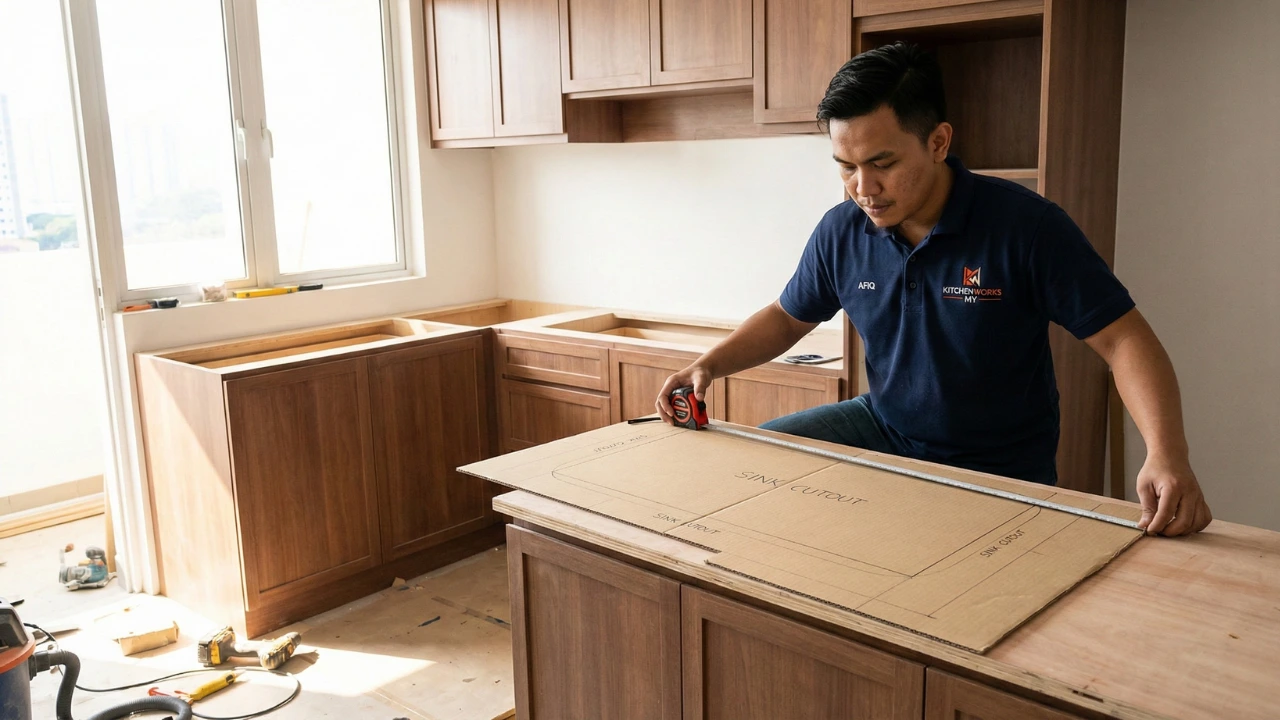
Accurate templating is the foundation of every successful countertop installation. A templating technician visits your home after your cabinets are installed (this timing is crucial) to capture your kitchen’s exact dimensions.
Using precise measuring tools and physical templates, the technician maps every angle, curve, and irregularity in your kitchen layout. Malaysian apartment kitchens often feature L-shaped or U-shaped configurations that require precise corner measurements. The template captures the positions for your sink cutout, hob opening, and any tap holes you’ve specified.
This template becomes the blueprint for everything that follows. Any errors at this stage will carry through to the final product, which is why reputable fabricators insist on templating only when cabinets are fully installed and level.
Why Timing Matters
In Malaysia’s humid climate, wooden cabinets can shift slightly after installation as they acclimatise to your home’s environment. Rushing to template before cabinets have settled can result in gaps between your countertop and walls, or misaligned sink cutouts. Professional fabricators typically recommend waiting three to five days after cabinet installation before templating.
Stage 2: Slab Selection and Layout Planning
With your template in hand, the fabrication team faces a critical decision: how to cut your countertop pieces from the slab to maximise material usage whilst ensuring the best aesthetic result.
This isn’t as simple as it sounds. A typical Malaysian kitchen might require three to five separate pieces—main countertop runs, an island top, backsplash sections, and perhaps a waterfall edge panel. The fabricator must position these pieces on the slab to minimise waste whilst also considering vein direction for marble-look patterns, ensuring the visual flow makes sense when installed.
For homeowners who’ve selected a dramatically veined pattern, this layout planning becomes even more crucial. The veins should flow logically across seams where pieces join, creating the illusion of a continuous surface. This is one reason why choosing different colours for each countertop section costs more—it requires multiple slabs and eliminates opportunities for efficient layout planning.
Stage 3: Cutting and Milling
Once the layout is finalised, the slab moves through two key pieces of equipment that transform it from a raw slab into precisely shaped countertop pieces.
Bridge Saw Cutting
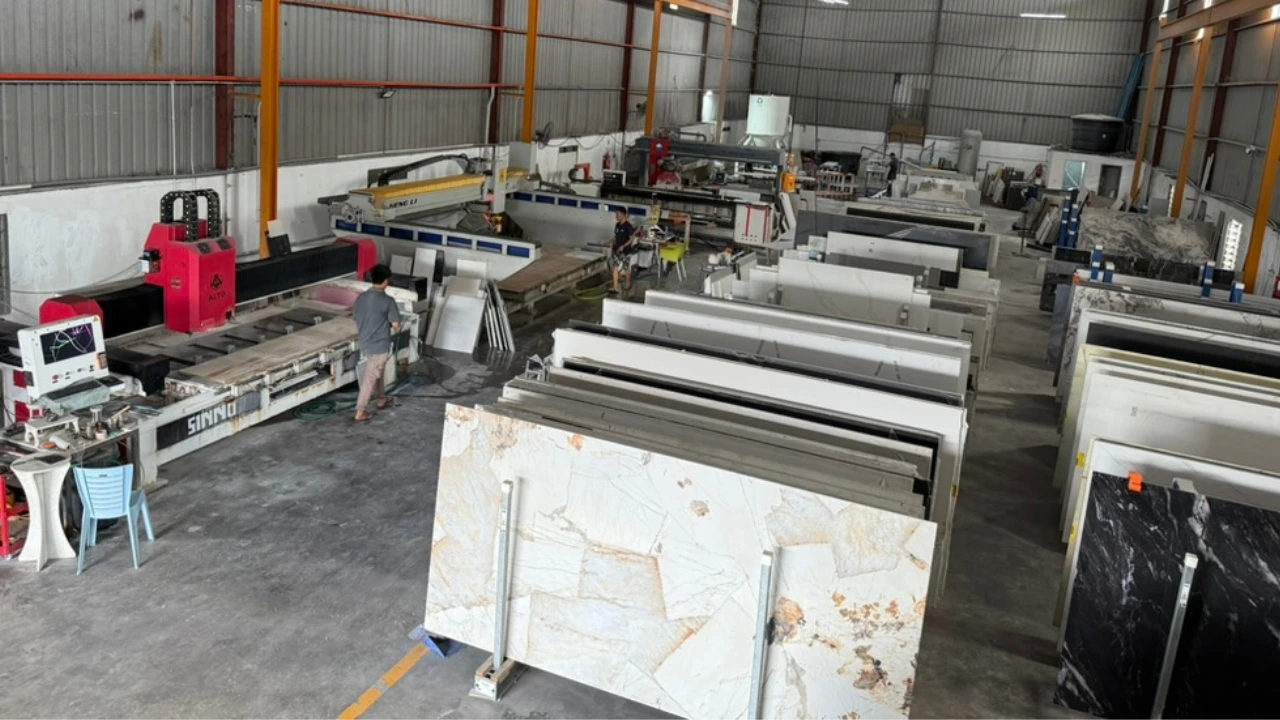
The first step involves the bridge saw machine—a powerful cutting system that slices through stone with diamond-tipped blades. This machine handles the primary cuts: trimming the slab to size, cutting out your countertop pieces according to the template, and creating straight edges.
The bridge saw uses a continuous flow of water during cutting, serving two crucial purposes: cooling the blade to prevent overheating and suppressing the silica dust that would otherwise pose serious health risks to workers. This is particularly important when working with quartz, which contains crystalline silica—a material that, when inhaled during fabrication, can cause irreversible lung damage.
Skilled operators guide the bridge saw to achieve clean, precise cuts. The machine’s overhead bridge design allows it to move across large slabs smoothly, making it ideal for the straight cuts that form the basic shape of your countertop pieces.
CNC Milling for Sink Holes and Detailed Work
After the bridge saw completes the primary cuts, the countertop pieces move to the CNC (Computer Numerical Control) machine for detailed milling work. This is where precision truly matters—the CNC mills out your sink opening to exact specifications, creates the hob cutout sized perfectly for your chosen appliance, and handles any curved or intricate shapes that the bridge saw cannot achieve.
The CNC machine excels at creating the precise cutouts required for undermount sink installations, including the slight inward angle on the cutout edge that allows the sink to sit properly. It also mills tap holes with perfect positioning and creates any custom shapes your kitchen design requires.
This two-stage process—bridge saw for cutting, CNC for milling—combines the efficiency of powerful cutting equipment with the precision of computer-controlled detailing. The result is countertop pieces that fit your kitchen exactly as templated.
Fabrication Differences by Material
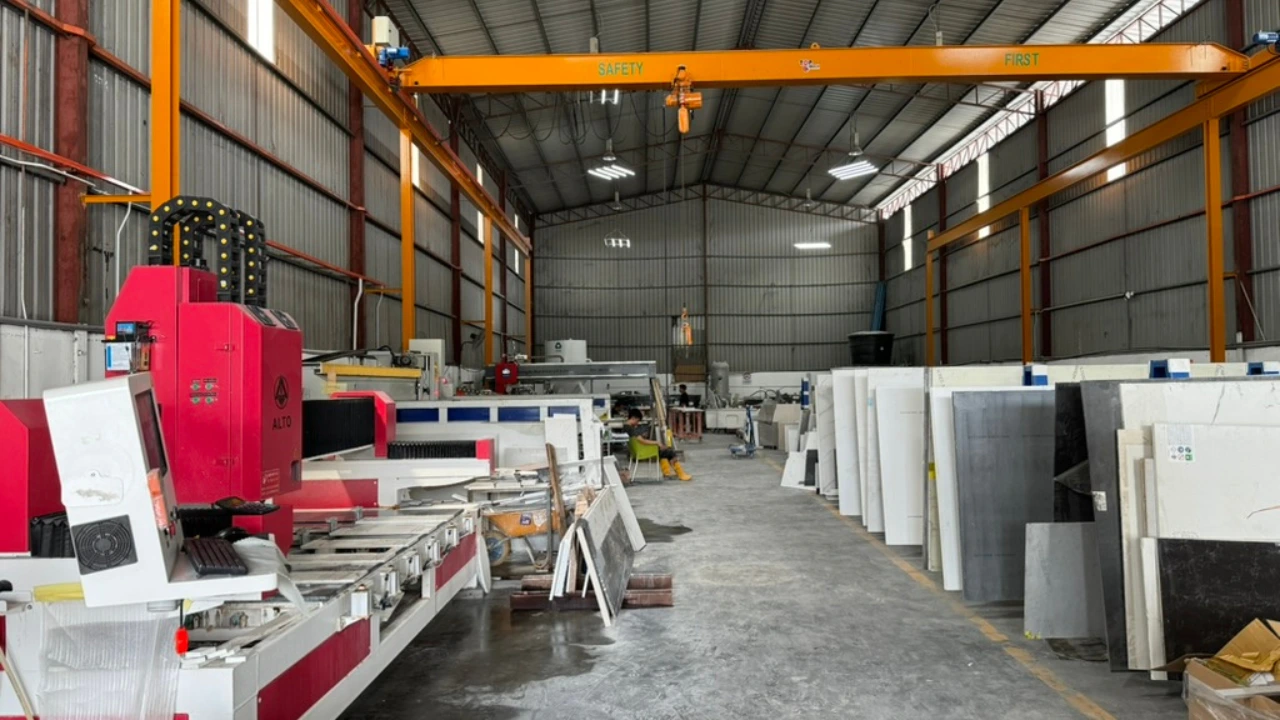
Different materials demand different handling at both the bridge saw and CNC stages. Quartz stone, with its resin content, cuts relatively smoothly and tolerates minor adjustments well. Sintered stone requires slower cutting speeds and more water flow due to its extreme hardness. Porcelain slabs are the most demanding—their layered structure means aggressive cutting can cause delamination, so fabricators must use specialised blades and techniques.
This is precisely why asking your tiler to install stone countertops is problematic. Without access to bridge saw and CNC equipment, along with material-specific expertise, the risk of damage, poor fit, or even personal injury is significant.
Stage 4: Edge Profiling
The edge of your countertop is more than a finishing detail—it’s one of the most visible parts of the installation and affects both the overall aesthetic and how the countertop handles daily wear. Edge profiling transforms the raw cut edge into your chosen style.
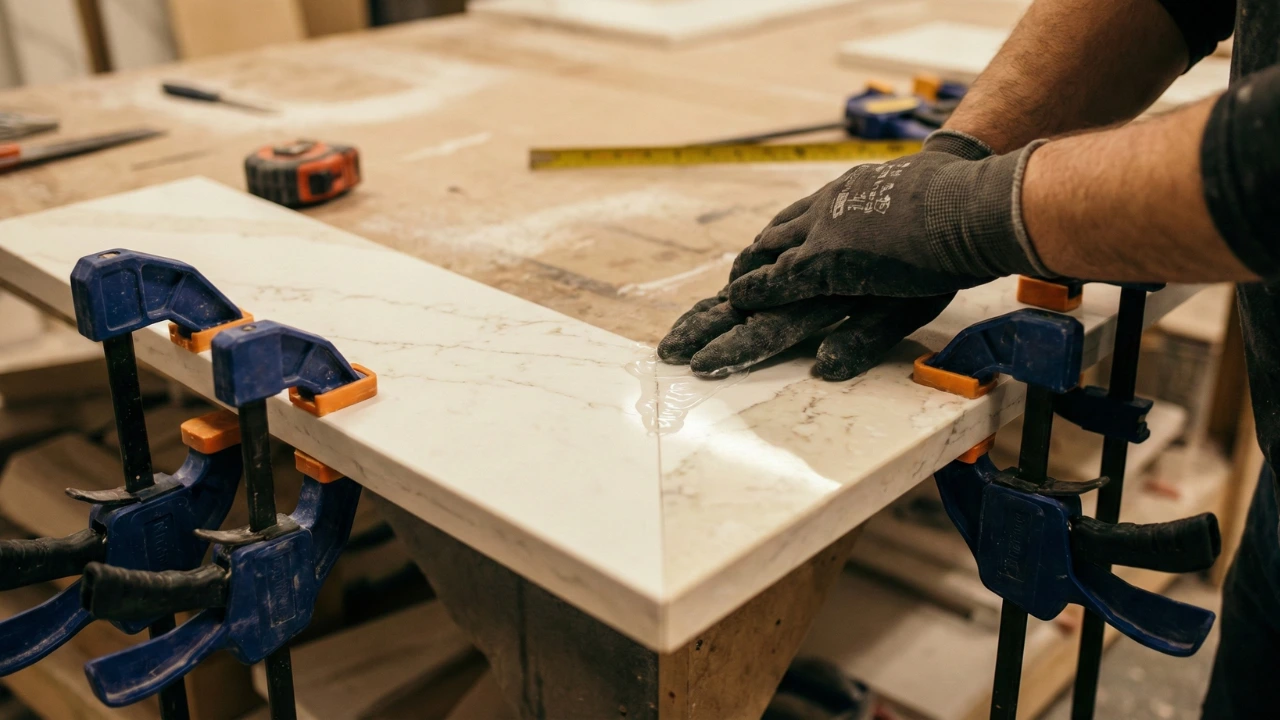
In Malaysian kitchens, the mitre edge has become the predominant choice for countertop installations. This technique involves cutting two pieces at precise 45-degree angles and joining them together, creating a sophisticated look that gives the appearance of a thicker, more substantial slab. The mitre edge is particularly popular for kitchen islands and waterfall edges, where the countertop surface continues down the side of the island to create a dramatic visual statement.
For quartz stone, edge profiling is relatively straightforward—the material polishes to a high gloss that matches the slab surface, and mitre joints can be achieved with tight, nearly invisible seams.
Sintered stone and porcelain require a different approach. Because these materials are harder and more brittle, tight mitre joints risk chipping over time—a common issue that can worsen with daily use. To address this, professional fabricators polish a 3mm chamfer on the edges where two mitre-cut pieces join. This chamfered edge significantly reduces the risk of chip-off, ensuring your countertop remains intact for years of heavy kitchen use.
The trade-off is that this chamfered joint exposes a thin line of the material’s body colour—typically white for sintered stone. Reputable fabricators will always discuss this with you before proceeding. If the visible chamfer line isn’t acceptable for your design preferences, quartz stone is often recommended as an alternative, since it allows for tighter mitre joints without the same chipping concerns.
This honest approach—explaining the technical realities before fabrication begins—is a hallmark of professional stone fabricators who prioritise long-term durability over short-term aesthetics.
The mitre technique is also used to create waterfall edges—where the countertop surface continues down the side of a kitchen island to the floor. This dramatic design element has become increasingly popular in Malaysian homes, particularly in open-concept kitchens where the island serves as a visual centrepiece.
Stage 5: Surface Finishing and Cutout Refinement
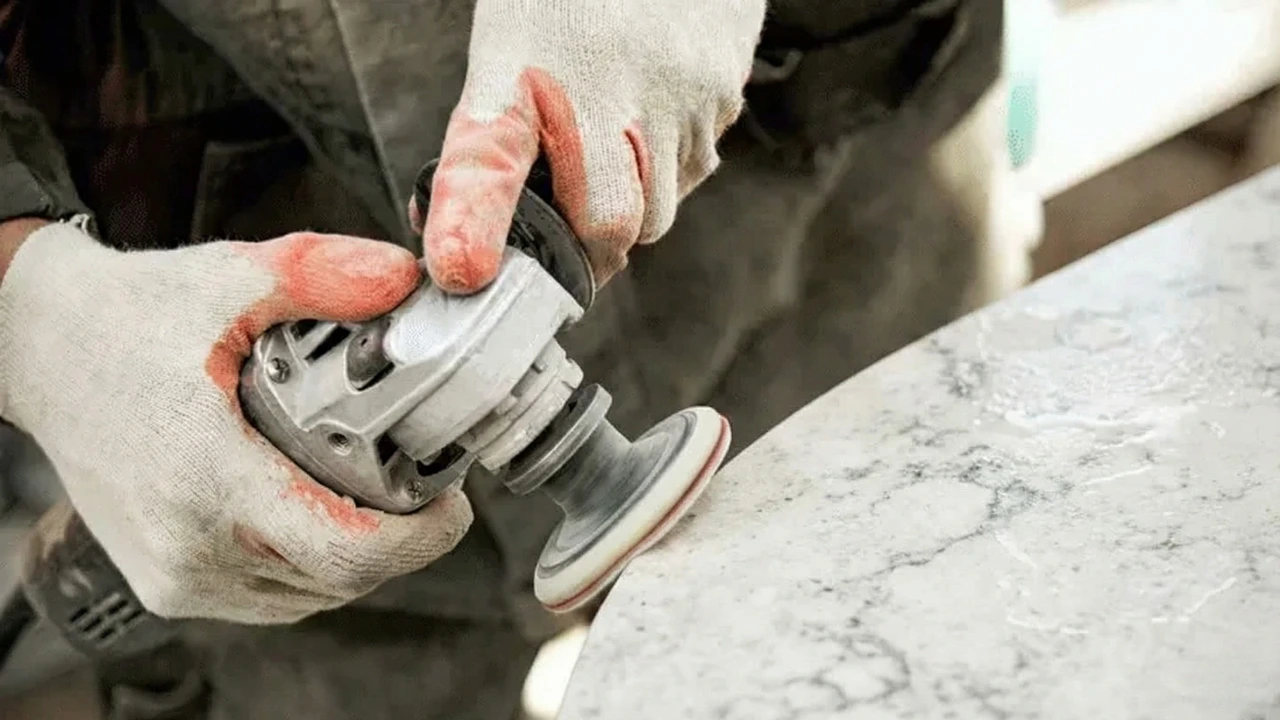
After edge profiling, the countertop pieces move to detailed finishing. Technicians inspect every edge and surface, smoothing any irregularities and ensuring the finish is consistent throughout. Sink and hob cutouts receive particular attention—these edges must be perfectly smooth to prevent water intrusion and ensure proper appliance fit.
For undermount sinks, fabricators create a slight polish on the inner cutout edge that will be visible once the sink is installed. Any roughness here would be noticeable when you’re washing dishes, so this finishing step is crucial.
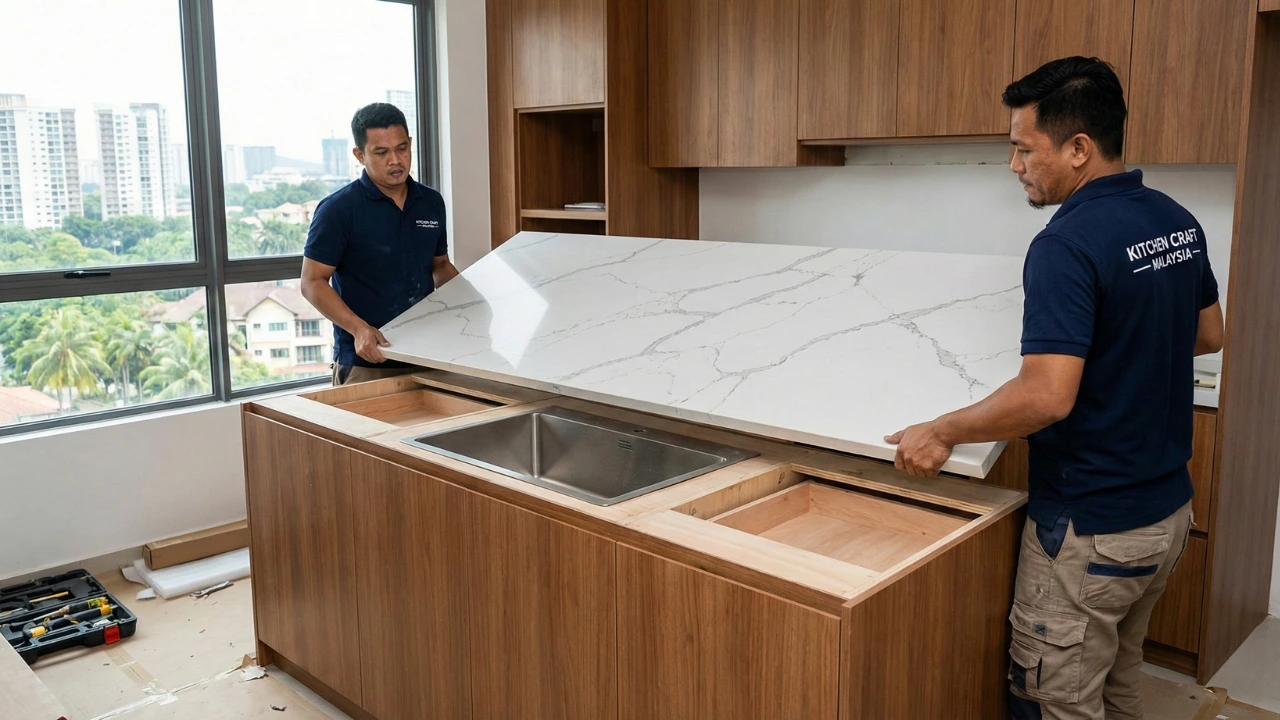
In Malaysian installations, the countertop is fully supported by a plywood base that sits on top of your kitchen cabinets. This plywood platform provides continuous, stable support across the entire countertop surface. The undermount sink is positioned on this plywood base first, and then the stone countertop is placed on top, with the sink fitting up into the cutout from below. This installation method ensures even weight distribution and provides solid support around the sink area—one of the most heavily used parts of any kitchen countertop.
Stage 6: Quality Control
Before your countertop leaves the fabrication facility, it undergoes thorough quality control inspection. Technicians check dimensional accuracy against the original template, verify that all cutouts are correctly positioned and sized, and examine the surface for any chips, scratches, or finishing inconsistencies.
This is also when colour matching is verified for installations requiring multiple pieces. Under the controlled lighting of the fabrication shop, any variation between pieces becomes apparent. If a significant mismatch exists, reputable fabricators will communicate this before installation rather than hoping you won’t notice.
Malaysian fabricators working with premium brands like Caesarstone or Silestone maintain particularly strict quality control standards to uphold brand warranties and certifications. This attention to detail is one reason why supply-and-install pricing for premium materials—ranging from RM 325 to RM 814 per square foot for Caesarstone, or RM 110 to RM 160 per square foot for Zenstone—reflects more than just the stone itself.
Stage 7: Installation Day
Your countertop finally arrives at your home, carefully transported in purpose-built racks that keep pieces vertical (lying stone flat during transport risks cracking) and separated by protective padding. The installation team typically comprises at least two experienced technicians—stone countertops are heavy, and proper handling requires coordinated effort.
Installation begins with a dry fit—placing all pieces in position without adhesive to verify everything aligns correctly. This is the moment when any template errors would become apparent. Assuming the fit is correct, technicians then apply silicone adhesive to the cabinet tops and carefully lower each piece into position.
Seams between pieces require particular skill. Fabricators use marble adhesive to join sections, casting a colour that closely matches the countertop’s base colour. The pieces are clamped tightly whilst the adhesive cures. A well-executed seam should be smooth to the touch and blend naturally with the overall surface. Poor seam work is one of the most common complaints about countertop installations, so this stage separates skilled fabricators from amateur operators.
The Final Connections
Once the countertop is secured, technicians make the final connections—applying silicone sealant around sink cutouts, ensuring the hob opening allows proper ventilation, and sealing the joint between the countertop and wall. In Malaysian kitchens, where the backsplash area is often exposed to splashes from wok cooking and heavy spice preparation, this sealing is especially important to prevent moisture intrusion behind the countertop.
The installation team will also verify that the countertop is perfectly level, making minor adjustments to cabinet supports if necessary. An unlevel countertop isn’t just aesthetically bothersome—it can cause structural stress that leads to cracking over time.
Why Professional Fabrication Commands Its Price
When you see how much quality stone countertops cost in Malaysia, it’s natural to wonder where that money goes. Now you understand: it’s not just purchasing a piece of stone. You’re paying for precise templating by trained technicians, bridge saw and CNC machinery worth hundreds of thousands of ringgit, skilled fabricators who understand each material’s unique requirements, quality control systems that catch problems before installation, transportation in specialised vehicles, and experienced installation teams who’ve handled hundreds of kitchens.
When suppliers quote supply-and-install pricing—say, RM 162.50 per square foot for entry-level Caesarstone or RM 473 per square foot for premium concrete-look finishes—that price encompasses this entire journey from slab to surface.
The Difference Quality Makes
In a Malaysian kitchen that might see twenty years of daily use, the difference between professional and amateur fabrication becomes starkly apparent. Properly fabricated countertops maintain their structural integrity around sink cutouts, present invisible seams that don’t collect grime, and feature edges that remain smooth and chip-free despite constant contact.
Poorly fabricated countertops, by contrast, often develop cracks radiating from cutouts (insufficient rodding), visible and discoloured seams (poor technique or wrong adhesive), and chipped edges that worsen over time (improper edge treatment for the material type).
What to Look for in a Fabricator
Understanding the fabrication process empowers you to ask the right questions before paying a deposit. When evaluating fabricators, consider enquiring about their templating process and accuracy standards, their experience with your specific material type (a fabricator who primarily works with quartz may not have the expertise for sintered stone), and whether you can visit their facility to see the equipment and processes firsthand.
Reputable fabricators welcome such questions—they’re proud of their capabilities and happy to demonstrate why their work commands professional pricing. Those who deflect or seem uncertain about technical details may lack the expertise your project deserves.
The Transformation Complete
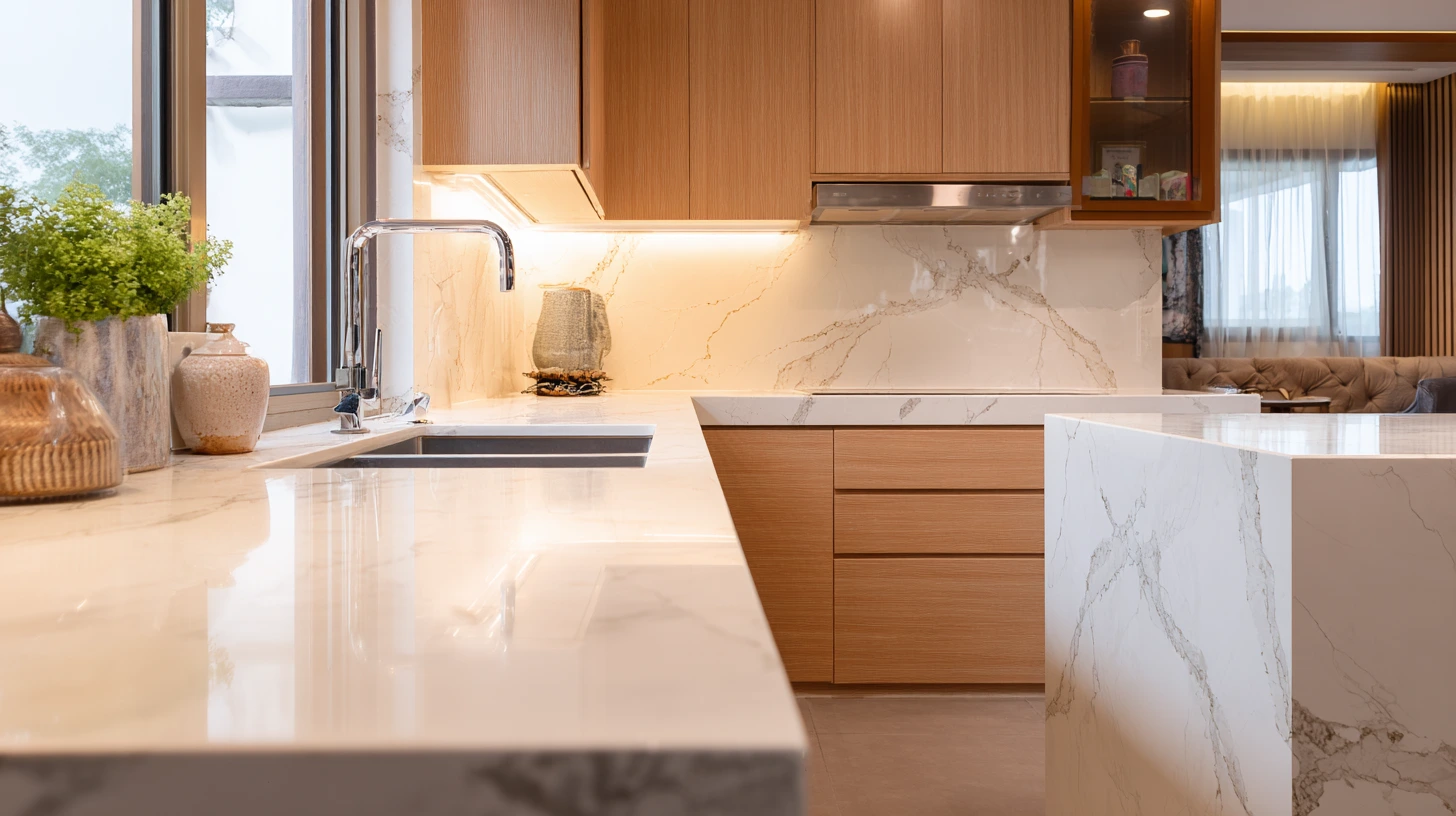
From a raw slab stored in a warehouse to the stunning surface where you’ll prepare countless family meals, your kitchen countertop undergoes a remarkable transformation. Each stage—templating, layout planning, CNC cutting, edge profiling, finishing, quality control, and installation—requires specific expertise, equipment, and attention to detail.
The next time you run your hand along your countertop’s smooth edge or admire how the veining flows seamlessly across a seam, you’ll appreciate the craftsmanship behind that surface. And when you’re comparing quotes from different suppliers, you’ll understand why quality fabrication matters just as much as the stone you select.
Your kitchen countertop isn’t just a surface—it’s the result of a carefully orchestrated manufacturing process that transforms raw material into the centrepiece of your Malaysian home.