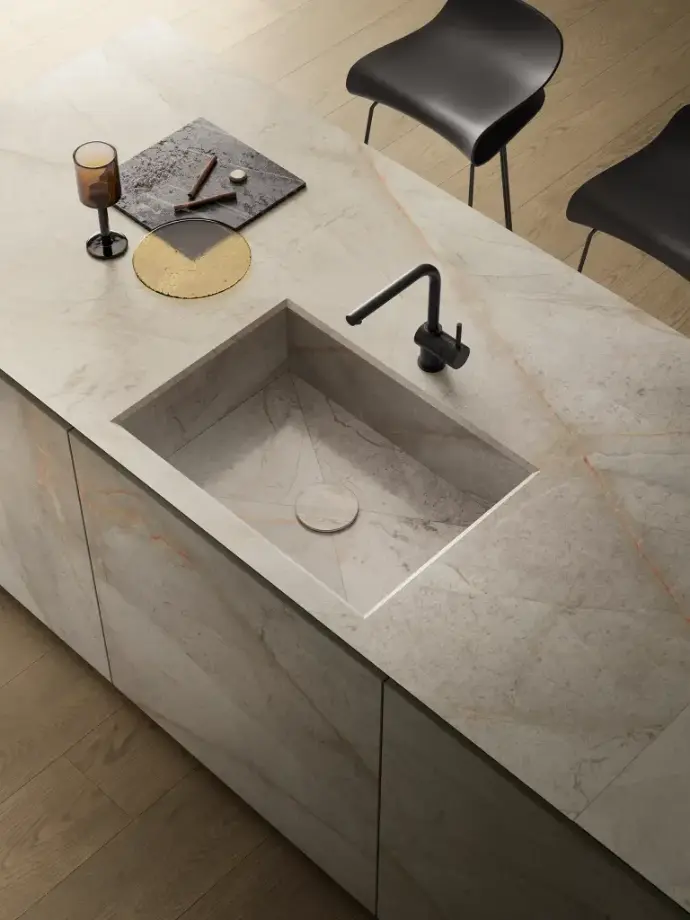
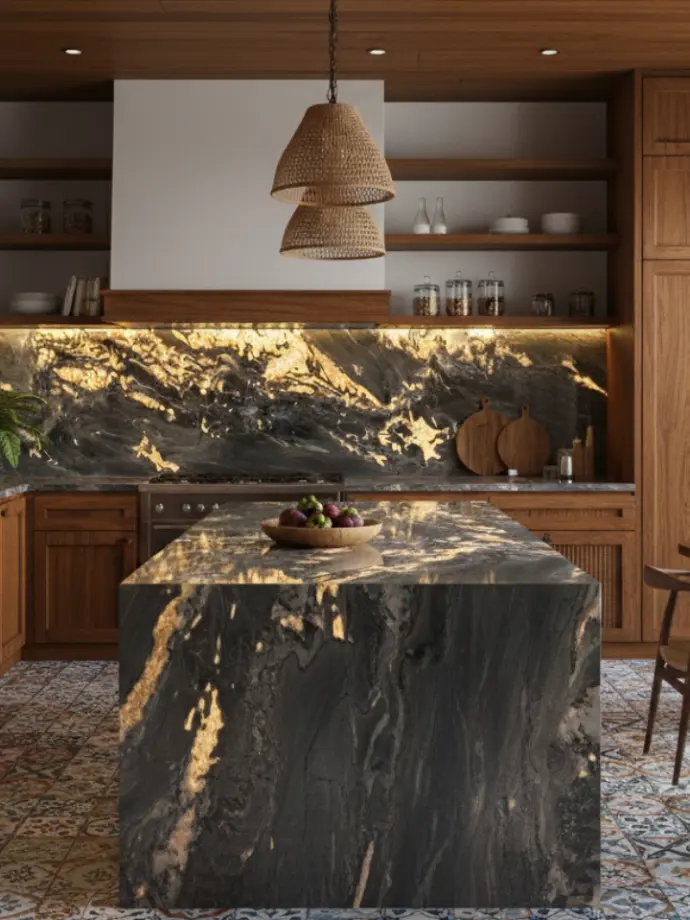
If you’re renovating your kitchen in Malaysia, you’ve probably found yourself caught between two of the most popular countertop materials on the market: sintered stone and quartz. Both are engineered surfaces that promise durability, beauty, and low maintenance. But which one is actually better for your home?
The honest answer? Neither material is universally “better.” Each excels in different areas, and the right choice depends entirely on your cooking habits, budget, aesthetic preferences, and how you plan to use your kitchen. This guide cuts through the marketing noise to give you a straightforward comparison based on real-world performance in Malaysian homes.
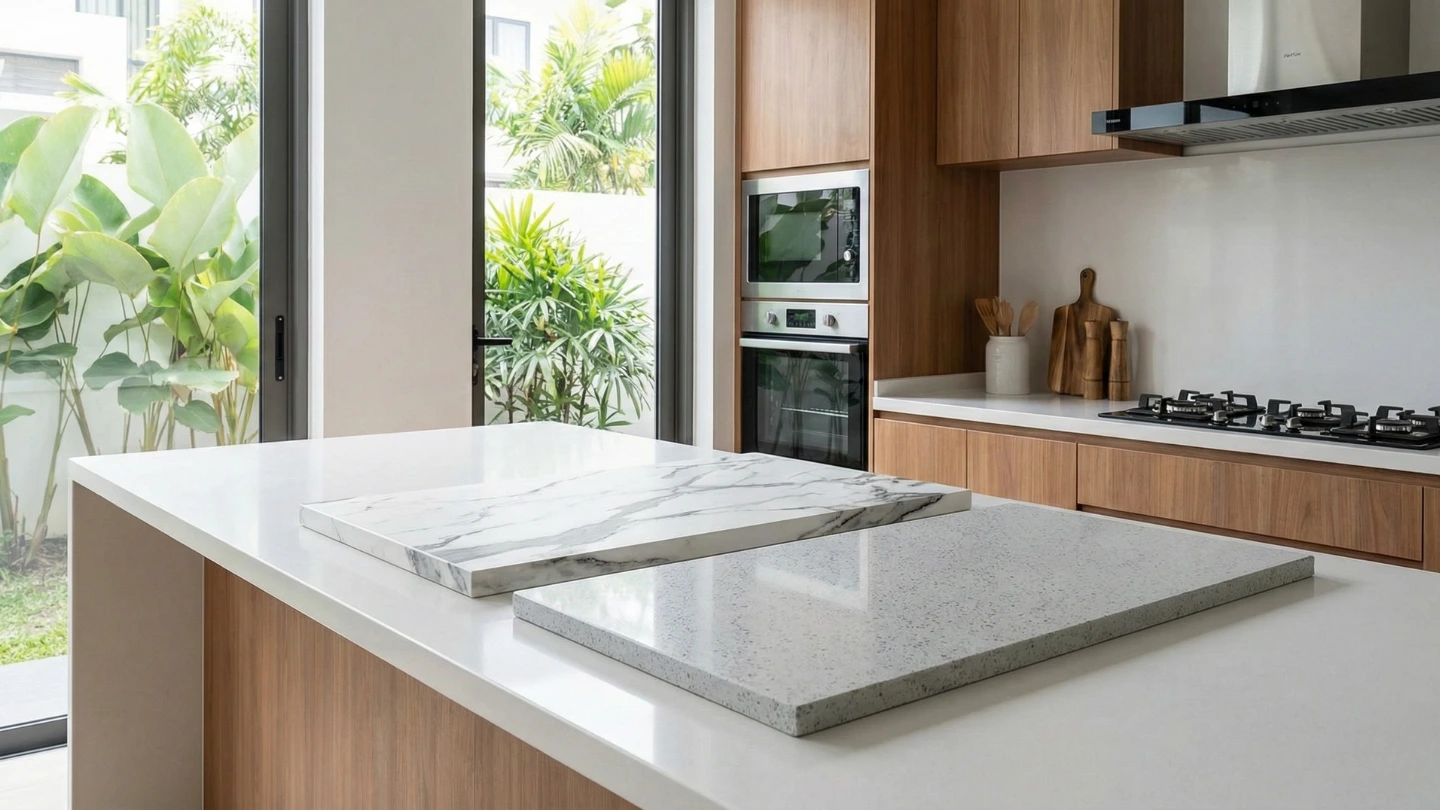
Understanding the Fundamental Differences
Before diving into comparisons, it’s essential to understand what these materials actually are. Despite both being “engineered” surfaces, sintered stone and quartz are manufactured using completely different processes—and this affects everything from heat resistance to long-term durability.
What Is Sintered Stone?
Sintered stone is created by mimicking the natural process that forms stone deep within the earth. Raw minerals—primarily silica, feldspar, and natural oxite pigments—are subjected to extreme heat (over 1,200°C) and pressure (approximately 400 bar). This process, called sintering, fuses the particles together without any resins or binding agents.
The result is a material that’s essentially the science behind sintered stone compressed into slab form. Because there are no organic resins in the composition, sintered stone is completely non-porous and highly resistant to UV rays, heat, and scratches.
The leading sintered stone brand available in Malaysia is Dekton, manufactured by Spanish company Cosentino.
What Is Quartz Stone?
Quartz countertops are engineered surfaces made from approximately 90–95% natural quartz crystals bound together with polymer resins (typically 5–10%). The manufacturing process involves mixing crushed quartz with pigments and resins, then compressing the mixture under vibration and heat to create solid slabs.
If you want to understand the complete manufacturing process, our guide on what quartz stone is and how it’s made covers everything Malaysian homeowners need to know.
The resin content is what gives quartz its flexibility and crack resistance, but it’s also the source of its primary weakness: heat sensitivity.
Heat Resistance: The Critical Difference for Malaysian Kitchens
For Malaysian homeowners, heat resistance isn’t just a nice-to-have feature—it’s essential. Our cooking style involves high-heat wok cooking, preparing sambal over open flames, and slow-cooking rendang. The difference between sintered stone and quartz in this area is significant.
Sintered Stone Heat Performance
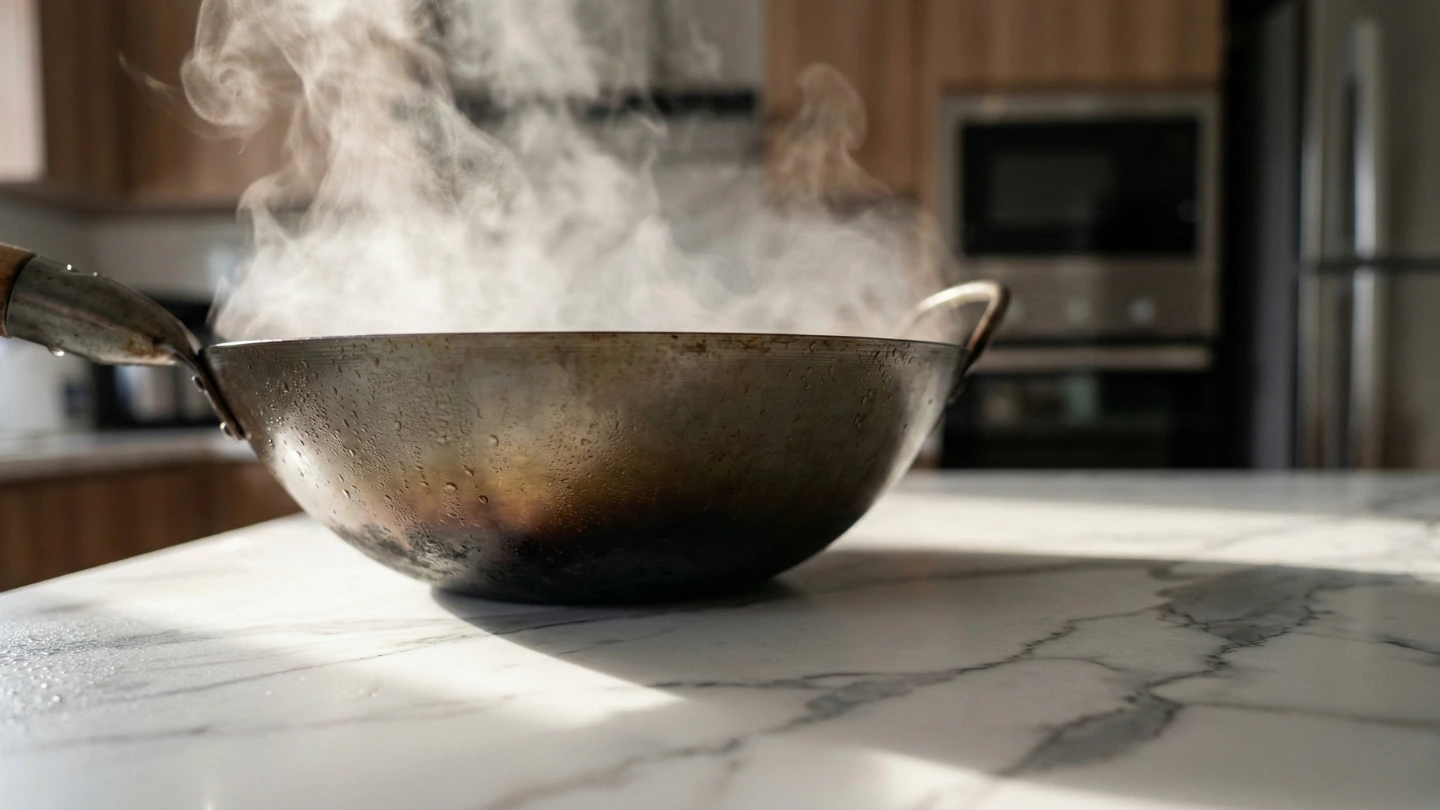
Sintered stone can withstand temperatures up to 300°C without any damage. You can place a hot wok directly from the stove onto a Dekton countertop without worrying about scorching, discolouration, or thermal shock. This heat resistance is permanent and doesn’t degrade over time.
This makes sintered stone particularly well-suited for Malaysian kitchens where hot cookware frequently touches counter surfaces. No trivets required—though using them certainly won't hurt.
Quartz Stone Heat Performance
Quartz countertops are rated for temperatures up to approximately 150°C before the resin binders begin to suffer damage. Direct contact with very hot pans can cause permanent discolouration, cloudy marks, or even cracking in severe cases.
For Malaysian cooking, this means you should always use trivets or hot pads when placing cookware from the stove onto quartz surfaces. Most quartz manufacturers explicitly state in their warranties that heat damage is not covered.
Winner: Sintered Stone — The ability to handle direct heat without protection is a significant advantage for Malaysian cooking styles.
Scratch Resistance: Daily Wear and Tear
Both materials are marketed as scratch-resistant, but the reality is more nuanced.
Sintered Stone Scratch Resistance
Sintered stone rates 7–8 on the Mohs hardness scale, making it one of the hardest countertop materials available. It resists scratches from knives, abrasive cleaners, and everyday wear extremely well. In fact, cutting directly on sintered stone will dull your knives before it damages the surface.
However, this hardness comes with a trade-off: sintered stone can be more brittle and prone to chipping at the edges if subjected to sharp impacts.
Quartz Stone Scratch Resistance
Quartz rates around 7 on the Mohs hardness scale—very similar to sintered stone. It handles daily wear excellently and won’t show scratches from normal kitchen activities. Like sintered stone, cutting directly on quartz will damage your knives rather than the surface.
The resin content actually gives quartz slightly more flexibility, making it somewhat less prone to edge chipping compared to sintered stone.
Winner: Draw — Both materials offer excellent scratch resistance for typical kitchen use.
Stain Resistance: The Malaysian Kitchen Test
Malaysian cooking involves turmeric, belacan, curry pastes, and other highly pigmented ingredients. Stain resistance is non-negotiable.
Sintered Stone Stain Performance
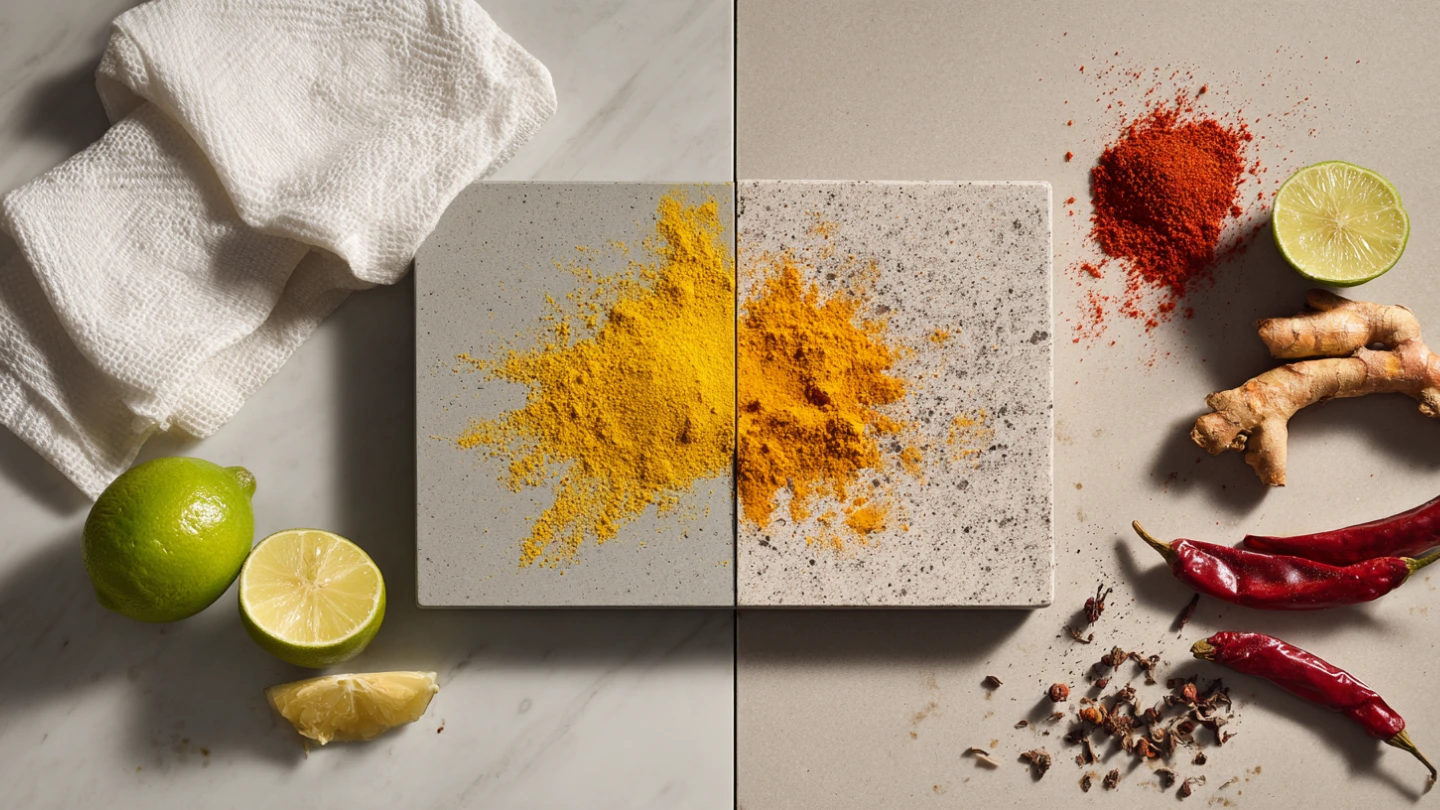
Because sintered stone contains no resins and is completely non-porous, it offers exceptional stain resistance. Turmeric, coffee, wine, and oil can be wiped away without leaving any trace—even if left sitting for extended periods.
The material is also resistant to acids, meaning lemon juice, vinegar, and tomato-based sauces won’t etch or damage the surface. Stubborn marks like permanent marker wipe off easily with appropriate cleaners.
Quartz Stone Stain Performance
Genuine quartz from reputable brands is highly stain-resistant—including against turmeric, despite what you may have heard. Turmeric spills on authentic quartz can be easily wiped clean using a cream cleanser like CIF Foam, even after sitting for some time. This is good news for Malaysian kitchens where turmeric is a daily ingredient.
The surface is non-porous, so coffee, wine, oil, and curry pastes clean up without issues under normal circumstances. Permanent markers and certain dyes are harder to remove on quartz compared to sintered stone, though they can still be cleaned off with the right products and some extra effort.
The key distinction here is between genuine quartz and inferior products. If you've heard horror stories about turmeric staining "quartz," the culprit is often compressed marble sold as quartz—a cheaper material that stains easily and is frequently misrepresented in the Malaysian market.
[turmeric-curry-stain-test-quartz-sintered-stone-comparison]
Winner: Slight edge to Sintered Stone — Both handle everyday Malaysian cooking stains well, but sintered stone edges ahead for stubborn marks like permanent marker which clean off more easily.
Aesthetic Options: Design Flexibility
Your countertop is a major visual element in your kitchen. Both materials offer impressive design options, but with different strengths and limitations.
Sintered Stone Aesthetics
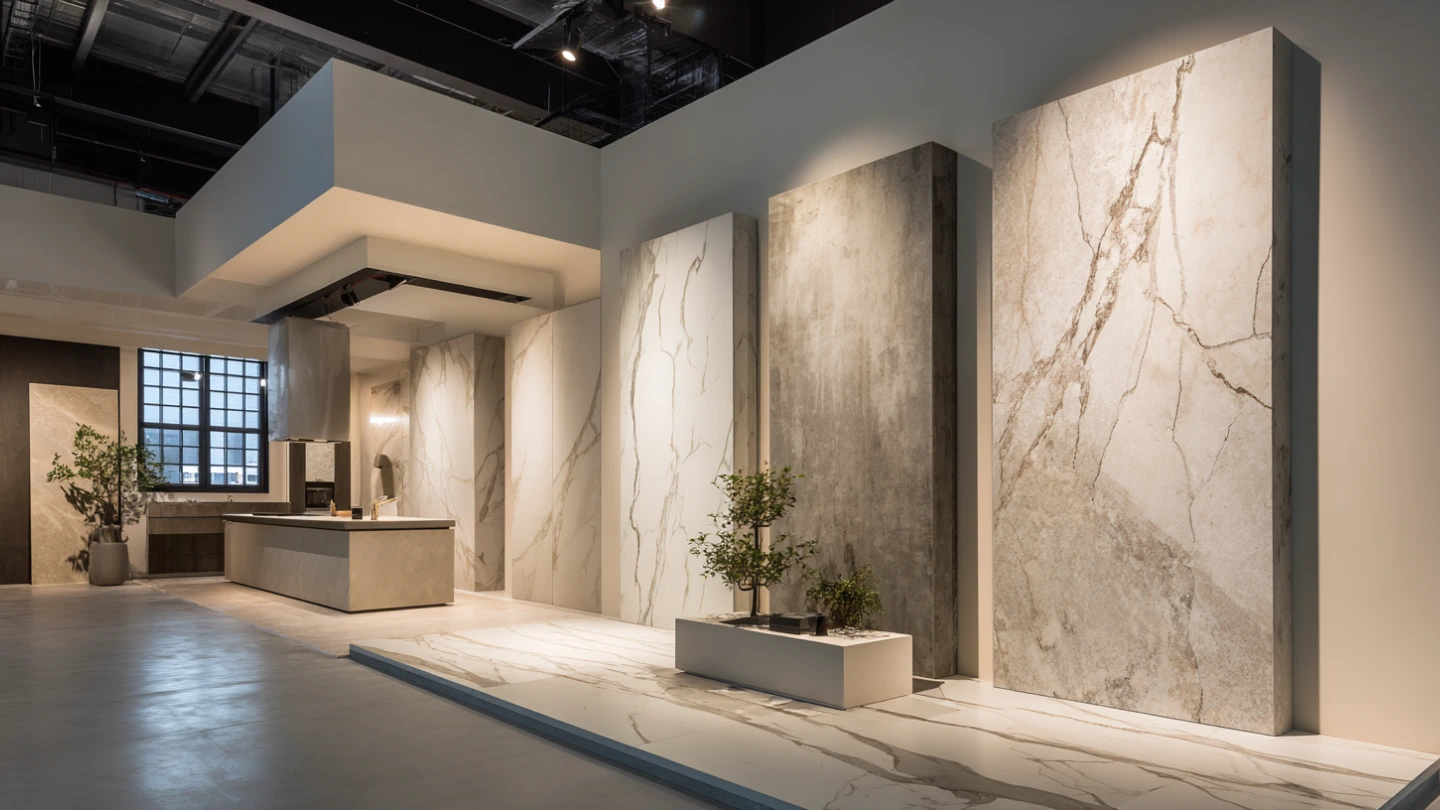
Sintered stone achieves its stunning visuals through High-Definition Digital Inkjet Printing technology. This advanced printing process can reproduce virtually any colour, pattern, or natural stone appearance with remarkable precision. Want a perfect Calacatta marble replica? A concrete industrial look? Even bold, vibrant colours? The digital printing technology makes it possible.
However, there's an important limitation to understand: the printed design only penetrates approximately 1mm into the surface. Sintered stone is not a full-body material. This means cut edges and mitre joints may reveal a different appearance underneath the printed surface layer. Fabricators typically address this through careful edge treatment and colour-matched finishing, but it's something to discuss with your installer—especially for waterfall edge designs where the edge is prominently visible.
Dekton offers collections that mimic marble, granite, concrete, and even oxidised metal finishes with exceptional realism on the surface.
[dekton-sintered-stone-marble-pattern-design-options-malaysia]
Quartz Stone Aesthetics
Quartz offers consistent colour throughout the entire slab thickness, which is advantageous for cut edges and waterfall installations where the material’s cross-section is visible.
However, because quartz countertops contain 90–95% natural quartz crystals, there’s limited room for pigments in the composition. This makes it difficult to achieve bright, vibrant colours. You’ll find plenty of whites, greys, blacks, and natural stone-inspired patterns, but bold blues, greens, or other vivid colours are rare in quartz collections.
Premium brands like Caesarstone and Silestone offer extensive collections that convincingly replicate Calacatta marble, concrete, and natural granite within this colour range. The patterns are consistent throughout the slab thickness, making edge profiles and waterfall installations straightforward.
Winner: Depends on priorities — Sintered stone offers unlimited surface design possibilities through digital printing but isn’t full-body; quartz has limited colour range but offers consistency throughout the slab thickness.
Malaysian Pricing Comparison: What You’ll Actually Pay
Price is often the deciding factor for Malaysian homeowners. Here’s what you can expect to pay for supply and installation (per square foot) based on current 2025 pricing.
Sintered Stone Pricing (Dekton)
Dekton is positioned as a premium material, and the pricing reflects this:
- Entry-level collections: RM229–317/sqft
- Mid-range collections: RM317–406/sqft
- Premium collections: RM406–474/sqft
For a typical Malaysian kitchen with 40–50 square feet of countertop space, expect to pay between RM9,160 and RM23,700 fully installed.
Quartz Stone Pricing
Quartz pricing varies significantly depending on the brand:
Budget brands (Zenstone):
- RM110–160/sqft supply and install
- Best for: Budget-conscious renovations, rental properties
Mid-range premium (Caesarstone):
- RM197–473/sqft supply and install
- Most popular range: RM325–394/sqft
Premium collections (Silestone, Caesarstone Premium):
- RM450–814/sqft supply and install
- Best for: High-end renovations, designer kitchens
For a detailed breakdown of quartz pricing across all brands, see our complete Malaysia quartz stone price guide.
Price Comparison Summary
| Material | Budget Option | Mid-Range | Premium |
|---|---|---|---|
| Quartz (Zenstone) | RM110–160/sqft | — | — |
| Quartz (Caesarstone) | RM197–325/sqft | RM325–473/sqft | RM512–814/sqft |
| Quartz (Silestone) | RM280–342/sqft | RM342–450/sqft | RM580–645/sqft |
| Sintered Stone (Dekton) | — | RM229–406/sqft | RM406–474/sqft |
Winner: Quartz — Offers more price points to suit different budgets, from RM110/sqft entry-level to RM800+/sqft premium options.
UV Resistance: Outdoor and Sun-Exposed Areas
If your kitchen has large windows or you’re considering an outdoor kitchen area, UV resistance becomes important.
Sintered Stone UV Performance
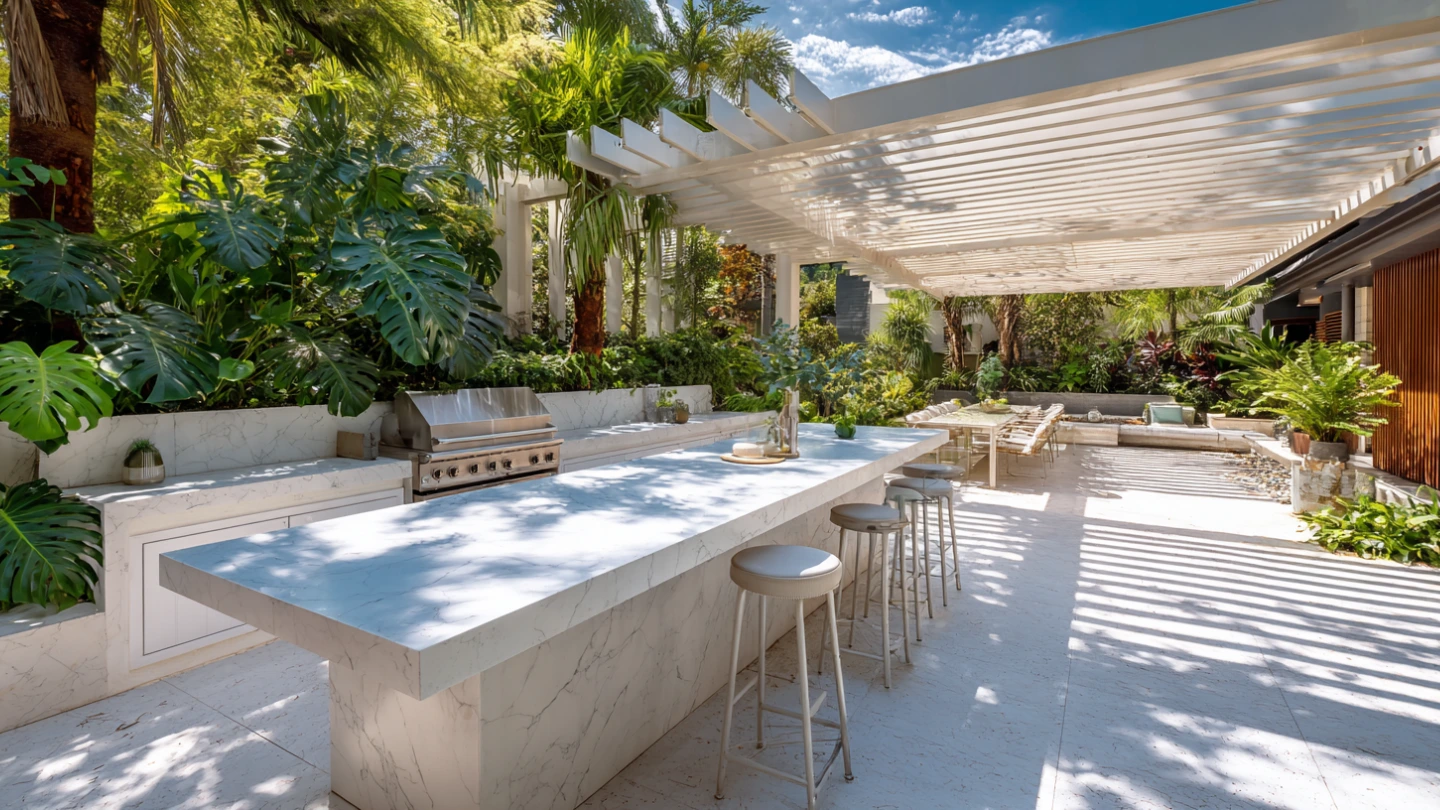
Sintered stone is completely UV-stable. The colours won’t fade, yellow, or change even with direct sunlight exposure for decades. This makes it suitable for outdoor kitchens, barbecue areas, and sun-drenched indoor spaces.
Quartz Stone UV Performance
Most quartz countertops are not UV-stable. Prolonged exposure to direct sunlight can cause yellowing or fading, particularly in lighter colours. This isn’t usually a problem for indoor kitchens with normal window exposure, but it rules quartz out for outdoor applications.
Some newer quartz formulations claim improved UV resistance, but the warranty exclusions for sun damage remain in place.
Winner: Sintered Stone — Essential advantage for outdoor applications or heavily sun-exposed areas.
Maintenance Requirements: Long-Term Care
Both materials are marketed as “low maintenance,” and that’s largely true. But there are differences worth noting.
Sintered Stone Maintenance
Daily cleaning requires only a damp cloth with mild soap. Because the surface is completely non-porous and contains no resins, you can use a wider range of cleaning products without concern—including bleach-based cleaners if needed.
Sintered stone never requires sealing, polishing, or special treatments. The appearance on day one is the appearance you’ll have in twenty years, assuming no physical damage.
Quartz Stone Maintenance
Quartz is similarly easy to clean with just soap and water for daily maintenance. Despite what some sources claim, common solvents like acetone and lacquer thinner are perfectly safe to use on quartz surfaces—fabricators use these regularly without any issues.
The one chemical you must absolutely avoid is caustic soda drain cleaner (known locally as Soda Kuda Api). This highly alkaline chemical will attack and destroy the resin binders in quartz, causing permanent damage to the surface. If you have a clogged sink, ensure the drain cleaner doesn’t come into contact with your quartz countertop, or use alternative drain clearing methods.
Like sintered stone, quartz never requires sealing. The surface maintains its appearance well over time, though the resin component can become slightly more susceptible to staining as it ages (typically after 15–20 years).
Winner: Draw — Both are genuinely low-maintenance materials for typical kitchen use.
Durability and Lifespan: The Long View
When investing thousands of ringgit in countertops, longevity matters.
Sintered Stone Durability
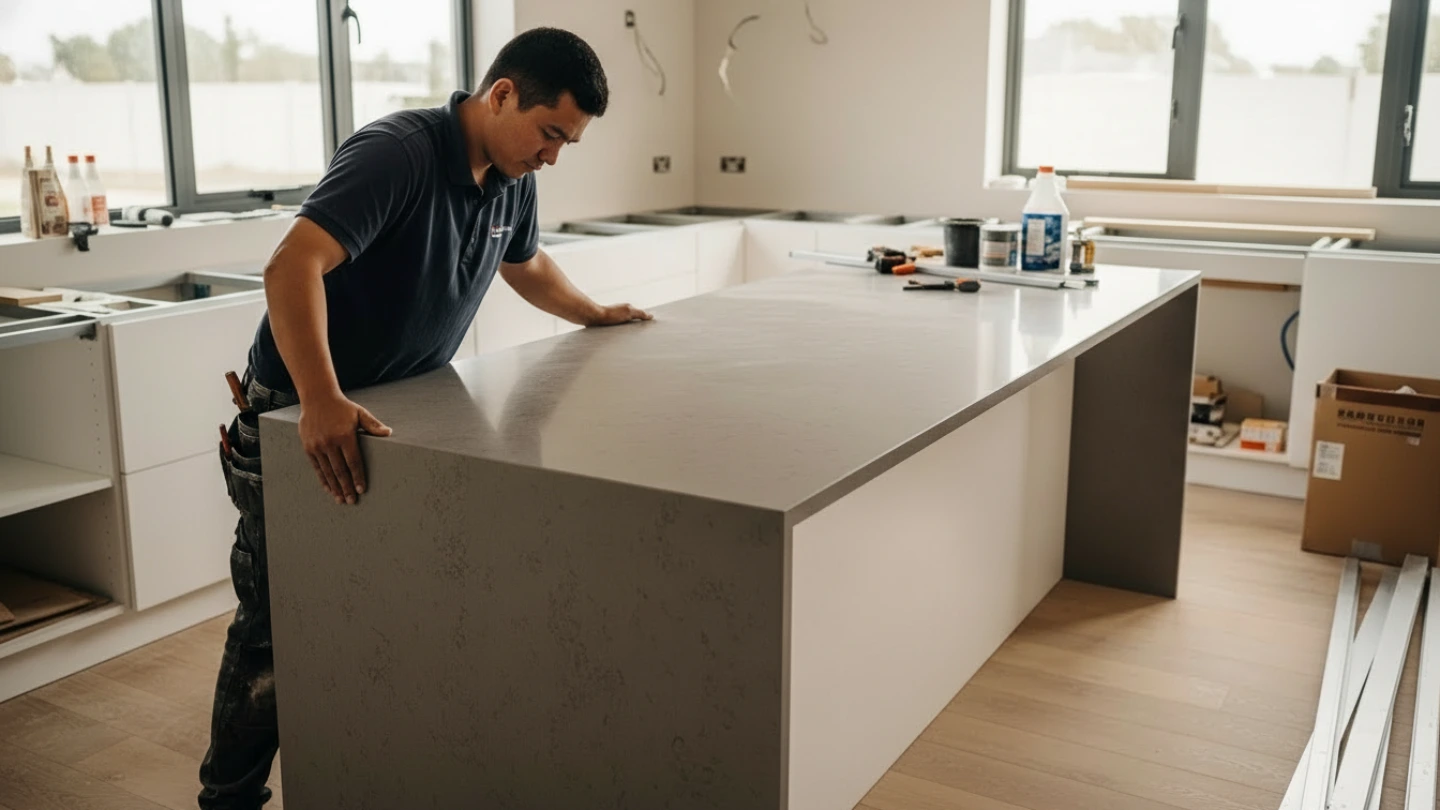
Sintered stone is incredibly durable and resistant to most forms of damage. The material won’t fade, stain, or degrade from chemical exposure. Under normal use, sintered stone countertops should last 25–30 years or more without significant wear.
The primary vulnerability is impact damage. The material’s hardness makes it more brittle, and sharp impacts (dropping a heavy pot, for example) can cause chipping or cracking, particularly at edges and corners. Repairs are possible but may be visible.
Quartz Stone Durability
Quartz countertops typically last 15–25 years under normal residential use. The resin component provides excellent crack resistance, making quartz somewhat more forgiving of impacts compared to sintered stone.
However, the resin does slowly degrade over time, particularly with UV exposure or repeated heat stress. This manifests as reduced stain resistance and potential yellowing in light colours after 15–20 years.
Winner: Sintered Stone — Longer expected lifespan, though quartz offers better impact resistance.
Which Material Suits Your Kitchen?
After comparing all the key factors, here’s how to decide which material is right for your Malaysian kitchen.
Choose Sintered Stone If:
- You do heavy wok cooking and want to place hot pans directly on the counter
- You frequently cook with turmeric and other staining ingredients
- You’re planning an outdoor kitchen or have a sun-exposed countertop area
- You want the longest possible lifespan from your investment
- You prefer the look of natural stone with full-body veining
- Your budget accommodates RM229/sqft or higher
Choose Quartz If:
- You cook frequently and want a surface that forgives accidental knocks from pots and pans without chipping or cracking
- You’re comfortable using trivets for hot cookware
- You want the widest possible range of colours and patterns
- Budget flexibility is important (options from RM110–800+/sqft)
- You’re renovating an indoor kitchen without excessive sun exposure
- You want established brands like Silestone with antibacterial protection
The Verdict: There’s No Universal Winner
Both sintered stone and quartz are excellent countertop materials that outperform older options like solid surface and laminate in every measurable way.
Sintered stone offers superior heat resistance, stain resistance, and UV stability—making it the better technical performer for demanding kitchen environments. If you cook frequently with high heat and want worry-free performance, the premium price is justified.
Quartz offers better value across a wider price range, broader aesthetic options, and slightly better impact resistance. For most Malaysian kitchens with normal cooking habits and sensible trivet use, quartz delivers excellent performance at a more accessible price point.
The “better” material is simply the one that matches your specific needs, cooking habits, and budget. Visit a showroom to see both materials in person, ask about the specific care requirements, and make an informed decision based on how you actually use your kitchen—not just how the materials perform in laboratory conditions.
Frequently Asked Questions
Can sintered stone crack?
Yes, sintered stone can crack or chip if subjected to sharp impacts, particularly at edges. The material is extremely hard but somewhat brittle. Proper installation with adequate support prevents most issues, but dropping heavy objects can cause damage.
Is quartz safe for food preparation?
Yes, quartz is food-safe when purchased from reputable brands. Look for NSF-51 certification, which indicates the surface meets food safety standards. All major brands available in Malaysia (Caesarstone, Silestone, Zenstone) meet these requirements.
Can I cut directly on either surface?
Technically yes, but you’ll ruin your knives. Both sintered stone and quartz are harder than steel knife blades. Always use a cutting board to protect your knives—the countertop will be fine either way.
Which is better for bathroom vanities?
Both work excellently for bathrooms. Sintered stone’s UV resistance makes it better for vanities near windows. Quartz’s broader colour range offers more design flexibility. Neither material is affected by humidity or moisture.
Do both materials require sealing?
No. Both sintered stone and quartz are non-porous and never require sealing, polishing, or special treatments. This is a significant advantage over natural stone options like granite or marble.
What about the environmental impact?
Sintered stone is generally considered more environmentally friendly because it contains no petroleum-based resins and uses natural mineral pigments. However, both materials require significant energy to manufacture. Neither is significantly “greener” than the other.
Looking for more countertop comparisons? Explore our guide to porcelain slab versus quartz stone countertops or learn about the difference between sintered stone and porcelain slab to understand all your options.