If you’re renovating your kitchen in Malaysia, chances are you’ve been drawn to the timeless elegance of marble — only to hear someone warn you that it stains, scratches, and needs constant attention. Then quartz enters the conversation, promising marble’s beauty without the headaches. But is that the full picture?
The truth is, both materials have genuine strengths and real limitations, and what works brilliantly in one household might be a costly mistake in another. This guide breaks down every factor that matters for Malaysian kitchens — from how each surface handles turmeric and sambal to what you’ll actually pay per square foot — so you can choose with confidence rather than guesswork.
Understanding the Two Materials
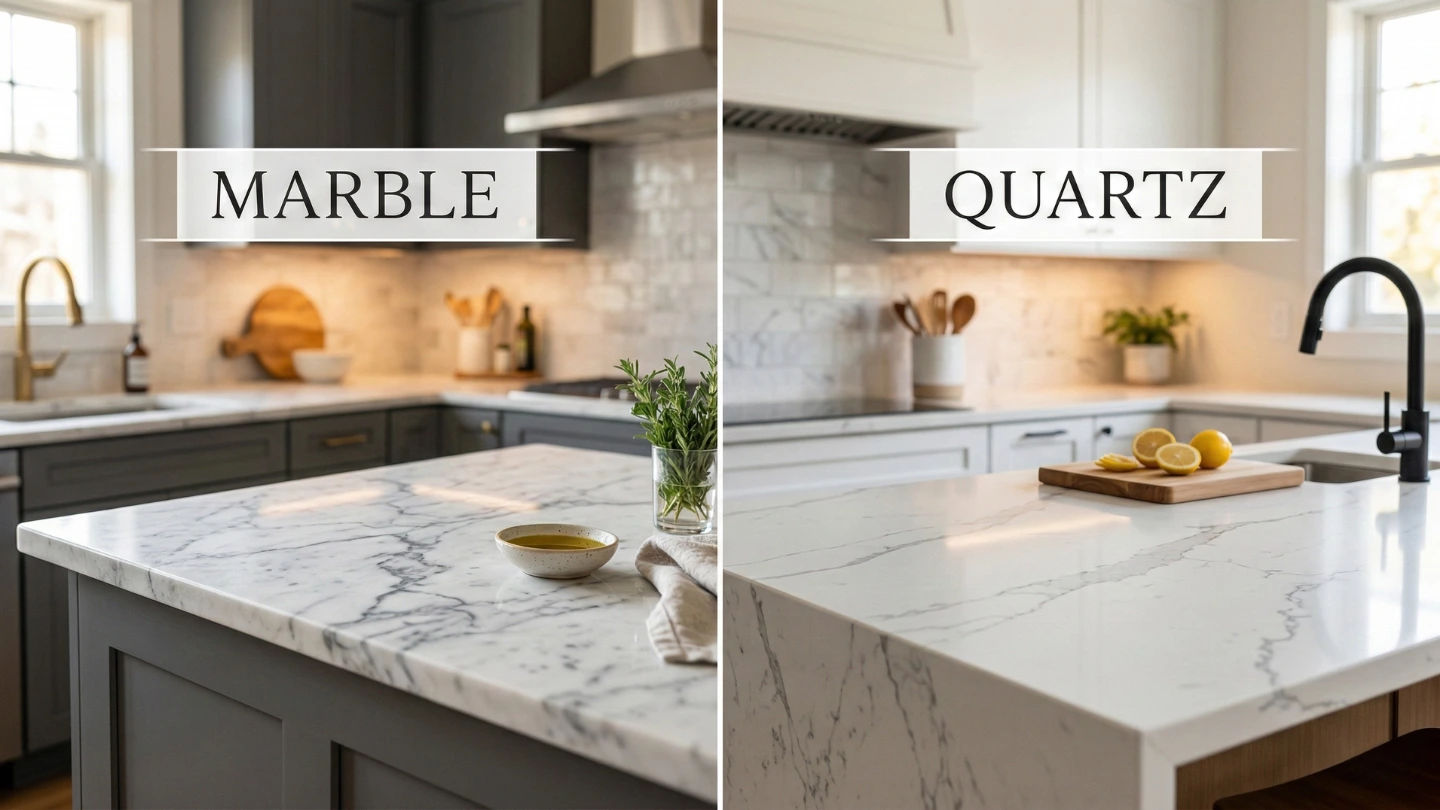
Before comparing performance, it helps to understand what you’re actually buying. Marble and quartz may look similar on a showroom slab, but they’re fundamentally different materials with different compositions, manufacturing processes, and properties.
What Is Marble?
Marble is a natural metamorphic rock composed primarily of calcium carbonate. It forms deep within the earth when limestone is subjected to intense heat and pressure over millions of years, creating the distinctive veining and translucency that has captivated architects and homeowners for centuries.
Every marble slab is genuinely one-of-a-kind. The veining patterns, colour variations, and mineral deposits are unique to each piece — no factory can replicate the depth and character of natural marble. Popular varieties like Carrara (softer grey veining) and Calacatta (bolder, more dramatic patterns) remain highly sought after for luxury Malaysian interiors. For a closer look at these two iconic varieties, our guide on Calacatta vs Carrara marble explores the differences in detail.
However, that same calcium carbonate composition is also the source of marble’s greatest weakness in kitchen environments: it reacts chemically with acids, causing permanent surface damage known as etching.
What Is Quartz Stone?
Quartz stone — also called engineered quartz — is a manufactured surface made from approximately 90–93% natural quartz crystals bound together with polymer resins and pigments. The manufacturing process combines these ingredients under intense pressure and heat to create a dense, non-porous slab.
Because quartz is engineered, manufacturers can control colour, pattern, and consistency with remarkable precision. Modern quartz designs convincingly replicate the look of Carrara and Calacatta marble — complete with delicate veining — whilst offering performance characteristics that natural marble simply cannot match.
Premium quartz brands available in Malaysia include Caesarstone and Silestone, along with more budget-friendly options like Zenstone and Moonstone. Each brand offers different collections at varying price points, giving Malaysian homeowners flexibility across a wide budget range.
Head-to-Head: How They Perform in Malaysian Kitchens
Stain Resistance
This is where the two materials diverge most dramatically — and where it matters most for Malaysian cooking.
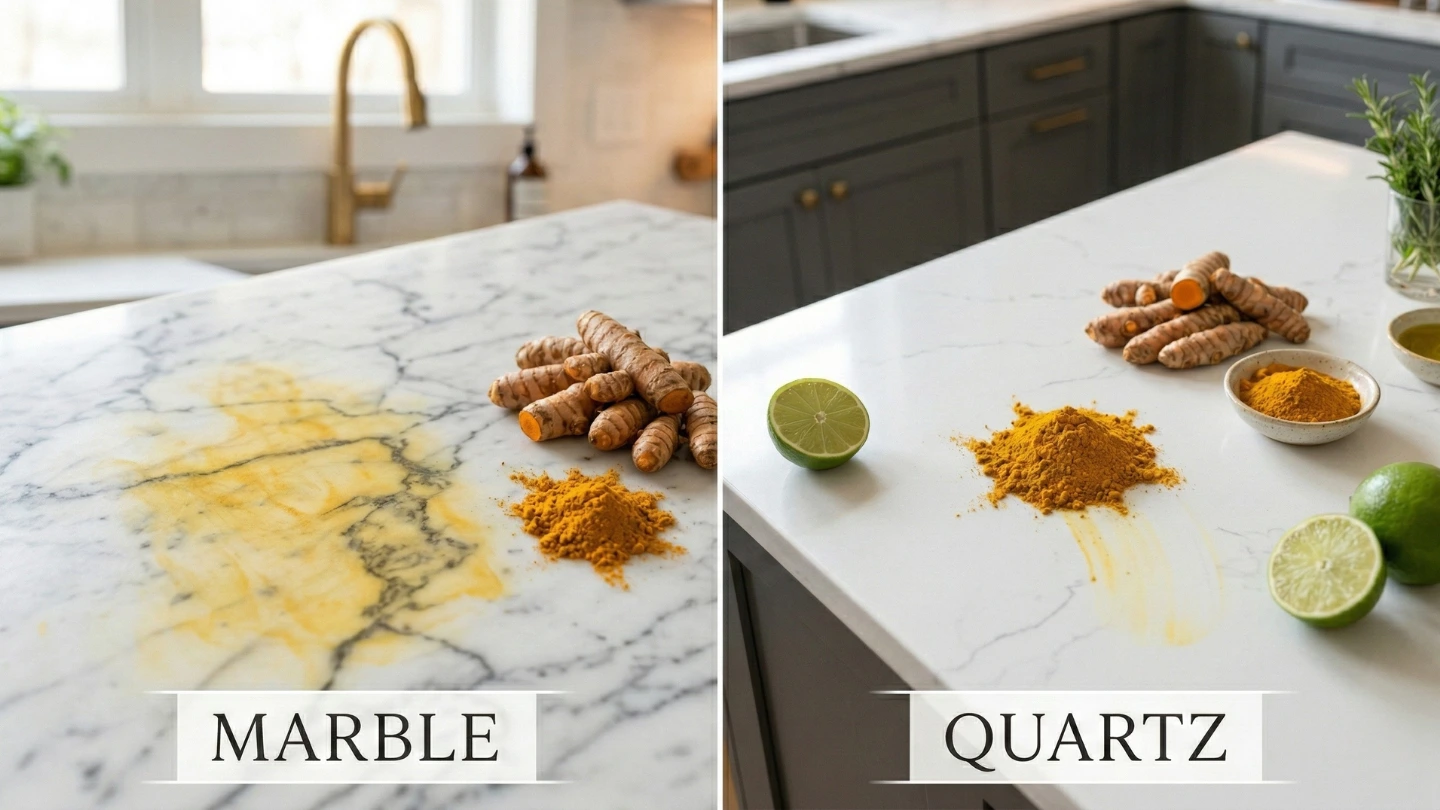
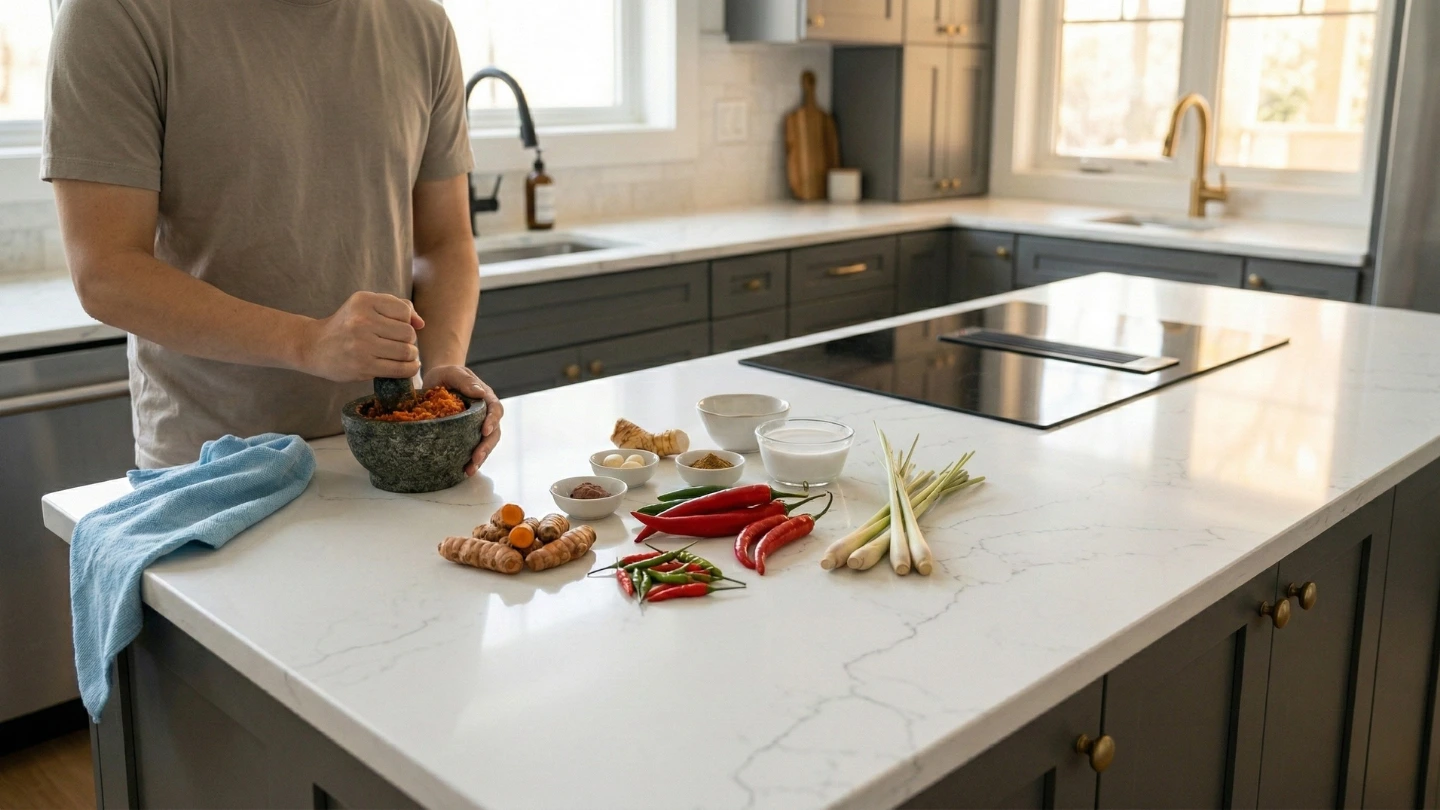
Marble is porous by nature. It absorbs liquids readily, and once a stain penetrates the surface, removal can be extremely difficult or impossible. Now think about what happens in a typical Malaysian kitchen: turmeric from your rendang, lime juice from your sambal, vinegar from achar, soy sauce, coffee, tomato-based curries. Every one of these common ingredients can leave permanent marks on marble.
Worse still, the calcium carbonate in marble doesn’t just stain — it etches. When acidic substances contact the surface, they trigger a chemical reaction that corrodes the stone, leaving dull, whitish marks that no amount of cleaning can remove. This isn’t a maintenance failure; it’s basic chemistry.
Quartz, by contrast, is non-porous. Liquids — including turmeric, belacan paste, kicap manis, and curry oils — sit on the surface rather than penetrating it. A quick wipe with mild soap and water is typically all it takes. Even stubborn turmeric stains come off with CIF Foam, a reality that surprises many homeowners who assume turmeric permanently stains everything.
Verdict for Malaysian kitchens: Quartz wins decisively. Malaysian cooking involves daily exposure to acidic, oily, and pigmented ingredients that marble simply cannot withstand without damage.
Heat Resistance
Marble handles heat reasonably well as a natural stone. You can place warm cookware on it without immediate damage, though extreme thermal shock (transferring a very hot pan directly from the stove) can potentially cause cracking.
Quartz is more sensitive to heat due to its resin component. Temperatures above 150–200°C can cause discolouration, scorching, or damage to the resin binders. This means you should always use trivets or heat pads when placing hot pots, woks, or pans on a quartz surface.
For Malaysian home cooks who regularly do high-heat wok cooking, deep-frying, or use heavy cast-iron cookware, this is a genuine consideration. Using trivets consistently becomes a non-negotiable habit with quartz countertops.
Verdict: Marble has a slight edge here, but neither material is the best choice for direct hot-pan contact. If heat resistance is your top priority, sintered stone outperforms both materials significantly.
Durability and Scratch Resistance
Marble rates approximately 3 on the Mohs hardness scale, making it one of the softer natural stones. It scratches relatively easily from knives, ceramic cookware, and even abrasive cleaning pads. Edges and corners are particularly vulnerable to chipping.
Quartz is significantly harder — rated around 7 on the Mohs scale. It resists scratches from daily kitchen use far better than marble, and the resin binder actually helps absorb impact, reducing the risk of chipping and cracking. Whilst we still recommend using cutting boards, quartz handles the bumps and scrapes of everyday Malaysian cooking far more gracefully than marble.
Verdict: Quartz is substantially more durable and scratch-resistant than marble.
Maintenance Requirements
This is the factor that catches most homeowners off guard after installation.
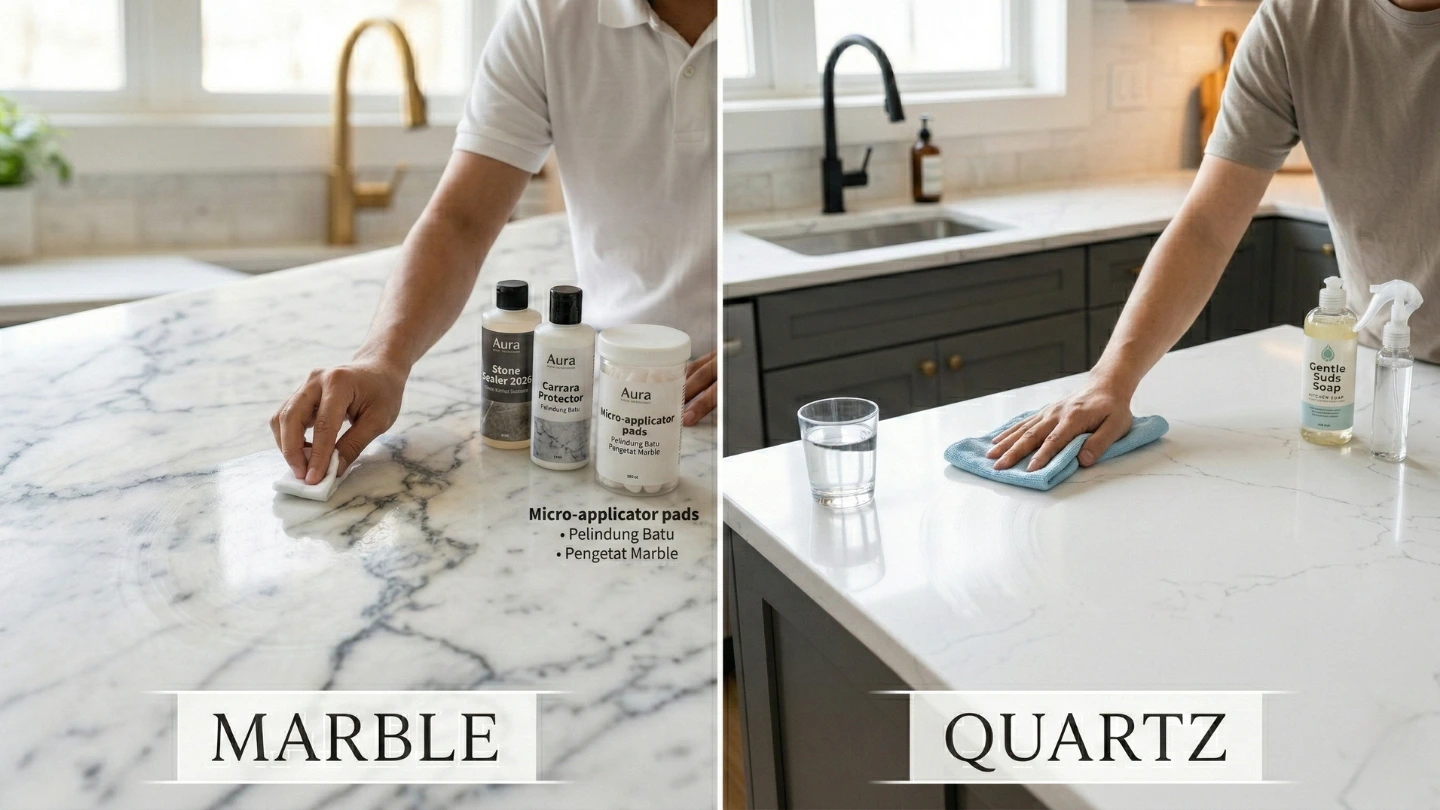
Marble demands consistent, careful maintenance. It requires sealing with a quality impregnator — modern formulations can last up to two years, but reapplication is necessary throughout the stone’s lifetime. Daily cleaning must avoid acidic or abrasive products. Spills need immediate attention; leaving lime juice or vinegar on the surface even briefly can cause permanent etching. Professional polishing may be needed periodically to restore the surface lustre.
In Malaysia’s humid climate (averaging 70–90% humidity), porous materials like marble are also more susceptible to moisture absorption, which can accelerate staining and potentially encourage bacterial growth if the sealant has degraded.
Quartz requires almost no maintenance. No sealing — ever. Daily cleaning with mild soap and water is sufficient. There’s no need for special cleaners, periodic professional treatments, or anxious rushing to wipe up spills. For Malaysian households — especially busy families or working professionals — this convenience is a major practical advantage. For a comprehensive cleaning guide tailored to Malaysian cooking challenges, including tips for handling turmeric, see our countertop cleaning guide.
Verdict: Quartz wins by a wide margin. The difference in daily effort is significant, and for most Malaysian households, low maintenance isn’t just convenient — it’s essential.
Hygiene
Marble’s porous surface can harbour bacteria, mould, and mildew in its micro-pores, particularly when the sealant has worn down. In Malaysia’s warm, humid environment, this creates genuine hygiene concerns for food preparation surfaces.
Quartz’s non-porous surface means bacteria and mould have nowhere to penetrate. Many premium quartz brands also carry NSF-51 food safety certification — a rigorous standard confirming the surface is safe for direct food contact. This is particularly important for homeowners who bake or prepare food directly on countertops.
Verdict: Quartz is the more hygienic choice, especially in Malaysia’s tropical climate.
Appearance and Aesthetics
This is where marble genuinely shines — and where the decision becomes personal rather than purely practical.
Marble offers a visual depth, warmth, and translucency that no engineered material can perfectly replicate. The way light passes through marble’s crystalline structure creates a luminous quality that photographers and interior designers adore. Each slab tells a geological story millions of years old, and that authenticity resonates with homeowners who value natural beauty above all else.
Quartz has made extraordinary strides in mimicking marble aesthetics. Premium collections from Caesarstone (such as Statuario Maximus and Calacatta Nuvo) and Silestone offer marble-look designs that are remarkably convincing. However, experienced eyes can still distinguish engineered patterns from natural ones — quartz veining tends to be more uniform and predictable, lacking the organic randomness of genuine marble.
That said, quartz offers a major practical advantage: consistency. If you need matching slabs for a kitchen island, backsplash, and countertop, quartz delivers uniform colour and pattern across all pieces. With marble, matching multiple slabs is challenging, and you’ll need to personally select each piece.
Verdict: Marble wins on pure natural beauty and character. Quartz wins on consistency and design flexibility. This one comes down to personal preference.
Pricing in Malaysia: What You’ll Actually Pay
Understanding real costs is essential for making an informed decision. Here’s what Malaysian homeowners should expect to budget, based on authentic supply-and-install pricing.
Marble Pricing
Natural marble countertops in Malaysia typically range from RM200 to RM600+ per square foot (supply and install), depending on the variety, origin, and complexity of fabrication. Premium varieties like Calacatta can cost significantly more than standard Carrara.
Additionally, factor in the ongoing costs of maintenance: professional sealing every one to two years, specialised cleaning products, and potential professional polishing to address etching and wear.
Quartz Pricing
Quartz offers a broader price range with options at every budget level:
- Budget-friendly quartz (Zenstone): RM110–160 per square foot
- Mid-range international brands (Caesarstone Standard/Deluxe, Silestone Entry/Mid-Tier): RM280–325 per square foot
- Premium collections (Caesarstone Supernatural, Silestone Designer/Premium): RM342–819 per square foot
These prices are supply-and-install, meaning they include the material, fabrication, and professional installation. Additional costs include sink cutouts (RM150 for undermount with profiling), cooker hob cutouts (RM100), and tap holes (RM50 each).
For a comprehensive pricing breakdown across all brands and collections, our 2025 quartz stone price guide covers everything you need to budget accurately.
Real-World Cost Example
For a typical 3-bedroom condo kitchen in the Klang Valley (approximately 25 square feet of countertop):
- Marble (mid-range Carrara): ~RM8,750–10,000 (supply & install) + ongoing maintenance costs
- Quartz (Caesarstone Standard): ~RM7,950 (supply & install) + RM300 in cutouts, with virtually no ongoing maintenance costs
- Quartz (Zenstone budget): ~RM3,750 (supply & install) + RM300 in cutouts
When you factor in marble’s ongoing sealing, specialised cleaning products, and potential repair costs, the lifetime cost difference between marble and mid-range quartz becomes even more significant.
Important note: If you encounter “quartz” countertops priced below RM100 per square foot, exercise extreme caution. This pricing often indicates compressed marble being sold fraudulently as quartz — a deceptive practice that costs Malaysian homeowners thousands of ringgit in premature replacements.
When Marble Still Makes Sense
Despite its limitations in active kitchens, marble isn’t a universally poor choice. There are situations where marble is perfectly appropriate — and even ideal:
- Bathroom vanities and basins. Bathrooms don’t face the same assault of acidic foods, high-heat cookware, and heavy daily use that kitchens do. Marble’s beauty can shine in a bathroom environment with far less risk.
- Decorative dry kitchen islands. In dual-kitchen Malaysian homes (a common layout in landed properties), the “dry kitchen” or display kitchen sees minimal actual cooking. A marble island here serves as a stunning centrepiece without the staining and etching risks of the wet kitchen.
- Flooring and wall cladding. Marble performs well as flooring and decorative wall panelling, where food-related staining and acid etching aren’t concerns.
- Homeowners who prioritise aesthetics above all else and are willing to commit to rigorous maintenance routines, accept the patina of wear over time, and budget for periodic professional restoration.
For a deeper look at why compressed marble (a budget alternative to natural marble) struggles in kitchen environments, read our guide: Thinking of a Compressed Marble Countertop? Read This First.
When Quartz Is the Clear Winner
For the majority of Malaysian households, quartz is the more practical and cost-effective choice. Quartz is ideal when you:
- Cook daily using Malaysian ingredients like turmeric, sambal, asam, and curry pastes
- Want a low-maintenance surface that doesn’t require sealing or special cleaners
- Prefer consistent colour and pattern matching across your kitchen surfaces
- Prioritise food safety and hygiene (especially with young children)
- Need a surface that handles Malaysia’s 70–90% humidity without concern
- Want reliable long-term performance backed by 10–25 year warranties from reputable brands
For a full rundown of the benefits and trade-offs, see our detailed guide on the pros and cons of quartz stone kitchen tops.
What About Getting the Marble Look Without the Marble Problems?
This is perhaps the most practical solution for homeowners who love marble’s aesthetics but need kitchen-grade performance. Modern quartz technology has made this entirely achievable.
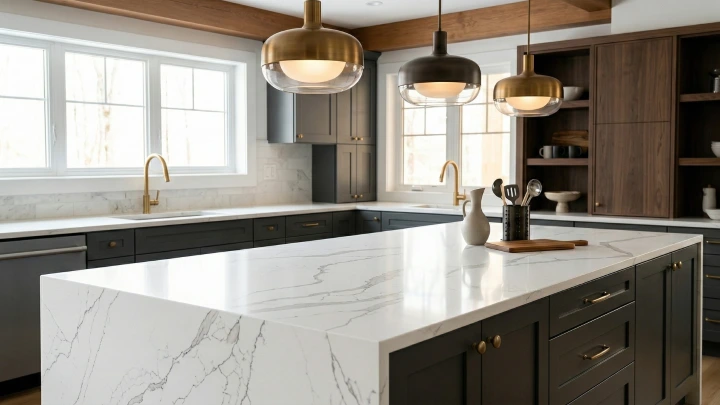
Premium marble-look quartz collections — like Caesarstone’s Supernatural Premium range (Statuario Maximus, Calacatta Nuvo, Empira White) and Silestone’s high-end series — feature realistic veining patterns that convincingly replicate natural marble. You get the visual drama of Calacatta or Carrara without worrying about etching from your morning lime juice or staining from last night’s rendang.
These marble-look quartz designs sit at the premium end of the price range (RM394–819 per square foot for Caesarstone Supernatural collections), but they offer the marble aesthetic with quartz’s superior stain resistance, zero sealing requirements, and comprehensive warranty coverage.
Installation and Timeline
Both marble and quartz follow similar installation processes in Malaysia, though there are a few differences worth noting.
Marble requires more careful handling during fabrication due to its softer composition and susceptibility to cracking. Fabricators need to be particularly cautious with edge profiles and sink cutouts. Not all fabricators in Malaysia are experienced with natural marble, so choosing a supplier with proven marble fabrication experience is essential.
Quartz is more forgiving during fabrication, and most established Malaysian countertop fabricators have extensive experience working with it. The resin content makes quartz less brittle and more predictable during cutting and finishing.
For both materials, expect the following general timeline: in-stock materials can typically be templated, fabricated, and installed within 7 working days, whilst special-order materials may take 21–28 days including overseas shipping and customs clearance. Installation itself usually takes just one day for a standard kitchen.
The Honest Comparison Summary
Here’s how marble and quartz stack up across the factors that matter most for Malaysian kitchens:
- Stain resistance: Quartz (excellent) vs Marble (poor)
- Heat resistance: Marble (moderate) vs Quartz (moderate — use trivets)
- Scratch resistance: Quartz (very high) vs Marble (low)
- Maintenance: Quartz (very low) vs Marble (high)
- Hygiene: Quartz (excellent, non-porous) vs Marble (poor without diligent sealing)
- Natural beauty: Marble (unmatched) vs Quartz (excellent replications available)
- Consistency: Quartz (uniform) vs Marble (each slab unique)
- Pricing (supply & install): Quartz RM110–819/sqft vs Marble RM200–600+/sqft
- Lifetime cost: Quartz (lower — no ongoing maintenance) vs Marble (higher — sealing, repairs)
- Warranty: Quartz (10–25 years from reputable brands) vs Marble (varies, often limited)
For an even broader comparison across 14 different countertop materials — including sintered stone, granite, porcelain slab, and budget alternatives — our complete guide to kitchen countertop materials in Malaysia covers every option in detail.
Making Your Decision
Choosing between marble and quartz ultimately comes down to how you use your kitchen and what you value most.
If you cook daily, handle acidic ingredients regularly, and want a surface that takes care of itself — quartz is the practical, cost-effective choice that won’t disappoint. You’ll spend your time enjoying your kitchen rather than maintaining it.
If you rarely use your kitchen for heavy cooking, value natural beauty above practical performance, and are genuinely prepared for the maintenance commitment — marble can be a stunning choice that brings unmatched character to your space.
And if you want marble’s beauty with quartz’s performance? Premium marble-look quartz gives you the best of both worlds. It’s the option most Malaysian homeowners ultimately choose once they understand the real-world differences between the two materials.
Whichever direction you lean, don’t fall for common myths about stone countertops that could cloud your judgement. Visit a showroom, see the materials in person, and make the choice that genuinely fits your lifestyle. Your countertop is a long-term investment you’ll interact with every single day — choose the one that works for how you actually live.