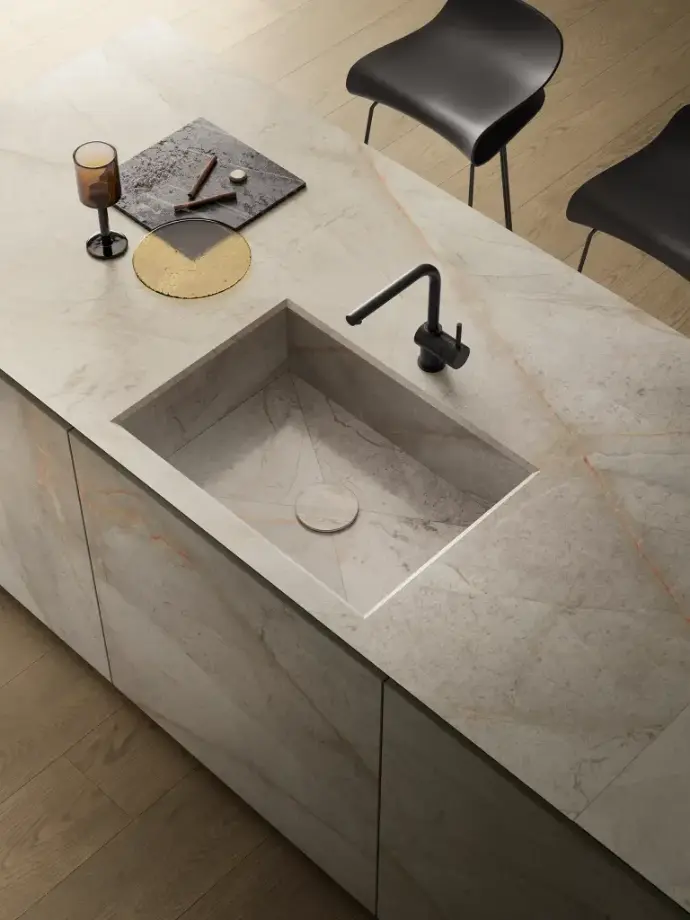
You thought you’d found the deal of a lifetime. A pre-fabricated porcelain countertop from China for RM1,500-2,500—already cut to your kitchen dimensions, edges polished, ready to ship. Compare that to RM5,000-10,000 for a locally supplied and installed porcelain slab or sintered stone countertop, and the maths seemed obvious.
You placed the order, paid a fraction of what your neighbours spent on their kitchen, and waited for delivery. The countertop arrived, looking exactly like the photos. All you needed was someone to install it.
Except now you’ve called a dozen installers, and they’ve all said no.
“We don’t work with customer-supplied materials.”
“Sorry, we can’t do on-site cutting for porcelain.”
“Find the people who sold it to you.”
Your beautiful pre-cut slab is leaning against your garage wall, and you’re realising that “pre-fabricated” doesn’t mean “ready to install.” Because here’s what nobody told you: your countertop arrived without a sink hole. The supplier left it uncut deliberately—a slab with a sink cutout would likely crack during the long shipping journey from China. Now that critical cut needs to happen here, on-site, and that’s precisely what no Malaysian installer wants to do on your China porcelain.
Why the Price Was So Attractive (And Why That’s the Problem)
Let’s acknowledge the elephant in the room: the price difference is staggering.
A pre-fabricated porcelain countertop from China costs RM1,500-2,500. A porcelain slab countertop from a Malaysian supplier like Moca Compact, fully installed, costs RM5,000-6,000. Premium sintered stone like Dekton costs RM10,000-20,000. That’s not a small difference—it’s 50-80% savings.
When you’re budgeting a kitchen renovation and every ringgit counts, that price gap is impossible to ignore. You’re not being foolish by noticing it. You’re being a smart consumer who found what appeared to be tremendous value.
The problem isn’t the price. The problem is that the product at that price point is fundamentally incomplete—and completing it in Malaysia is nearly impossible.
The Pre-Fabricated Illusion: What “Ready to Install” Actually Means
When you ordered that pre-fabricated countertop, you probably imagined the installer would simply lift it onto your cabinets, secure it, and walk away. The reality is far more complex.
Here’s something critical most buyers don’t realise: your pre-fabricated countertop arrived without a sink hole cut. This isn’t an oversight—it’s intentional. China suppliers leave the sink hole uncut because cutting a large opening creates stress points that dramatically increase the risk of cracking during shipping. A countertop with a sink cutout is far more fragile than a solid slab.
So your “ready to install” countertop is actually missing the most critical and dangerous cut of all.
Beyond the sink hole, every kitchen installation requires additional on-site modifications. Your walls aren’t perfectly straight. Your cabinets may have slight variations. The plumbing positions might differ slightly from the drawings.
Even the most precisely pre-fabricated countertop needs adjustments:
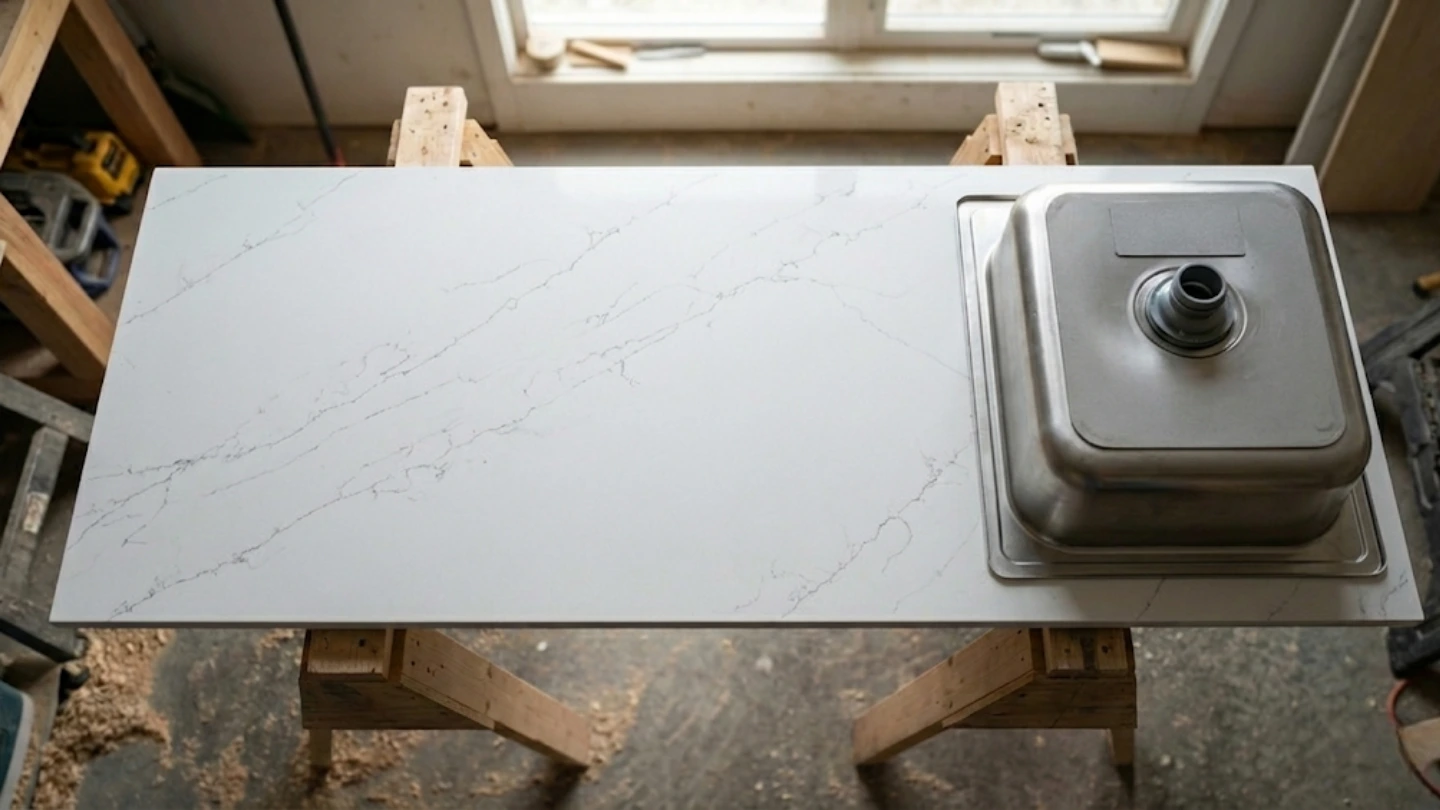
Sink hole cutting — Your countertop arrived as a solid slab. The sink opening MUST be cut on-site to match your actual sink dimensions and position. This is not optional—without it, you have no functional kitchen sink.
Tap hole drilling — Holes for mixer taps, soap dispensers, or filtered water taps are typically cut on-site to match your specific fixtures and preferred positions.
Scribing to walls — Where countertops meet walls, installers must trim and shape edges to follow the wall’s actual contour, which is never perfectly straight.
Joint polishing — L-shaped or U-shaped kitchens require multiple pieces joined on-site, with seams that need cutting, fitting, and polishing.
Edge adjustments — Minor trimming where pieces meet appliances, walls, or other surfaces.
These aren’t optional extras—they’re standard requirements for any professional countertop installation. And every single one involves cutting, grinding, or polishing your pre-fabricated slab on-site.
Why On-Site Work on Porcelain Is a Nightmare
Here’s what most homeowners don’t understand: the material you bought—whether labelled “sintered stone” or correctly identified as porcelain slab—is extraordinarily difficult to work with on-site.
Porcelain slabs are extremely brittle. Unlike quartz stone, which contains resin binders that provide flexibility and absorb stress, porcelain is essentially fired ceramic. It has zero give. When stress concentrates at a point—like during cutting—it doesn’t flex. It cracks.
In a proper factory environment, porcelain fabrication happens under controlled conditions with specialised equipment designed specifically for this material. CNC machines cut at precise speeds with specific blade types. Water flow is carefully calibrated. The slab is fully supported on flat surfaces throughout the process. Temperature and humidity are controlled. Operators are trained specifically for porcelain handling.
On-site? None of these conditions exist.
The Sink Hole Problem: The Cut You Cannot Avoid
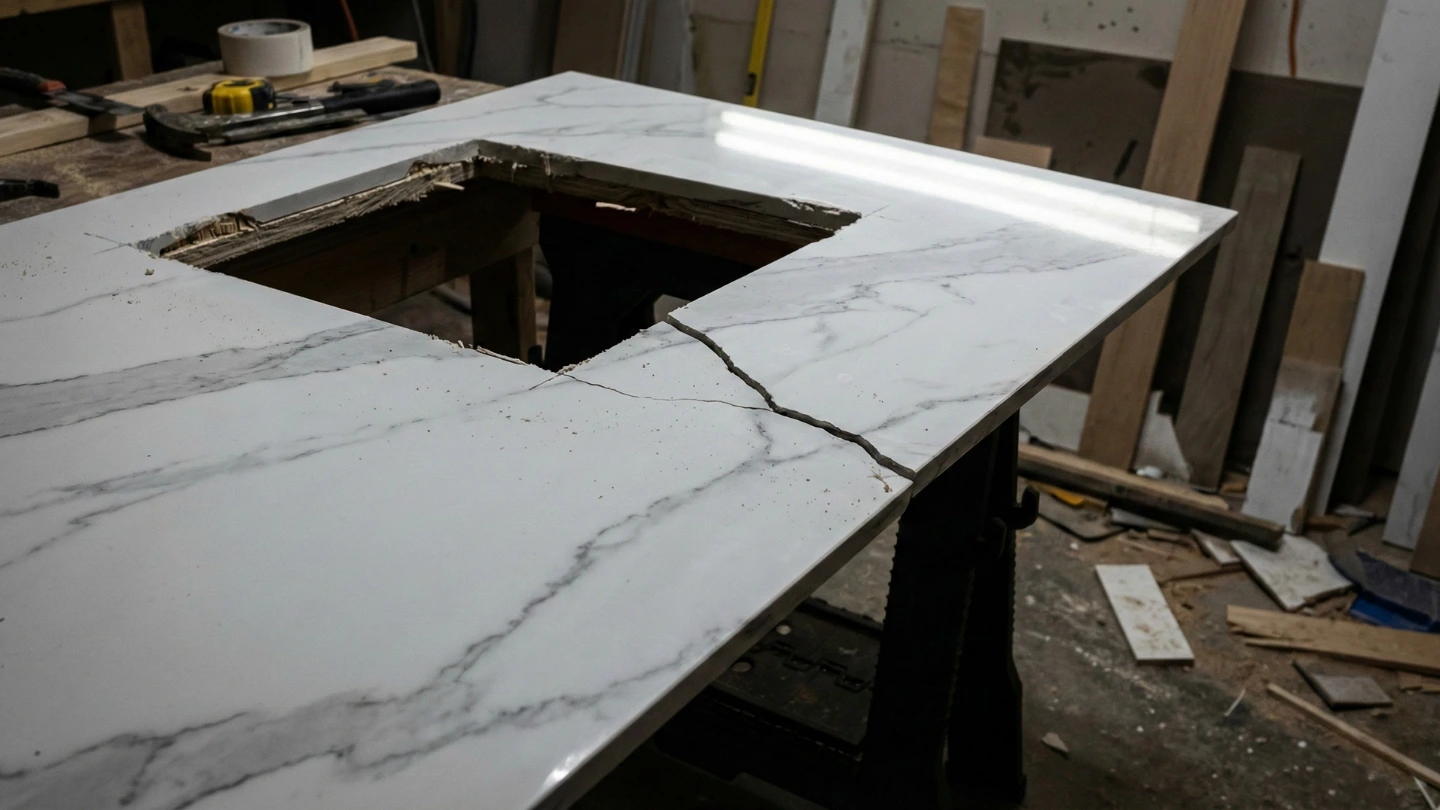
This is the heart of the problem. Your countertop has no sink hole—and it needs one.
China suppliers don’t pre-cut sink holes because doing so would almost guarantee the slab cracks during the long shipping journey. The stress points created by a large rectangular cutout make the material extremely vulnerable to vibration and impact damage. Leaving it as a solid slab is the only way to get it to Malaysia in one piece.
But now that solid slab is in your home, and cutting a sink hole is the most dangerous on-site operation for porcelain. The installer must remove a large rectangular section from the middle of your countertop—creating exactly those stress points the supplier avoided during shipping.
In a factory, this is done with CNC precision, proper support underneath, and controlled cutting speeds. The corners are carefully radiuses to distribute stress. The entire process might take thirty minutes of careful, calibrated work.
On-site, the installer is working with handheld tools, often in awkward positions, without proper support underneath the slab. One moment of excessive pressure, one slight vibration, one hidden internal stress point in the material—and your countertop cracks from the sink cutout corner straight to the edge.
We’ve seen this happen countless times. A homeowner calls us after their “installer” attempted to cut a sink hole in their China porcelain slab. The result: a countertop with a crack running from the sink corner to the edge, completely unusable, thousands of ringgit wasted.
The Edge Polishing Challenge
When pre-fabricated pieces need joining or trimming on-site, the cut edges require polishing to match the factory finish. This seems straightforward until you understand what’s involved.
Porcelain edge polishing requires a sequence of progressively finer diamond pads, water for cooling and dust suppression, and consistent pressure across the entire edge. Factory polishing uses automated equipment that maintains perfect consistency. On-site polishing relies on handheld grinders and human skill.
The result of on-site polishing rarely matches factory quality. You’ll likely see visible differences between the original factory edges and any edges modified on-site—waviness, inconsistent sheen, or visible scratch patterns. For a premium material that’s supposed to look flawless, this compromises the entire aesthetic.
The Dust and Safety Issue
Cutting and grinding porcelain generates enormous amounts of fine silica dust—a serious health hazard requiring proper extraction systems and respiratory protection. In a factory, industrial dust extraction and worker safety protocols manage this risk.
On-site, in your kitchen, controlling this dust is nearly impossible. It gets everywhere—into your cabinets, your appliances, your ventilation system. Even with plastic sheeting and portable extraction, porcelain cutting creates a mess that takes days to fully clean.
Many installers simply won’t do it because they lack proper safety equipment for on-site porcelain work, and they’re not willing to risk their health for your job.
The Equipment Gap: Why Installers Can’t Do What Factories Do
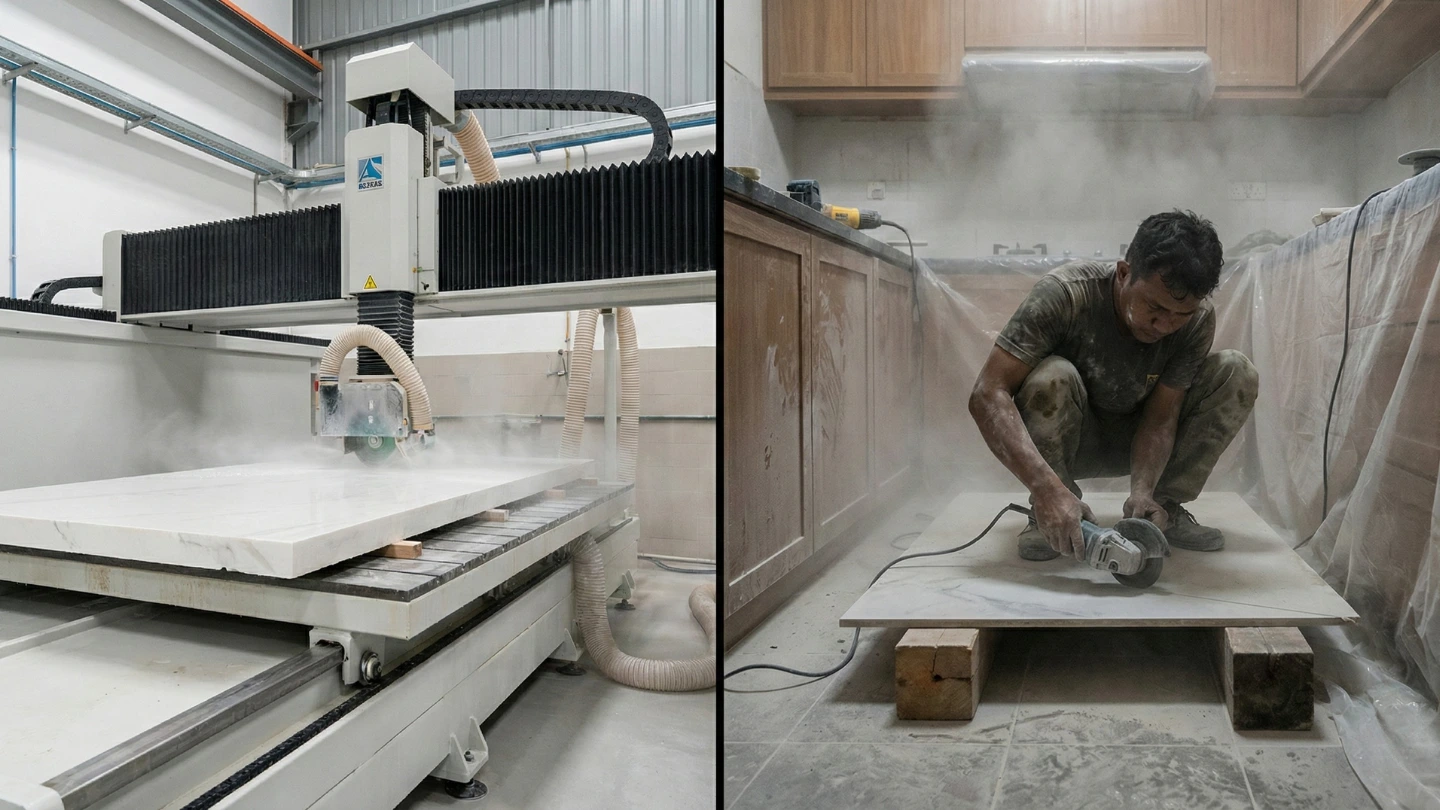
Professional countertop installation in Malaysia has evolved around quartz stone, which dominates the local market. Quartz is far more forgiving than porcelain—it cuts cleanly with standard equipment, tolerates minor handling stress, and can be adjusted on-site with reasonable confidence.
The tools and techniques that work beautifully for quartz simply don’t translate to porcelain.
When installers work with quartz, they carry angle grinders with diamond blades, polishing pads, and standard support equipment. These tools handle quartz predictably. The same tools on porcelain? Disaster waiting to happen.
Proper porcelain work requires specialised blades designed for ultra-hard materials, significantly slower cutting speeds, more water flow, better support systems, and different techniques altogether. Most installation teams don’t own this equipment because they rarely need it—their supplier partners handle porcelain fabrication in factory settings where proper equipment exists.
Asking a quartz installer to cut your porcelain slab on-site is like asking a car mechanic to service an aeroplane. The fundamental requirements are different, and the consequences of getting it wrong are severe.
The Liability Question Nobody Wants to Answer
Even if an installer had the right equipment and skills, there’s still the liability problem.
When you purchase a countertop through proper supply-and-install channels, the supplier takes responsibility for the entire process. If something goes wrong during fabrication or installation, they replace the material at their cost. Their warranty covers both material and workmanship.
With your pre-fabricated China slab, that accountability chain is broken.
If an installer attempts on-site work and your slab cracks, who pays? The installer will argue the material had internal defects or stress points invisible to the eye. You’ll argue their technique was wrong. The original supplier is thousands of kilometres away in China, completely unreachable.
This ambiguity creates legal and financial exposure that no sensible business accepts. The installer has everything to lose—their reputation, the cost of their labour, potential legal disputes—and almost nothing to gain. Even charging a premium doesn’t justify the risk when one cracked slab could wipe out the profit from ten successful jobs.
Professional installers have learned this lesson the hard way. They’ve seen colleagues get burned by customer-supplied materials. They’ve heard the horror stories. And they’ve decided, reasonably, that no amount of money makes this risk worthwhile.
“But the China Supplier Said Installation Would Be Easy”
Of course they did. At RM1,500-2,500 for a complete countertop, they’re not offering consultation services—they’re selling volume.
China suppliers selling pre-fabricated countertops to Malaysian consumers aren’t lying exactly—they’re just selling a product without any responsibility for what happens after delivery. In their view, the countertop is “ready to install” because the major fabrication is complete. They’ve cut it to your dimensions and polished the visible edges.
What they conveniently don’t explain:
They deliberately left the sink hole uncut. A countertop with a sink cutout is fragile and likely to crack during the long shipping journey from China. Leaving it as a solid slab protects their product during transit—but transfers the most dangerous cutting work to you.
They’ve never seen your actual kitchen. They worked from drawings or measurements you provided, which may or may not match reality.
They’re not responsible for installation. Once the slab leaves their factory, their obligation ends. The sink hole that MUST be cut? That’s your problem now.
They don’t understand the Malaysian installation market. They don’t know that local installers lack equipment for on-site porcelain work, or that finding someone to cut your sink hole will be nearly impossible.
The supplier got paid. You got a solid slab with no sink hole. And now you’re stuck with the gap between what you bought and what you actually need: a functional countertop in your kitchen.
The Real Cost Comparison: Why “Cheap” Isn’t Always Affordable
Let’s be honest about why you bought from China: the price was irresistible.
What You Paid
A pre-fabricated China porcelain countertop for a standard L-shaped kitchen costs approximately RM1,500-2,500—sometimes even less for simpler designs. Add shipping to Malaysia (RM300-800 depending on your location and supplier), and you’re looking at RM1,800-3,300 total for a countertop that would cost RM5,000-6,000 through local porcelain slab supply-and-install channels like Moca Compact.
That’s potentially 40-60% savings. On paper, it’s a no-brainer.
The Problem: You Can’t Use It Yet
Your beautiful countertop is sitting in your home, but it’s not functional. It needs:
- Sink hole cutting — RM300-800 if anyone agrees to do it (most won’t)
- Tap hole drilling — RM50-150 per hole
- Installation labour — RM500-1,500 depending on complexity
- Scribing and adjustments — RM200-500 for fitting to your actual walls
But here’s the catch: finding someone to do this work is nearly impossible. And if they do agree, they’ll charge premium rates because they’re taking on enormous risk.
The Hidden Cost: When No One Will Touch It
After calling fifteen installers and getting rejected by all of them, what are your options?

Option A: Pay extreme premiums Some installers might agree for 2-3x normal rates. Your RM500 installation becomes RM1,500. Your RM500 sink cutout becomes RM1,500. Suddenly your RM2,500 countertop costs RM5,500-7,000 total—and you still have no warranty.
Option B: Take desperate risks You find a tiler who “will try” but doesn’t have proper equipment. The sink hole cracks. Your RM2,500 countertop becomes RM0. You now need to buy another countertop—this time locally.
Option C: The countertop sits unused Months pass. Your kitchen renovation stalls. You eventually give up and purchase locally anyway. The China countertop becomes an expensive garage decoration.
Compare to Proper Supply-and-Install
What could you have purchased with professional supply-and-install service for the same material type?
Porcelain Slab:
- Moca Compact (established porcelain slab brand): RM110-130 per square foot, fully installed
Sintered Stone:
- Dekton (premium sintered stone by Cosentino): RM229-474 per square foot, fully installed
For a 45-square-foot L-shaped kitchen:
- Moca Compact total: RM4,950-5,850 — includes factory fabrication, sink cutout, polished edges, professional installation, and warranty
- Dekton total: RM10,305-21,330 — premium sintered stone with full warranty and professional handling
- Your China countertop total (best case): RM3,300-7,300 — no warranty, amateur on-site work, high crack risk
Here’s the reality check: Moca Compact costs only slightly more than your China countertop after installation fees—and you get factory fabrication, professional installation, and actual warranty coverage. The “savings” from buying China pre-fabricated porcelain essentially disappear when you factor in the installation nightmare.
The Real Equation
| Scenario | Material Cost | Installation & Modifications | Risk of Total Loss | Warranty | True Total |
|---|---|---|---|---|---|
| China pre-fabricated | RM1,800-3,300 | RM1,500-4,000 (if anyone agrees) | HIGH | None | RM3,300-7,300 + risk |
| Moca Compact supply & install | RM4,950-5,850 | Included | LOW | Yes | RM4,950-5,850 |
| Dekton supply & install | RM10,305-21,330 | Included | LOW | 25 years | RM10,305-21,330 |
The China option looks cheaper until you account for the installation nightmare, the crack risk, and the zero warranty. When you compare like-for-like with Moca Compact—another porcelain slab product—the price difference is minimal, yet Moca Compact comes with professional fabrication and warranty protection.
Scenario 1: The Impossible Search
You call fifteen installers. Three don’t call back. Eight say no immediately when they hear “customer-supplied porcelain.” Two ask questions and then decline once they understand on-site cutting is needed. Two quote prices so high they exceed buying new locally.
Your slab sits in the garage for six months while you keep searching. Eventually, you give up.
Scenario 2: The Desperate Compromise
You find a tiler who “has experience with large tiles” and agrees to try. He doesn’t have proper equipment but promises to be careful.
During sink hole cutting, the slab cracks. He blames the material quality. You blame his technique. There’s no warranty, no recourse, and you’re now out the cost of the slab plus his labour. You still need a countertop.
Scenario 3: The Cosmetic Disappointment
An installer agrees to the job and successfully completes it—technically. But the on-site cut edges don’t match the factory polish. The sink cutout corners show visible stress marks. The joint where two pieces meet has a noticeable seam that the factory pieces don’t have.
You have a functional countertop, but it doesn’t look like what you envisioned. For a premium material chosen for its aesthetics, this defeats much of the purpose.
Scenario 4: The Expensive Success
You find a specialist willing to do the work properly, with correct equipment and techniques. They charge accordingly—significantly more than standard installation. The job is completed successfully, but your total cost exceeds what you would have paid for a proper supply-and-install package from day one.
You’ve paid more for less warranty protection and more stress.
What Should You Do Instead?
If you haven’t yet purchased that pre-fabricated China slab, reconsider your approach.
Understand the Full Installation Reality
Pre-fabricated doesn’t mean no-work-required. Every kitchen installation needs on-site adjustments. If you’re buying porcelain or sintered stone, those adjustments must happen in a factory environment with proper equipment—not on-site with handheld tools.
When you purchase from local suppliers with supply-and-install service, they template your actual kitchen, fabricate in their factory with proper equipment, and install pieces that require minimal on-site modification. This isn’t a luxury—it’s the only reliable way to install these materials.
Recognise the Material Difference
Many homeowners believe they’re buying sintered stone when they’re actually purchasing porcelain slab—a related but different material. Both require specialised handling, but true sintered stone from brands like Dekton undergoes proprietary processes that create more consistent, workable material. Generic China imports vary wildly in quality and behaviour.
Value Professional Fabrication
The countertop fabrication process involves precision equipment, trained operators, and controlled conditions. This isn’t overhead you’re paying for unnecessarily—it’s the only way to reliably cut, shape, and finish these materials without cracking them.
When you buy pre-fabricated and expect on-site modifications, you’re trying to skip the fabrication step that makes these materials viable. It rarely works.
Calculate the True Total Cost
Never compare pre-fabricated slab prices to supply-and-install packages. The comparison is meaningless until you add shipping, duties, installation premiums, and the cost of on-site work. Often, the “savings” disappear entirely—and you’re left with more risk and no warranty.
Already Bought the Slab? Your Realistic Options
If you’ve already purchased a pre-fabricated China slab and are discovering this reality too late, here’s what you can actually do:
Option 1: Find a Porcelain Specialist (Difficult and Expensive)
Some fabricators do have proper equipment for porcelain and sintered stone work. They may be willing to take your slab to their factory, perform the necessary modifications there, and return for installation.
This is your best option for a successful outcome—but expect to pay significantly more than standard rates. The fabricator is taking on risk and using specialised equipment. They’ll charge accordingly.
Be prepared to sign waivers accepting liability for material defects. If the slab cracks during their factory work, you may have no recourse. They didn’t supply the material and can’t warrant it.
Option 2: Request Factory Sink Cutting
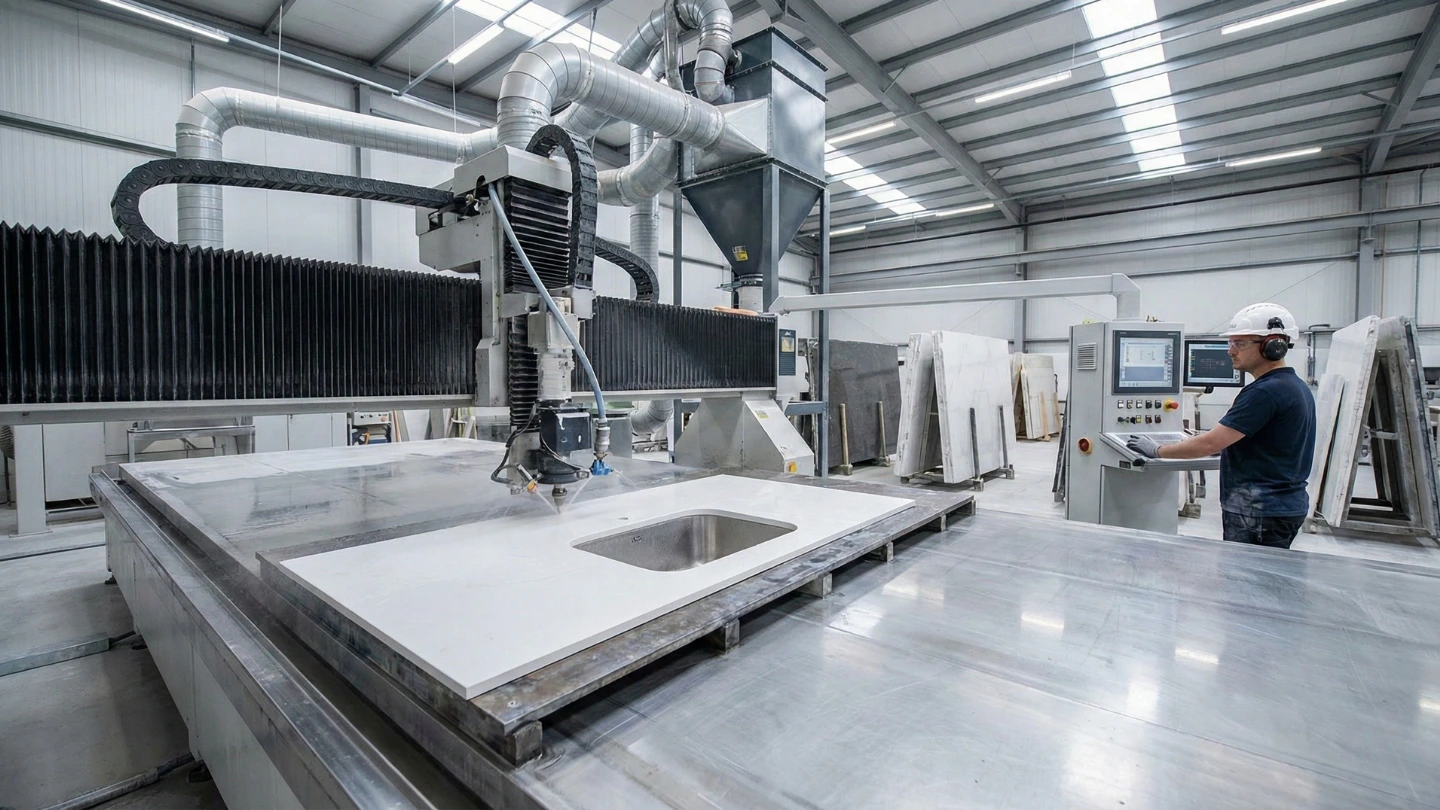
If you can find a fabricator willing to help, ask if they’ll take your countertop to their factory to cut the sink hole using proper CNC equipment, then return for installation.
This separates the high-risk cutting from the on-site work. The sink hole gets cut in controlled factory conditions with proper support and equipment, dramatically reducing crack risk. On-site, the installer only needs to handle placement and minor adjustments.
Expect to pay extra for this service—transporting your countertop to their factory, using their equipment, and making a second trip for installation adds cost. But it’s far safer than on-site cutting.
Option 3: Repurpose the Material
Porcelain slabs work beautifully for applications that don’t require complex fabrication. Feature walls, fireplace surrounds, outdoor cladding—these installations involve simpler cuts and don’t require sink holes.
You might find a tiler experienced with large-format porcelain willing to install your slab as a wall feature. You won’t get your kitchen countertop, but you’ll recover some value from your purchase.
Option 4: Sell and Move On
List the slab for sale. Other homeowners in similar situations might be searching, or contractors might want it for projects with simpler requirements.
You’ll lose money, but recovering something is better than nothing. Consider the loss an educational expense and purchase properly through local supply-and-install channels.
Option 5: Accept the Lesson
Sometimes the wisest choice is acknowledging a mistake and not compounding it. If none of the above options work, you may need to set aside the China slab and purchase a countertop properly.
This feels like waste—and it is. But continuing to pursue a problematic slab can waste even more money and time. A functional kitchen has value. A garage full of unusable stone does not.
The Industry Reality: Why This Situation Exists
Malaysian installers aren’t being inflexible for the sake of it. They’ve learned through experience that customer-supplied porcelain materials create problems that aren’t worth the money.
The stone industry operates on thin margins with significant liability exposure. A cracked slab during on-site work represents material loss (your problem legally, but their reputation practically), wasted labour, potential disputes, and damage to their professional standing.
When installers control the entire process—material supply, factory fabrication, and installation—they can manage quality throughout and stand behind the result. When you insert an unknown variable (your China slab) and expect them to perform high-risk on-site work (cutting, polishing, sink holes), you’re asking them to gamble their reputation on your purchasing decision.
From their perspective, there’s no upside that justifies this risk. They can fill their schedule with proper supply-and-install jobs that carry manageable risk and reasonable profit. Why would they accept a job where everything that can go wrong probably will?
Making the Right Choice for Your Kitchen
We understand the appeal. When you’re comparing RM2,000 to RM7,000, the decision seems obvious. Every homeowner wants to stretch their renovation budget as far as possible, and that China pre-fabricated countertop looks like the smart choice.
But the true cost of a countertop isn’t just the purchase price—it’s the total cost of having a functional surface in your kitchen. A RM2,000 countertop that can’t be installed costs you RM2,000 plus whatever you eventually spend on a replacement. A RM7,000 countertop that’s professionally fabricated and installed costs you exactly RM7,000.
The cheapest countertop is the one that works the first time.
Before you click “buy” on that pre-fabricated China porcelain, ask yourself: who will cut the sink hole? Who will drill the tap holes? Who will scribe it to my walls? If you can’t answer these questions with specific names and confirmed agreements, you’re not ready to buy.
Your kitchen deserves a countertop that actually gets installed. And you deserve a renovation that ends with a functional kitchen—not months of frustration and a garage full of regret.