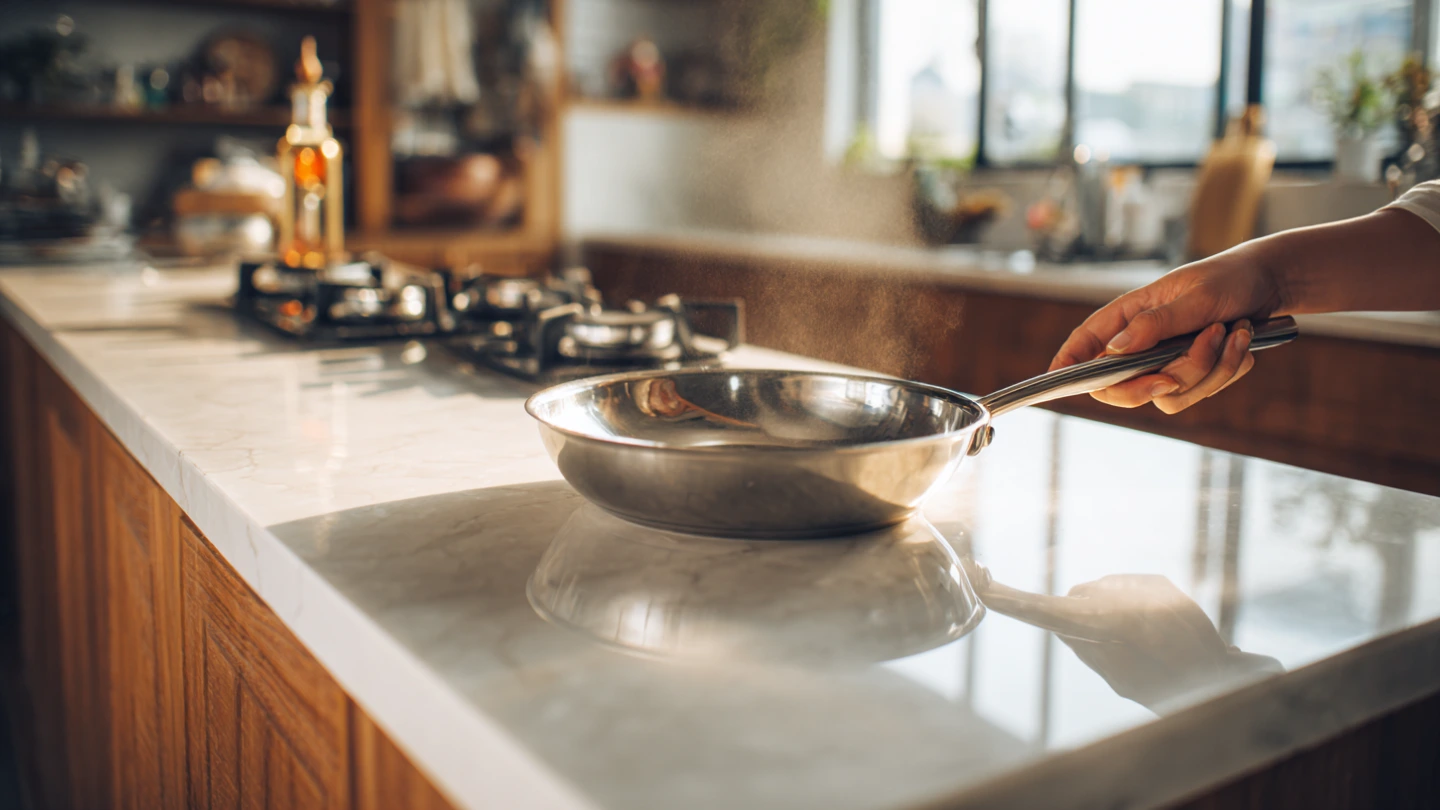
If you’ve just had a beautiful quartz stone countertop installed in your Malaysian kitchen — or you’re about to — this question has probably crossed your mind. You’ve lifted a smoking wok off the stove, both hands full, and the nearest surface is your gleaming new kitchen top. Can you just set it down?
The short answer is no. You should not place hot pans, woks, or pots directly on a quartz stone kitchen top. Doing so can cause permanent damage — from faint discolouration to visible scorch marks and, in extreme cases, cracking.
But this isn’t a flaw that should put you off quartz. It’s a characteristic you need to understand and manage — and once you do, it takes almost no effort. In this guide, we’ll explain exactly why quartz reacts to heat the way it does, what temperatures are actually dangerous, what heat damage looks like in practice, and how Malaysian homeowners can protect their countertops with simple, everyday habits.
Why Quartz Stone Isn’t Heat Resistant
To understand why hot pans are a problem, you need to understand what quartz stone is and how it’s made.
Unlike granite, which is quarried directly from the earth, quartz stone is an engineered material. It’s manufactured by combining approximately 90–95% crushed natural quartz crystals with 5–10% polymer resins and pigments. The quartz crystals provide hardness and visual appeal, whilst the polymer resins bind everything together into a solid, non-porous slab.
Here’s the critical point: those polymer resins are what make quartz vulnerable to heat.
Polymer resins — typically polyester or acrylic-based — begin to soften and degrade at temperatures above 150°C. When you place a hot pan directly onto the surface, the heat transfers into the resin, and if the temperature exceeds what the resin can tolerate, damage occurs.
This isn’t a manufacturing defect or a sign of low quality. Even premium brands like Caesarstone and Silestone contain resin — it’s essential to the material. The resin is what makes quartz non-porous (so bacteria and liquids can’t penetrate), crack-resistant (pure quartz crystals would be brittle), and consistent in appearance. Without it, you wouldn’t have a countertop — you’d have a pile of loose crystals.
The trade-off for these excellent properties is heat sensitivity. It’s a fair exchange, but one you need to be aware of.
How Hot Is Too Hot?
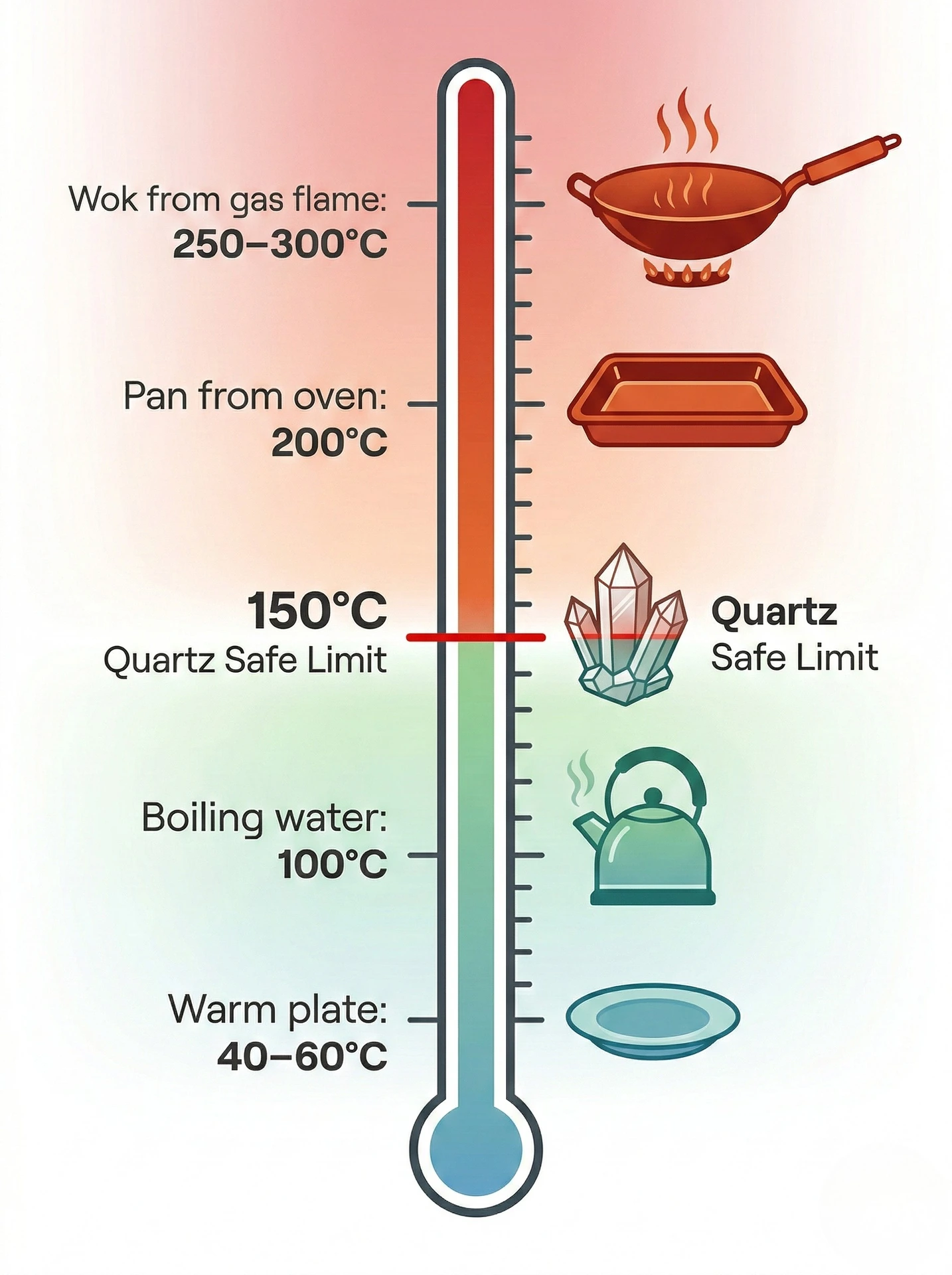
Most quartz manufacturers recommend keeping surface contact below 150°C. To put that in perspective:
- A wok fresh off a gas flame: 200–300°C — well above the danger zone
- A pan from the oven at 200°C: dangerous if placed directly on quartz
- A baking tray from a 180°C oven: still risky, especially with prolonged contact
- A pot of boiling water (100°C): generally safe for brief contact, but not ideal for extended periods
- A warm plate from the microwave: safe — nowhere near the threshold
The most dangerous scenario in Malaysian kitchens is wok cooking. Stir-frying at high heat — whether it’s char kuey teow, nasi goreng, or sambal tumis — pushes wok temperatures to 250–300°C. That’s nearly double what quartz resin can handle. Setting a wok at that temperature directly on quartz, even for a few seconds, can leave a mark.
What Heat Damage Actually Looks Like on Quartz
Heat damage on quartz doesn’t always look dramatic. In fact, many homeowners don’t immediately realise it’s happened. Here’s what to look for:
Discolouration and Yellowing
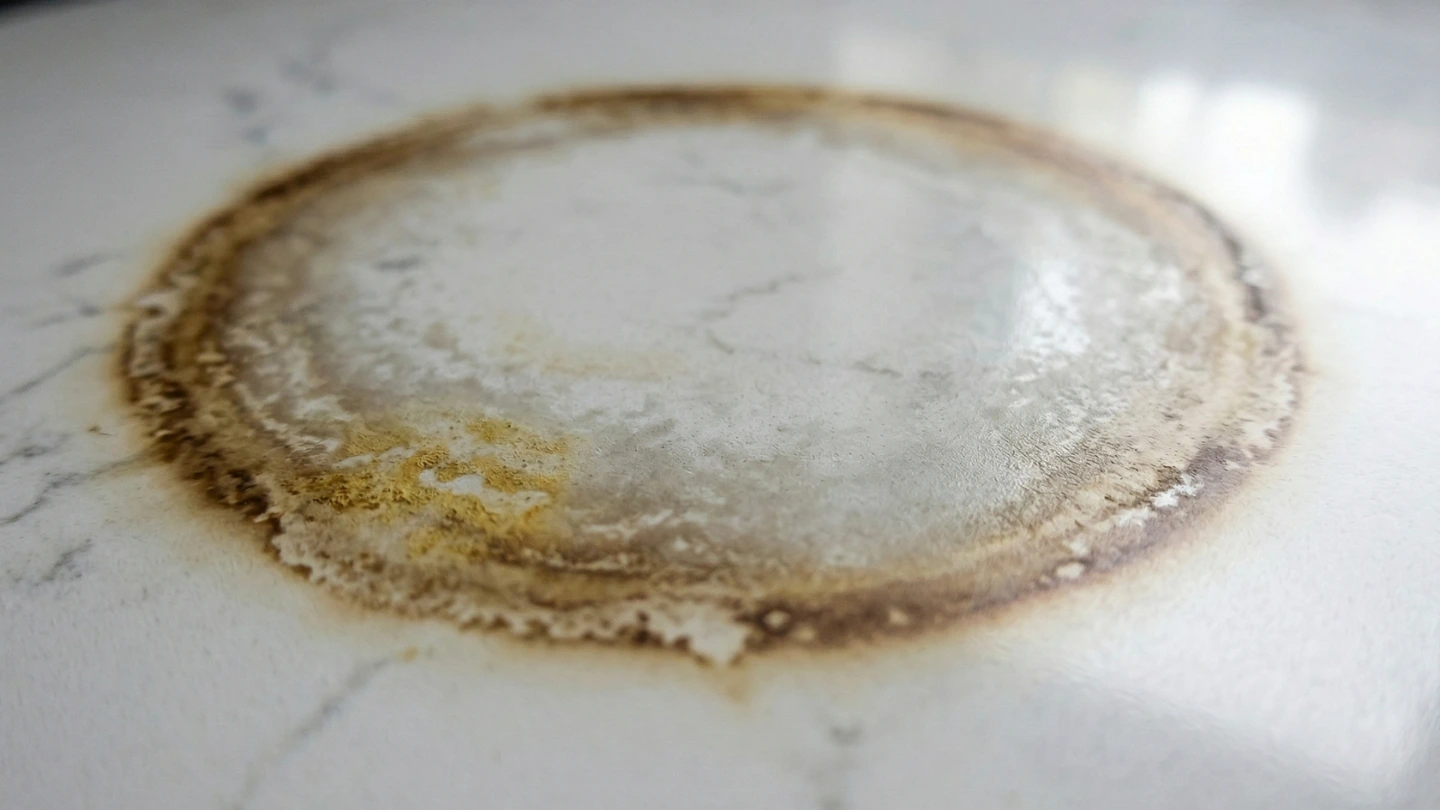
The most common form of heat damage is a faint white, yellow, or cloudy mark where the hot item made contact. This happens when the resin in that localised area softens and changes structure. On darker quartz colours, the mark appears as a lighter patch. On white or light quartz, it may appear as a dull, cloudy spot that no amount of cleaning removes.
Scorch Marks
More severe heat exposure — such as placing a smoking wok or a pan straight from high flame — can leave visible brown or black scorch marks. These are areas where the resin has actually burned. Scorch marks are permanent and cannot be buffed out or cleaned away.
Surface Cracking
In extreme cases, sudden and intense heat can cause thermal shock — a rapid temperature change that creates stress within the slab. This can result in hairline cracks radiating from the point of contact. Thermal shock is more likely when the countertop is cold (such as in an air-conditioned kitchen) and a very hot item is placed on it suddenly.
See It for Yourself
If you’re wondering just how quickly heat can damage a quartz surface, watch this demonstration by Thrifty Tani. He places an extremely hot pot directly on a quartz stone top — and the result speaks for itself.
The Frustrating Truth
All three types of heat damage are permanent. Unlike a scratch that might be buffed out by a professional, heat damage to quartz resin cannot be reversed. The affected area would need to be cut out and replaced — which is expensive and often impractical. Prevention is genuinely the only solution.
Malaysian Cooking and Quartz: Specific Scenarios
Malaysian cooking styles involve more high-heat techniques than many other cuisines. Let’s look at common kitchen scenarios and their risk levels:
Wok Cooking (High Risk)
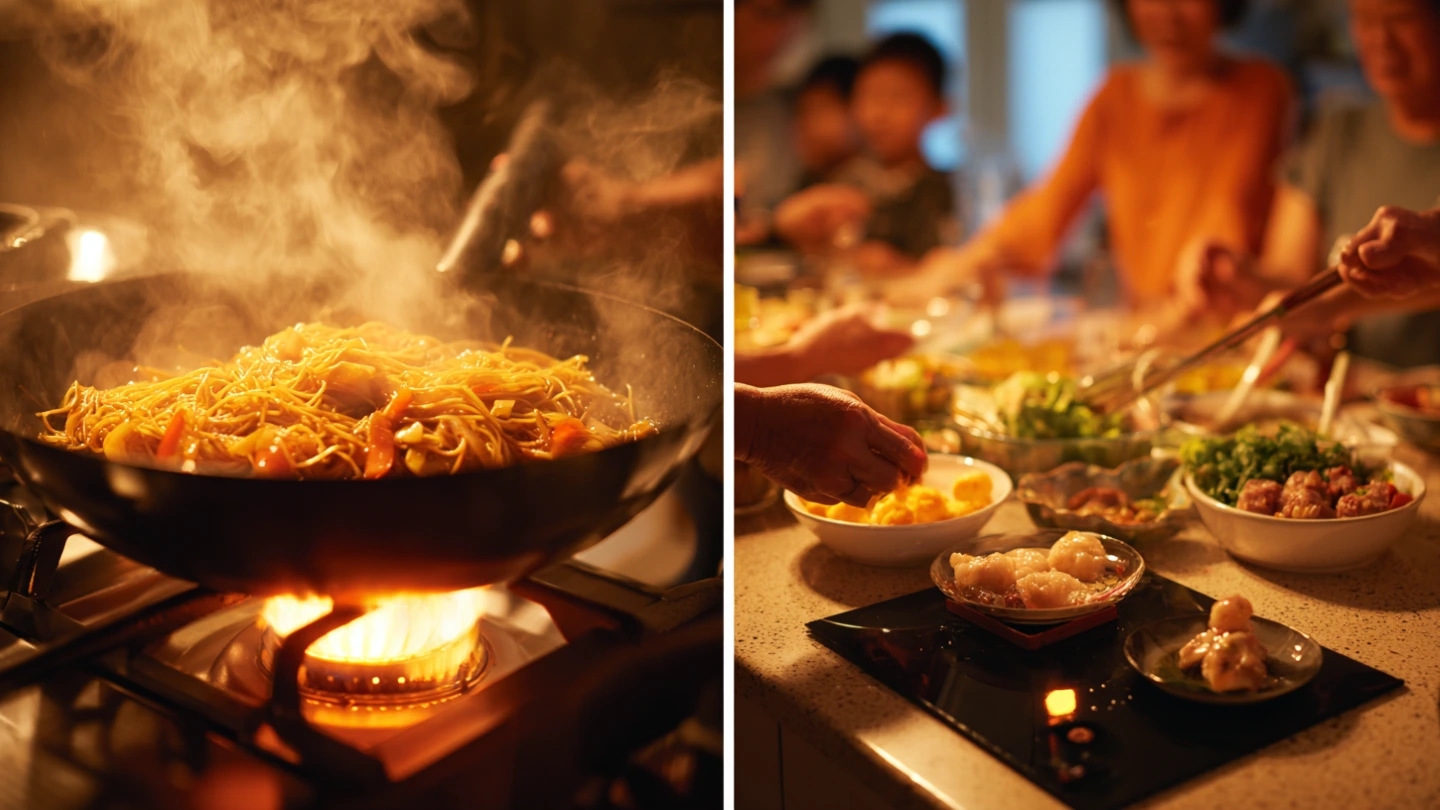
Wok cooking is central to Malaysian cuisine. Whether you’re tossing mee goreng or achieving that elusive wok hei on char kuey teow, your wok reaches extremely high temperatures — often 250–300°C on a gas flame. This is the single biggest heat risk for quartz countertops in Malaysian kitchens.
What to do: Always have a designated trivet or heat pad within arm’s reach of your stove. Make it part of your wok cooking setup — trivet goes down before the wok comes off the flame.
Steamboat and Hot Pot Gatherings (Moderate Risk)
During Hari Raya, Chinese New Year, or weekend family steamboat sessions, portable burners and hot pots sit on the counter for hours. The sustained heat from the burner’s base can gradually warm the quartz surface beyond safe temperatures, even if no flame directly contacts it.
What to do: Place a thick, heat-resistant mat or wooden board under any portable burner. The mat should be larger than the burner’s base to catch any radiated heat.
Rice Cookers and Air Fryers (Low to Moderate Risk)
These appliances generate heat from their bases during operation. A rice cooker during cooking can reach 100–120°C at its base, whilst air fryers can get significantly hotter. Over time, repeated heat exposure from appliance bases can cause gradual discolouration.
What to do: Use a heat-resistant mat under any heat-generating appliance. This is good practice for any countertop material, not just quartz.
Coffee and Tea Preparation (Low Risk)
Setting a hot kettle or teapot on quartz briefly is generally safe — water boils at 100°C, which is below the danger threshold. However, a kettle that’s been left on the stove until it’s glowing hot at the base could be risky.
What to do: Brief contact is fine. If you’re a multiple-cups-a-day tea drinker, a small trivet near your kettle station keeps things worry-free.
How to Protect Your Quartz Kitchen Top from Heat Damage
The good news is that protecting quartz from heat damage is extraordinarily simple. You don’t need expensive products or complicated routines — just a few consistent habits.
Use Trivets and Heat Pads
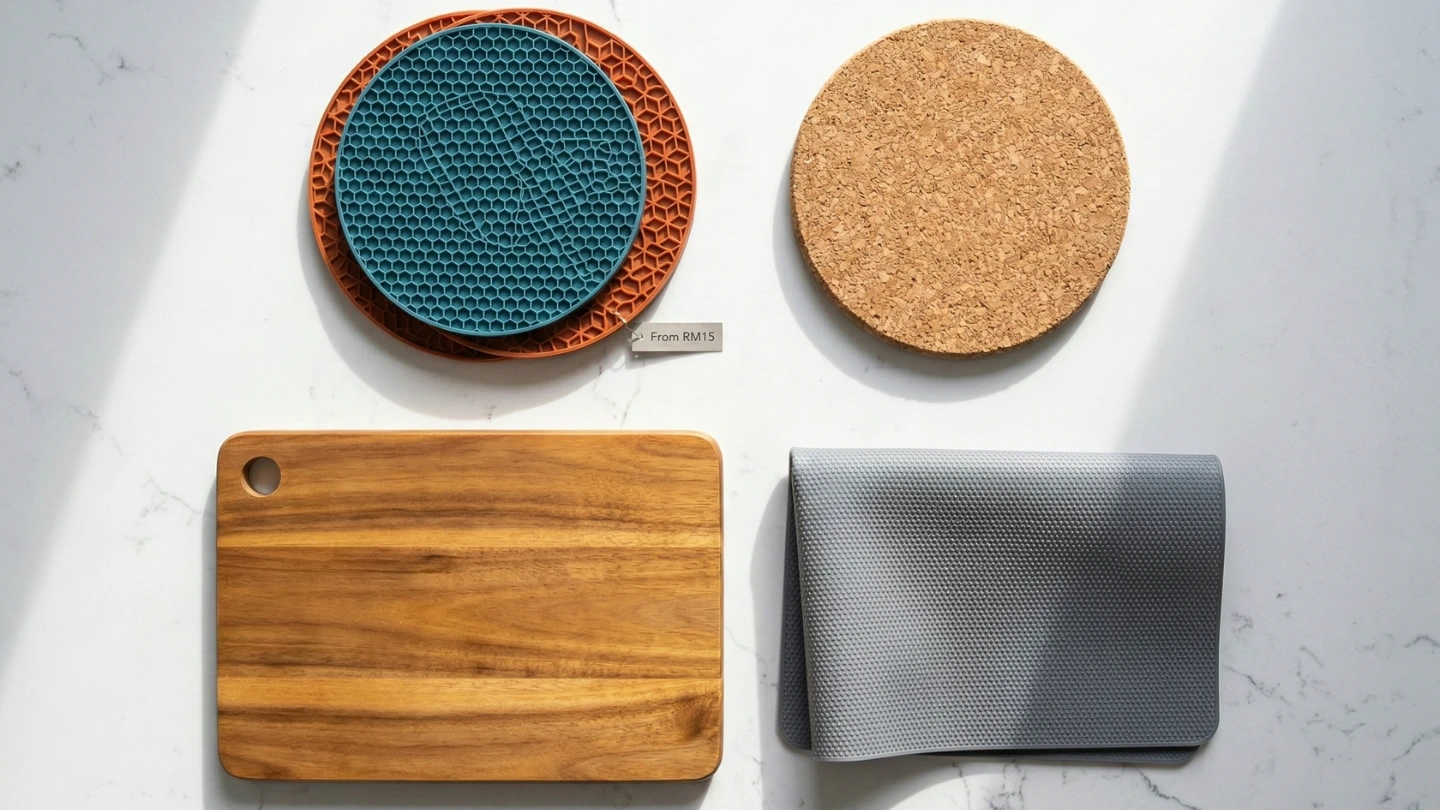
This is the single most important habit. Keep trivets, silicone heat pads, or wooden boards strategically placed near your stove and oven. The best trivets for Malaysian kitchens are:
- Silicone trivets — lightweight, easy to clean, heat-resistant up to 250°C+, and they won’t scratch your countertop
- Wooden chopping boards — double duty as both a heat barrier and food prep surface
- Cork trivets — affordable, effective, and widely available at shops like MR.DIY or IKEA Malaysia
The key is accessibility. If a trivet is buried in a drawer, you won’t use it when your hands are full and a hot wok needs to go somewhere immediately. Mount a hook near the stove, keep a trivet on the counter permanently, or use a wall-mounted trivet holder.
Create a Dedicated Landing Zone
Designate one area of your kitchen counter as the “hot zone” — a permanent spot where a heat-resistant mat or thick wooden board always sits. This becomes the automatic destination for anything hot. Over time, it becomes habit, and you won’t even think about it.
Use Mats Under Appliances
Place heat-resistant mats under rice cookers, air fryers, slow cookers, and any appliance that generates heat at its base. This is especially important for appliances that run for extended periods.
Let Things Cool Briefly
If you’ve forgotten your trivet and need to set something down urgently, use the stove grate, a wooden chopping board, or even a folded tea towel as a temporary barrier. Just five minutes of cooling can bring a pan’s temperature from dangerous to safe.
“But My Quartz Supplier Said It’s Heat Resistant?”
This is a common source of confusion — and frustration — for Malaysian homeowners. Some sellers describe quartz as “heat resistant,” which isn’t entirely wrong but is dangerously misleading.
Quartz is heat resistant in the sense that it handles normal kitchen temperatures without issue. Warm plates, room-temperature items, and brief contact with moderately warm objects won’t cause problems. Compared to materials like laminate or solid surface, quartz tolerates heat better.
But “heat resistant” is not the same as “heat proof.” Quartz cannot withstand the kind of direct, intense heat that Malaysian cooking regularly produces. The distinction matters, and understanding it prevents expensive mistakes.
If a supplier tells you that you can place hot pans directly on quartz without any protection, be cautious. That’s either a misunderstanding of the material or a deliberate oversimplification. Reputable brands are transparent about this limitation in their care guidelines. It’s one of the genuine cons of quartz stone kitchen tops — but it’s a manageable one.
What If Heat Resistance Is Your Top Priority?
If you cook with serious heat every day and the idea of always reaching for a trivet frustrates you, quartz might not be the best material for your specific cooking habits. That’s not a criticism of quartz — it’s about matching the right material to your lifestyle.
Sintered Stone: The Heat-Proof Alternative
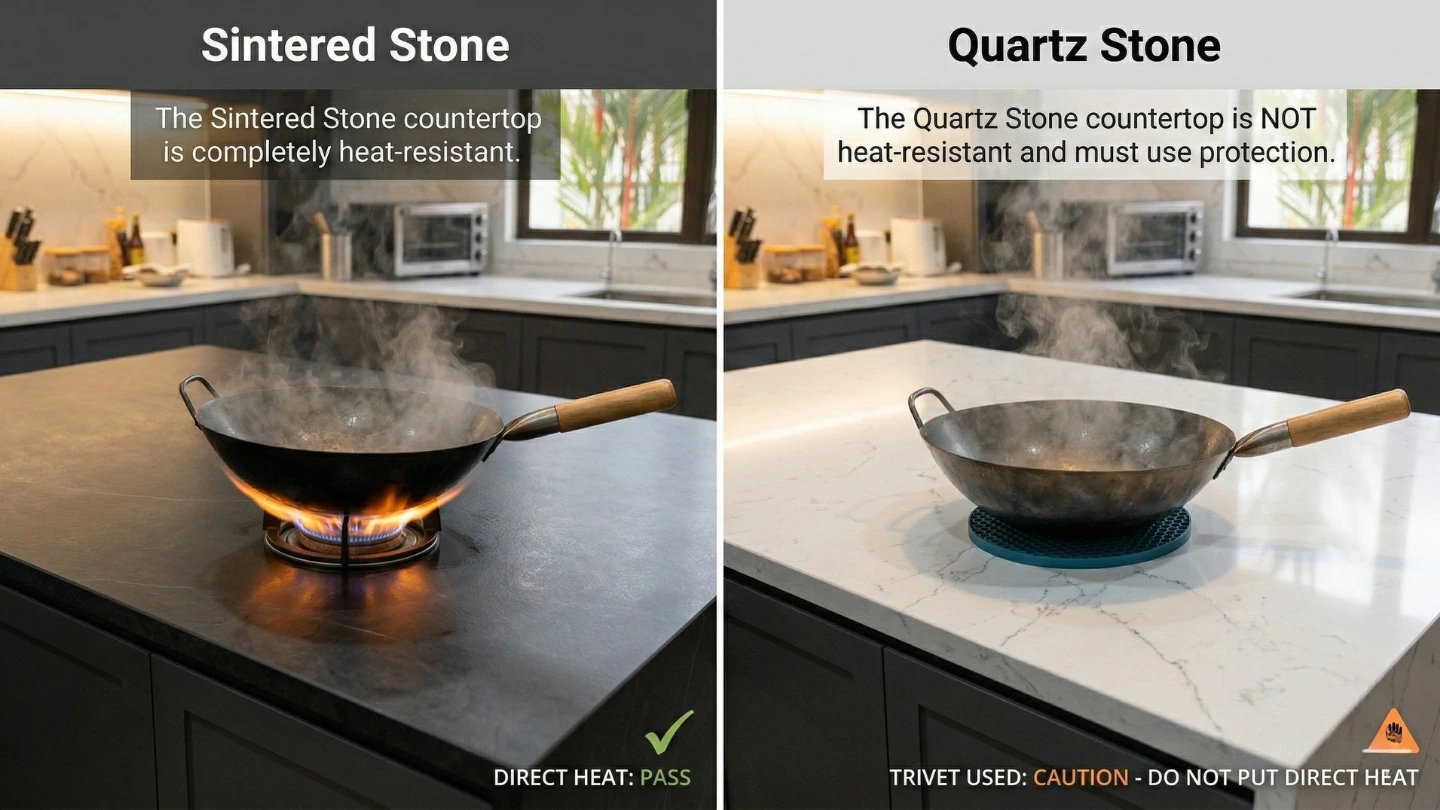
Sintered stone is manufactured at temperatures exceeding 1,200°C — far beyond anything a kitchen produces. It contains no polymer resins, which means you can place hot pans directly on sintered stone without any risk of damage. No trivets needed.
For Malaysian homeowners who do heavy wok cooking daily and want that freedom, sintered stone brands like Dekton offer genuine peace of mind. The trade-off is a higher price point — Dekton typically costs RM229–474 per square foot (supply and install) compared to Zenstone quartz at RM110–160 per square foot — and fewer design options compared to quartz’s extensive colour range.
If you’re weighing these two materials specifically, our guide on whether sintered stone is better than quartz breaks down the full comparison beyond just heat resistance.
Granite: Natural Heat Tolerance
Granite is a natural stone formed under extreme geological heat and pressure. It handles hot pans well in most cases, though it requires periodic sealing and is more maintenance-intensive than quartz.
The Hybrid Approach
Some Malaysian homeowners take a practical middle ground: quartz for the main countertop area (where its stain resistance, easy cleaning, and beautiful appearance shine) and a sintered stone or granite insert near the stove as a dedicated heat zone. This gives you the best of both worlds without committing your entire kitchen to one material.
Quartz Heat Damage vs Other Types of Damage
It’s worth putting heat damage in context. Quartz is remarkably resilient against most things that can go wrong in a kitchen:
- Stains: Quartz’s non-porous surface means turmeric, kicap manis, chilli oil, and coffee wipe away easily. It vastly outperforms granite and marble in stain resistance. For stubborn stains, follow our countertop cleaning guide.
- Scratches: With a Mohs hardness rating of 7, quartz resists scratches from knives, utensils, and everyday kitchen activities.
- Bacteria and mould: The non-porous surface doesn’t harbour bacteria or mould — a genuine advantage in Malaysia’s humid tropical climate.
- Impact: The resin content actually makes quartz more impact-resistant than natural stone, meaning it’s less likely to chip from dropping a heavy pot.
Heat is quartz’s one notable vulnerability. But when you consider that a simple trivet eliminates the risk entirely, it’s a minor inconvenience weighed against quartz’s many practical advantages.
Common Questions About Quartz and Heat
Can I put a warm (not hot) pan on quartz?
A pan that’s been off the heat for 10–15 minutes and feels warm but not too hot to touch is generally safe. The danger zone is items above 150°C — if you can hold your hand near it comfortably, it’s likely fine. When in doubt, use a trivet.
Will a single incident ruin my countertop?
Not necessarily. A brief contact with a moderately hot pan might leave no visible damage at all. The risk increases with higher temperatures, longer contact times, and repeated incidents in the same spot. But why take the chance? A RM15 silicone trivet is far cheaper than countertop repairs.
Can heat damage be repaired?
Unfortunately, no. Heat damage to quartz resin is permanent. Professional stone repair specialists can sometimes minimise the appearance of minor discolouration, but they cannot restore the surface to its original condition. Severe scorch marks or cracks require section replacement, which is costly and may not match the surrounding countertop perfectly.
Does quartz quality affect heat resistance?
All quartz — regardless of brand or price — contains polymer resin. A Caesarstone slab and a budget quartz slab have the same fundamental heat limitation. Premium brands may use slightly more advanced resin formulations, but no quartz product on the market is rated for direct contact with items above 150°C.
Is this just a Malaysian problem?
Not at all — quartz heat sensitivity is universal. However, Malaysian cooking habits (heavy wok use, high-heat stir-frying, steamboat gatherings) mean Malaysian homeowners encounter the risk more frequently than those in countries where lower-heat cooking methods are more common. It’s not a bigger problem here — it’s just a more relevant one.
[quartz-countertop-care-tips-trivet-placement-kitchen]
Don’t Let Heat Sensitivity Put You Off Quartz
It’s easy to read about heat damage and feel discouraged about choosing quartz. But here’s some perspective: quartz remains one of the most popular and practical countertop materials in Malaysian homes for very good reasons.
It’s low maintenance, beautifully consistent in appearance, highly stain-resistant, hygienic, and available in hundreds of colours and patterns. The pros of quartz stone kitchen tops genuinely outweigh the cons for the vast majority of Malaysian homeowners.
The heat limitation is real, but it’s also one of the easiest kitchen habits to manage. You wouldn’t put a hot pan on your wooden dining table or your laminate office desk — treating quartz the same way is simply sensible countertop care.
Thousands of Malaysian families cook with woks, prepare elaborate Hari Raya spreads, and host steamboat dinners on quartz countertops every week — without a single heat incident. The difference is simply knowing the rule and keeping a trivet handy.
Conclusion
Can you put hot pans directly on a quartz stone kitchen top? No — and now you understand exactly why. The polymer resins that give quartz its excellent durability, stain resistance, and non-porous surface are the same component that can’t tolerate extreme heat. Temperatures above 150°C can cause permanent discolouration, scorch marks, or cracking that no amount of cleaning or polishing can fix.
For Malaysian homeowners, this matters because our cooking culture involves high-heat techniques that routinely exceed quartz’s safe temperature range. But the solution is refreshingly simple: use trivets, keep heat pads near your stove, and place mats under hot appliances.
If you’re someone who absolutely wants the freedom to slam a smoking wok down anywhere on your counter without thinking twice, sintered stone might be a better fit for your kitchen. But if you can live with reaching for a trivet — and most people can — quartz stone delivers a combination of beauty, practicality, and durability that’s genuinely hard to beat.
The smartest approach isn’t avoiding quartz because of heat sensitivity. It’s choosing quartz with full awareness of its one limitation — and managing it with a habit that takes less than two seconds.
Considering quartz for your kitchen? Explore the complete pros and cons of quartz stone kitchen tops or compare it with sintered stone to find the best fit for your Malaysian home.