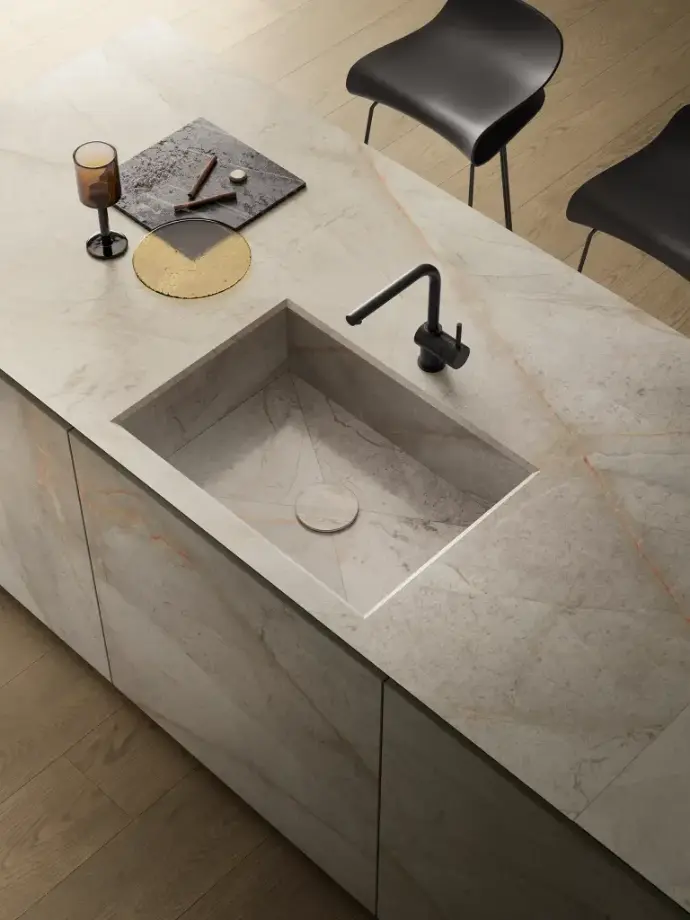
You are about to renovate your kitchen. The cabinets are sorted, the design is settled, and then comes the question most homeowners do not think about deeply enough: where should your countertop stone actually come from?
Most people assume this is a decision that gets made by default — you sign the carpenter’s quotation, the stone appears, and the job is done. But the reality is that you have three very distinct options, each with different risks, costs, and outcomes. And one of them is almost always a mistake.
Here is an honest breakdown of all three.

Option 1: Bundle the Stone with Your Carpenter
This is the most common approach in Malaysia. When a homeowner hires a carpenter to build and install kitchen cabinets, the carpenter typically offers to include the countertop stone as part of the overall package. You get one quotation, one point of contact, and in theory, a seamless renovation.
How It Works
Your carpenter sources the stone — usually through a fixed arrangement with one or two local stone suppliers — and adds it to your cabinet quotation. Once the cabinets are installed, the stone is fabricated and fitted as part of the same project.
Why Homeowners Choose This
It is convenient. You deal with one person, follow one timeline, and do not need to coordinate separately. For homeowners who are unfamiliar with the stone industry, it also removes the anxiety of having to evaluate stone suppliers on their own.
The Problems You Should Know
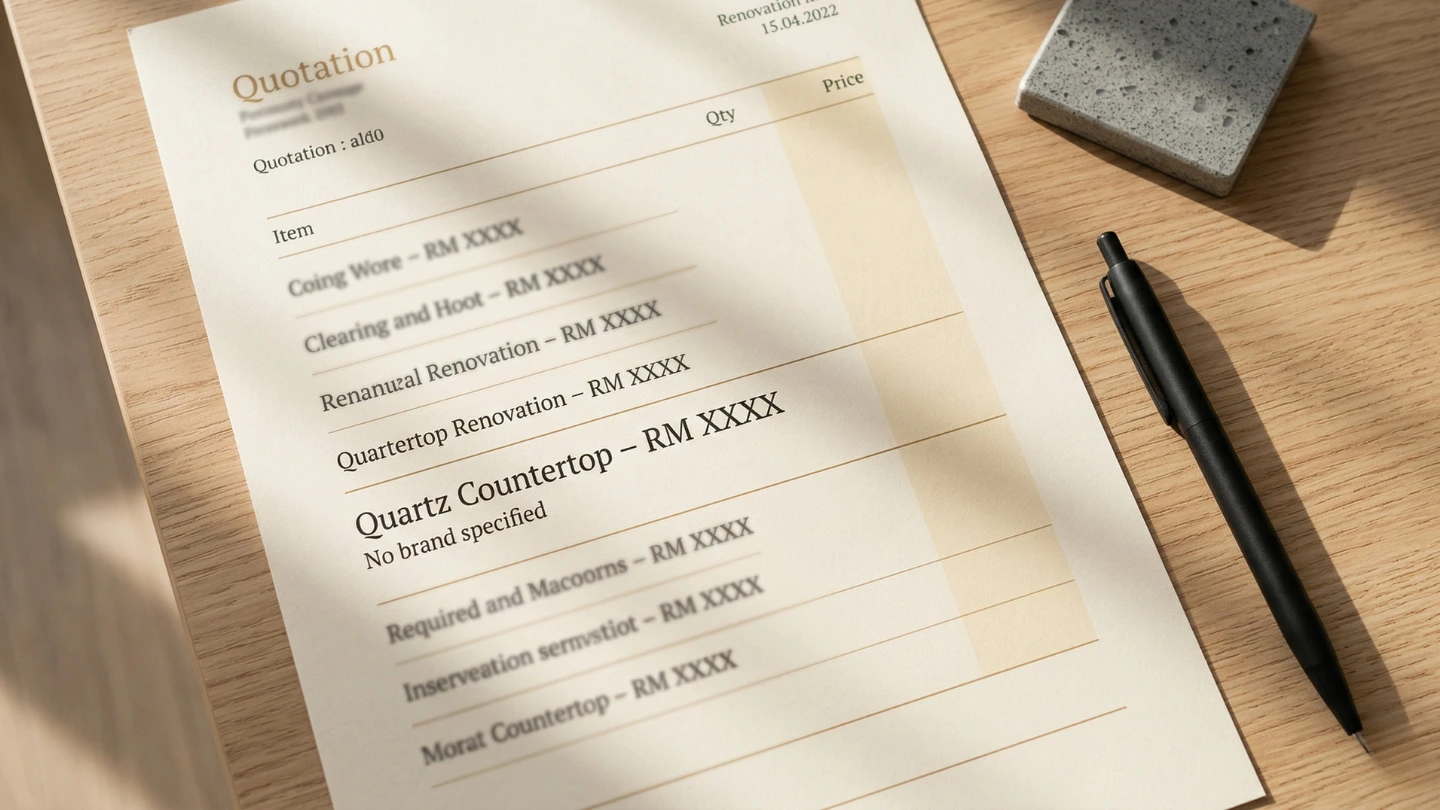
You rarely know what stone you are getting. Most carpenters quote “quartz top” or “stone worktop” without specifying the brand, the collection, or the thickness. That vague line item on your quotation could mean a RM 110 per square foot local quartz — or it could mean something far cheaper that was purchased at a bulk rate and marked up significantly.
The selection is limited. Carpenters typically work with one or two stone suppliers they have an ongoing arrangement with. If you want a specific brand — say, Caesarstone from the USA or Silestone from Spain — your carpenter may simply not be able to accommodate it.
Accountability is unclear. If the countertop develops a problem — a chipped edge, a poorly finished seam, or an uneven surface — who is responsible? The carpenter may point to the stone installer, and the stone installer may not even know who you are, since your relationship is with the carpenter, not them directly.
You may not be entitled to brand warranty. Premium brands like Caesarstone and Silestone offer product warranties, but these are typically valid only when the stone is installed by authorised parties. If your stone arrived through a third-party arrangement, that warranty coverage may not apply to you.
When It Still Makes Sense
Bundling with your carpenter is a reasonable choice if the carpenter can clearly state the brand name, collection, thickness, and price of the stone — and that price aligns with market rates. If they can answer those questions transparently, you are making an informed decision. If they cannot, that is a signal to look elsewhere.
Option 2: Shop for Stone Online — Especially from China — and Hand It Over to Your Wet Worker or Tiler to Install
This option has grown in popularity amongst Malaysian homeowners who are budget-conscious and comfortable shopping online. The premise is straightforward: find a stone on a Chinese platform or via an import agent, send your kitchen measurements, receive the slabs, and pass them to your wet worker or tiler to install.
On paper, it sounds clever. In practice, it is the option most likely to end in frustration.
How It Works
Homeowners browse platforms such as Alibaba, 1688, or local import agents who offer Chinese-manufactured quartz or sintered stone at prices significantly lower than what Malaysian stone brands charge. They place an order based on their own measurements, wait for the slabs to arrive, and then approach their tiler or wet worker to handle the installation.
Why It Seems Attractive
The pricing looks compelling. Chinese-manufactured stone can appear to cost a fraction of equivalent Malaysian or international brands. For a homeowner who sees “quartz” as a generic commodity, this appears to be a straightforward way to save money.
Why This Almost Always Goes Wrong
Your tiler or wet worker will very likely refuse to install it.
This is not an exaggeration — it is a common and well-documented problem in the Malaysian renovation industry. Tilers and wet workers are not stone fabricators. Installing a kitchen countertop from raw slabs requires precision cutting, edge profiling, seam joining, and careful templating. These are specialised skills that most tilers do not have and do not claim to have.
Even if a tiler is willing to attempt the installation, reputable stone fabricators and installers in Malaysia will typically refuse to work with Chinese stone from unverified suppliers. The reasons are practical: they cannot verify the material composition, the slab consistency, or whether the stone will behave predictably under fabrication equipment. If the stone cracks during cutting — which happens — they are not liable, but you are left with broken slabs and no recourse.
We cover this in detail in our article: Bought Sintered Stone from China? Here’s Why No Malaysian Installer Will Touch It
Quality is unverifiable until it is too late.
Chinese-manufactured stone varies enormously in quality. Colour batches may not be consistent across slabs. The composition of the material — particularly for quartz — may not match what is advertised. By the time you discover the problem, the slabs are already in your home and the vendor is unreachable for meaningful recourse.
If you want to understand how to tell authentic quartz from inferior alternatives, read: How to Spot Fake Quartz and Protect Your Renovation Investment
Your measurements alone are not enough.
Professional stone installation requires an on-site template — a precise measurement taken after the cabinets are in place, accounting for wall irregularities, sink cutouts, hob openings, and edge profiles. Ordering stone based on rough measurements provided before installation is a recipe for slabs that do not fit correctly, with no easy way to resolve the discrepancy once the stone has arrived.
You also risk tiler refusal for a different reason.
Even if a tiler is willing to attempt countertop installation, many will decline to take responsibility for stone they did not supply. If the stone chips during handling, or if the seam does not line up correctly, they will argue that the problem is with the material — not their workmanship. You will be left holding the liability.
We cover the broader issue of supply-and-install separation in: Can You Buy Quartz and Ask Your Tiler to Install It in Malaysia?
The Bottom Line on This Option
The savings that appear attractive on screen rarely materialise in practice — and the risks are significant. Unless you have extensive experience managing renovation procurement and have already confirmed that a qualified fabricator will accept the stone, this path is best avoided.

Option 3: Source Directly from a Stone Fabrication Factory
This is the option that most Malaysian homeowners do not know they have — and the one that offers the best balance of quality, selection, price transparency, and accountability.
Rather than routing your stone through your carpenter or sourcing it yourself from overseas, you engage a dedicated stone fabrication specialist directly. These are companies that specialise exclusively in stone surfaces: consultation, material selection, site templating, fabrication, and installation are all handled under one roof.
How It Works
You visit the stone fabricator’s showroom, browse their actual stone collections, and select a material and colour. After your cabinets are installed (or once the base cabinets are in place), the fabricator sends a team to do an on-site template — taking precise measurements of the actual space. The stone is then cut, profiled, and installed by their own team.
Your carpenter handles the cabinets. The stone fabricator handles the stone. Two separate specialists, each doing what they do best.
Why This Approach Works Well
You know exactly what you are getting. A dedicated stone fabricator carries a named collection from specific brands. You can see the actual slab before committing. There is no ambiguity about what material is being installed in your home.
The selection is far wider. A stone fabrication factory typically carries local Malaysian brands such as Zenstone (quartz, from RM 110 per square foot) and Moca Compact (sintered stone, from RM 110 per square foot), as well as international names like Caesarstone from the USA (from RM 327 per square foot) and Dekton from Spain (from RM 240 per square foot). This breadth is something a carpenter’s arrangement cannot match.
Accountability is clear and complete. From the moment you select your stone to the day it is installed, one company is responsible for the outcome. If a seam is not finished to your satisfaction, or if a problem develops after installation, you have one contact point — and that company has full visibility into every stage of the job.
Templating is done on-site, by professionals. Instead of ordering based on rough measurements, the fabricator’s team templates your space after the cabinets are in place. This accounts for every wall irregularity, every cutout, and every edge profile — dramatically reducing the risk of fit problems.
You are more likely to get valid brand warranty coverage. Dedicated stone fabricators are often authorised installers for the brands they carry, which means the product warranty is valid. This is not a guarantee when stone passes through a carpenter’s arrangement.
To understand what actually goes into producing a kitchen countertop at a fabrication level, read: From Slab to Surface: How Your Kitchen Countertop Is Made in Malaysia
What About the Coordination?
The only additional step required is a small amount of coordination between your carpenter and your stone fabricator. The cabinets need to be installed (or at minimum, the base cabinets need to be in position) before templating can begin. In practice, experienced stone fabricators in Malaysia are accustomed to this workflow and will liaise with your carpenter directly to agree on a templating date.
The time from templating to installation is typically 7 working days for in-stock stones. For special-order international brands, expect 21 to 28 working days. As long as you plan this into your overall renovation schedule, the coordination is minimal.
Read more about how the timeline works: How Long Does Countertop Installation Take in Malaysia?

A Quick Comparison
| Carpenter Bundle | China Online + Tiler | Stone Fabrication Factory | |
|---|---|---|---|
| Material transparency | Often vague | Unknown until arrival | Fully visible in showroom |
| Selection | Limited | Wide but unverifiable | Wide and verifiable |
| Fabrication quality | Depends on subcontractor | High risk | Specialist craftsmanship |
| Installation accountability | Split between carpenter and stone sub | Uncertain | Single point of contact |
| Brand warranty | Often not valid | Not applicable | Likely valid |
| Pricing transparency | Bundled, hard to separate | Low upfront, high risk | Clear and itemised |
| Coordination required | Minimal | High | Low to moderate |
Which Option Should You Choose?
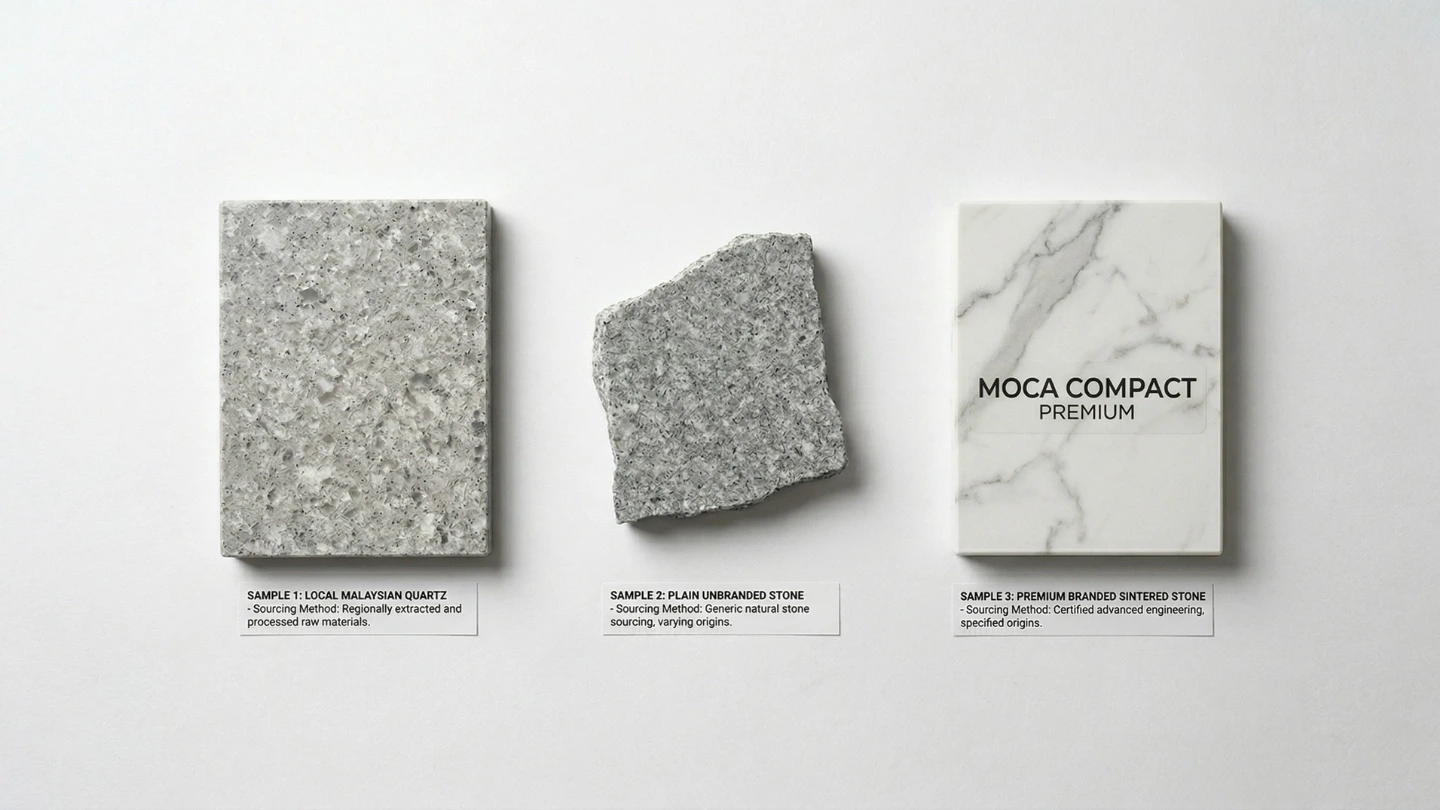
Go with your carpenter’s bundle if they can clearly name the brand, collection, and thickness of the stone — and the price aligns with what you would pay sourcing it directly. Ask for the brand name, ask to see a sample, and compare the price against market rates before you agree.
Avoid the China online route unless you have already confirmed that a qualified stone fabricator will accept and install the material. The combination of quality uncertainty, tiler reluctance, and measurement risk makes this a path that rarely ends well for Malaysian homeowners.
Source directly from a stone fabrication factory if you want control over the material, clear accountability for the installation, and confidence that the outcome will match what you agreed to. The small amount of coordination required is far outweighed by the benefits — and for most homeowners undertaking a full kitchen renovation, this is the approach that delivers the best long-term outcome.
Your countertop is one of the most used surfaces in your home. It deserves a deliberate decision — not just a line item that you sign off on without knowing what is behind it.